 Safekipedia
Petroleum
Adapted from Wikipedia · Discoverer experience
Petroleum, also known as crude oil or simply oil, is a natural resource that appears as a yellowish-black liquid chemical mixture found in geological formations. It consists mainly of hydrocarbons and is a fossil fuel formed over millions of years from the anaerobic decay of organic materials from buried prehistoric organisms, particularly planktons and algae.
Once extracted, oil is refined and separated into many products for direct use or manufacturing. Petroleum products include fuels such as gasoline, diesel, kerosene and jet fuel; bitumen, paraffin wax and lubricants; reagents used to make plastics; solvents, textiles, refrigerants, paint, synthetic rubber, fertilizers, pesticides, pharmaceuticals, and thousands of other petrochemicals. Petroleum is used in making many materials essential for modern life, and the world consumes about 100 million barrels each day.
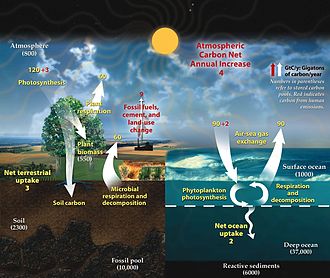
Petroleum is a non-renewable resource, and its exploitation damages the natural environment, climate system and human health. Extraction, refining and burning of petroleum fuels release large quantities of greenhouse gases back into the Earth's atmosphere, making petroleum a major contributor to anthropogenic climate change. Other negative environmental effects include oil spills and pollution of air and water sources.
Etymology
The word petroleum comes from Medieval Latin petroleum, which means "rock oil". It is made from two words: petra, meaning "rock", and oleum, meaning "oil". People started using this word in monasteries in southern Italy a long time ago. It became a common name for the liquid form of hydrocarbons after the oil industry grew in the 1800s.
You can read more about it in books like De Natura Fossilium by Georg Bauer.
History
Main article: History of the petroleum industry
Petroleum has been used by people for thousands of years. Over 4,300 years ago, the Sumerians used a substance called bitumen to build boats. Ancient people in places like Babylon used petroleum for building and medicine. In China, people began using oil for fuel more than 2,000 years ago.
In the 1800s, people started drilling wells to find oil on purpose. One of the first wells was dug in Poland in 1853. In 1859, an American named Edwin Drake drilled the first oil well in Pennsylvania, which started a big increase in oil use around the world. During the 20th century, oil became very important for vehicles and many industries. Today, oil is still a very important resource, with countries like the United States, Russia, and Saudi Arabia producing the most.
Composition
Petroleum is made up of different kinds of liquids, gases, and solids. The lighter parts are gases like methane, propane, and butane. Most of the liquid and solid parts are heavier organic compounds, especially hydrocarbons, which are made of carbon and hydrogen.
When oil comes out of a well, it is mostly crude oil. Because the pressure is lower at the surface, some gas comes out and can be collected or burned. In places with hot underground temperatures, gas may contain heavier hydrocarbons like pentane and hexane, which look like gasoline. These are called natural-gas condensate. Different oils have different mixes of these components, which affects their properties.
| Hydrocarbon | Average | Range |
|---|---|---|
| Alkanes (paraffins) | 30% | 15 to 60% |
| Naphthenes | 49% | 30 to 60% |
| Aromatics | 15% | 3 to 30% |
| Asphaltics | 6% | remainder |
Formation
Petroleum is a fossil fuel made from old plants and tiny sea creatures called zooplankton and algae. Over millions of years, these organisms died and sank to the bottom of ancient seas or lakes. They got buried under layers of mud and water with very little oxygen, which stopped most bacteria from breaking them down.
As more layers built up, heat and pressure grew. This changed the buried plants and animals into a waxy material called kerogen. With even more heat and pressure deep underground, kerogen turned into the liquid we call petroleum. This slow change happened over millions of years, using heat from deep inside the Earth.
Some scientists once thought petroleum could form without any living things, but most evidence shows it comes from ancient plants and creatures.
Reservoirs
For oil to be found and collected, three important things need to be in place. First, there needs to be a rock layer full of materials that can turn into oil when heated deep underground. Second, there needs to be a special kind of rock that can hold the oil. And third, there needs to be a layer above that keeps the oil from escaping to the surface.
Inside these special rock places, oil, water, and gas usually settle into layers like a three-layer cake. Oil often moves upward through rocks until it gets trapped, forming an oil field. We get oil by drilling deep wells into these traps. At first, the natural pressure in the rock helps push the oil up, but later we may need to use water or other methods to help bring more oil to the surface.
Classification
See also: Benchmark (crude oil)
The petroleum industry groups crude oil based on where it is found, how thick it is, and how much sulfur it contains. Oil can be light (less thick), heavy (more thick), or medium. It is called sweet if it has little sulfur and sour if it has a lot. Light and sweet oil is more valued because it is easier to turn into fuels like gasoline.
Some common examples of oil used as standards around the world include:
- West Texas Intermediate (WTI), a high-quality oil used in North America.
- Brent Blend, a mix of oils from the North Sea.
- Dubai-Oman, used for oil in the Middle East going to Asia.
- Tapis (from Malaysia).
- Minas (from Indonesia).
- The OPEC Reference Basket, an average of oils from several countries.
- Midway Sunset Heavy, used for heavy oil in California.
- Western Canadian Select, used for heavy oil in Canada.
While these are the standards, the actual oil traded often differs and may be priced lower than these benchmarks.
Use
Once extracted, oil is refined and separated, most easily by distillation, into many products for direct use or use in making things. These include gasoline, diesel, and kerosene for fuel, as well as materials used to make plastics, medicines, and crop protections. By amount, most petroleum is turned into fuels for engines.
Because oil has a lot of energy, is easy to move, and is found in many places, it became the world's most important energy source in the middle of the 1900s. Petroleum is mainly used to make fuels like gasoline, diesel, and jet fuel, which are important energy sources. It is also used to make lubricants that help machines run smoothly.
Many medicines come from petroleum after several steps of processing. Modern healthcare relies on petroleum for important ingredients and solutions. Almost all crop protections and plastics come from petroleum. Plastics and synthetic materials are made from molecules that come from petroleum.
Industry
In the 1950s, shipping costs were a big part of the price of oil moving from the Persian Gulf to the United States. But in the 1970s, big ships called supertankers made shipping much cheaper. By 2010, shipping cost was only a small part of the final price.
Crude oil is bought and sold as a future on the NYMEX and ICE exchanges. These are special agreements where people agree to buy or sell a certain amount of oil at a set date in the future. Each agreement is for 1,000 barrels of oil and can be planned up to nine years ahead.
Use by country
The world uses a lot of petroleum, also called oil. In 2021, people used about 97 million barrels of oil each day. Oil comes from ancient plants and tiny sea creatures that lived millions of years ago.
Different countries use and produce different amounts of oil. Some countries make more oil than they need and sell the extra to others. Other countries need to buy oil because they don’t have enough of their own. This helps people and machines all over the world run smoothly.
Main articles: List of countries by oil extraction, List of countries by proven oil reserves
See also: Fossil fuel exporters and OPEC
| Consuming nation 2011 | (1,000 bbl/ day) | (1,000 m3/ day) | Population in millions | bbl/year per capita | m3/year per capita | National production/ consumption |
|---|---|---|---|---|---|---|
| United States 1 | 18,835.5 | 2,994.6 | 314 | 21.8 | 3.47 | 0.51 |
| China | 9,790.0 | 1,556.5 | 1345 | 2.7 | 0.43 | 0.41 |
| Japan 2 | 4,464.1 | 709.7 | 127 | 12.8 | 2.04 | 0.03 |
| India 2 | 3,292.2 | 523.4 | 1198 | 1 | 0.16 | 0.26 |
| Russia 1 | 3,145.1 | 500.0 | 140 | 8.1 | 1.29 | 3.35 |
| Saudi Arabia (OPEC) | 2,817.5 | 447.9 | 27 | 40 | 6.4 | 3.64 |
| Brazil | 2,594.2 | 412.4 | 193 | 4.9 | 0.78 | 0.99 |
| Germany 2 | 2,400.1 | 381.6 | 82 | 10.7 | 1.70 | 0.06 |
| Canada | 2,259.1 | 359.2 | 33 | 24.6 | 3.91 | 1.54 |
| South Korea 2 | 2,230.2 | 354.6 | 48 | 16.8 | 2.67 | 0.02 |
| Mexico 1 | 2,132.7 | 339.1 | 109 | 7.1 | 1.13 | 1.39 |
| France 2 | 1,791.5 | 284.8 | 62 | 10.5 | 1.67 | 0.03 |
| Iran (OPEC) | 1,694.4 | 269.4 | 74 | 8.3 | 1.32 | 2.54 |
| United Kingdom 1 | 1,607.9 | 255.6 | 61 | 9.5 | 1.51 | 0.93 |
| Italy 2 | 1,453.6 | 231.1 | 60 | 8.9 | 1.41 | 0.10 |
| Country | Oil Production (bbl/day, 2016) | |
|---|---|---|
| 1 |  Russia Russia | 10,551,497 |
| 2 |  Saudi Arabia (OPEC) Saudi Arabia (OPEC) | 10,460,710 |
| 3 |  United States United States | 8,875,817 |
| 4 |  Iraq (OPEC) Iraq (OPEC) | 4,451,516 |
| 5 |  Iran (OPEC) Iran (OPEC) | 3,990,956 |
| 6 |  China, People's Republic of China, People's Republic of | 3,980,650 |
| 7 |  Canada Canada | 3,662,694 |
| 8 |  United Arab Emirates (OPEC) United Arab Emirates (OPEC) | 3,106,077 |
| 9 |  Kuwait (OPEC) Kuwait (OPEC) | 2,923,825 |
| 10 |  Brazil Brazil | 2,515,459 |
| 11 |  Venezuela (OPEC) Venezuela (OPEC) | 2,276,967 |
| 12 |  Mexico Mexico | 2,186,877 |
| 13 |  Nigeria (OPEC) Nigeria (OPEC) | 1,999,885 |
| 14 |  Angola (OPEC) Angola (OPEC) | 1,769,615 |
| 15 |  Norway Norway | 1,647,975 |
| 16 |  Kazakhstan Kazakhstan | 1,595,199 |
| 17 |  Qatar (OPEC) Qatar (OPEC) | 1,522,902 |
| 18 |  Algeria (OPEC) Algeria (OPEC) | 1,348,361 |
| 19 |  Oman Oman | 1,006,841 |
| 20 |  United Kingdom United Kingdom | 939,760 |
| # | Exporting nation | 103bbl/d (2011) | 103m3/d (2011) | 103bbl/d (2009) | 103m3/d (2009) | 103bbl/d (2006) | 103m3/d (2006) |
|---|---|---|---|---|---|---|---|
| 1 | Saudi Arabia (OPEC) | 8,336 | 1,325 | 7,322 | 1,164 | 8,651 | 1,376 |
| 2 | Russia 1 | 7,083 | 1,126 | 7,194 | 1,144 | 6,565 | 1,044 |
| 3 | Iran (OPEC) | 2,540 | 403 | 2,486 | 395 | 2,519 | 401 |
| 4 | United Arab Emirates (OPEC) | 2,524 | 401 | 2,303 | 366 | 2,515 | 400 |
| 5 | Kuwait (OPEC) | 2,343 | 373 | 2,124 | 338 | 2,150 | 342 |
| 6 | Nigeria (OPEC) | 2,257 | 359 | 1,939 | 308 | 2,146 | 341 |
| 7 | Iraq (OPEC) | 1,915 | 304 | 1,764 | 280 | 1,438 | 229 |
| 8 | Angola (OPEC) | 1,760 | 280 | 1,878 | 299 | 1,363 | 217 |
| 9 | Norway 1 | 1,752 | 279 | 2,132 | 339 | 2,542 | 404 |
| 10 | Venezuela (OPEC) 1 | 1,715 | 273 | 1,748 | 278 | 2,203 | 350 |
| 11 | Algeria (OPEC) 1 | 1,568 | 249 | 1,767 | 281 | 1,847 | 297 |
| 12 | Qatar (OPEC) | 1,468 | 233 | 1,066 | 169 | – | – |
| 13 | Canada 2 | 1,405 | 223 | 1,168 | 187 | 1,071 | 170 |
| 14 | Kazakhstan | 1,396 | 222 | 1,299 | 207 | 1,114 | 177 |
| 15 | Azerbaijan 1 | 836 | 133 | 912 | 145 | 532 | 85 |
| 16 | Trinidad and Tobago 1 | 177 | 112 | 167 | 160 | 155 | 199 |
| # | Importing nation | 103bbl/day (2011) | 103m3/day (2011) | 103bbl/day (2009) | 103m3/day (2009) | 103bbl/day (2006) | 103m3/day (2006) |
|---|---|---|---|---|---|---|---|
| 1 | United States 1 | 8,728 | 1,388 | 9,631 | 1,531 | 12,220 | 1,943 |
| 2 | China | 5,487 | 872 | 4,328 | 688 | 3,438 | 547 |
| 3 | Japan | 4,329 | 688 | 4,235 | 673 | 5,097 | 810 |
| 4 | India | 2,349 | 373 | 2,233 | 355 | 1,687 | 268 |
| 5 | Germany | 2,235 | 355 | 2,323 | 369 | 2,483 | 395 |
| 6 | South Korea | 2,170 | 345 | 2,139 | 340 | 2,150 | 342 |
| 7 | France | 1,697 | 270 | 1,749 | 278 | 1,893 | 301 |
| 8 | Spain | 1,346 | 214 | 1,439 | 229 | 1,555 | 247 |
| 9 | Italy | 1,292 | 205 | 1,381 | 220 | 1,558 | 248 |
| 10 | Singapore | 1,172 | 186 | 916 | 146 | 787 | 125 |
| 11 | Republic of China (Taiwan) | 1,009 | 160 | 944 | 150 | 942 | 150 |
| 12 | Netherlands | 948 | 151 | 973 | 155 | 936 | 149 |
| 13 | Turkey | 650 | 103 | 650 | 103 | 576 | 92 |
| 14 | Belgium | 634 | 101 | 597 | 95 | 546 | 87 |
| 15 | Thailand | 592 | 94 | 538 | 86 | 606 | 96 |
| # | Consuming nation | (bbl/day) | (m3/day) |
|---|---|---|---|
| 1 | Japan | 5,578,000 | 886,831 |
| 2 | Germany | 2,677,000 | 425,609 |
| 3 | South Korea | 2,061,000 | 327,673 |
| 4 | France | 2,060,000 | 327,514 |
| 5 | Italy | 1,874,000 | 297,942 |
| 6 | Spain | 1,537,000 | 244,363 |
| 7 | Netherlands | 946,700 | 150,513 |
| 8 | Turkey | 575,011 | 91,663 |
Environmental effects
Main article: Environmental impact of the petroleum industry
Burning petroleum releases gases that warm our planet and affect the air we breathe. These gases, especially from oil and coal, have caused the air to hold more carbon dioxide than it has in hundreds of thousands of years. This warming changes weather patterns and melts ice in places like the Arctic.
When oil is taken from the ground or ocean, it can sometimes harm the nearby environment. Accidents, like when ships carrying oil crash, can spill oil into the water. These spills cover beaches and hurt animals that live in the water. Even smaller spills can cause a lot of damage to plants and animals. Cleaning up these spills is very hard and needs many people working together.
Alternatives
In 2018, about half of all petroleum was used for road transport, while 8% was used for aviation, and 17% was used for other purposes. Electric vehicles are a key alternative for cars, and biojet fuels are an option for airplanes. Single-use plastics can harm the environment and pollute the oceans, but as of 2022, the best ways to replace them were still being studied.
Main articles: Electric vehicles, biojet, Single-use plastics
International relations
See also: 2022 boycott of Russia and Belarus
Control of petroleum production has greatly influenced international relations during much of the last century. Organizations like OPEC have had a major impact on world politics. With the growth of renewable energy and efforts to address climate change, some believe that countries heavily dependent on oil may see their power change in the future.
Main articles: oil war and Petro-aggression
Petroleum production has often been linked with conflicts. Because oil deposits are found in only a few countries, disagreements over oil production and territory have led to disputes and wars, such as during the 2020 Russia–Saudi Arabia oil price war and the Iran–Iraq War.
Future production
The use of oil, especially for cars, has grown a lot over the past century. Even when there was a lot of oil available, people still bought cars that didn't use much fuel. But economic troubles in 2008 slowed this down a bit.
Experts think that demand for oil might drop in the future, especially as countries like China grow and change. Some groups are also pushing to use less oil because they worry about its future. This could make it harder to find and use new oil.
We may also see changes in how oil is found and used. Some places have lots of oil but need special technology to get it out. As we use more of these tricky places, it might become more expensive. Some believe that at some point, we may not be able to get as much oil as we used to, especially as the world starts using more clean energy instead.
Main article: Peak oil
Hydrocarbons on other worlds
On Saturn's largest moon, Titan, there are lakes filled with special liquids called hydrocarbons, like methane and ethane. The space probe Cassini–Huygens discovered that these lakes hold about 300 times more of these liquids than all the oil we have on Earth.
In 2015, the Curiosity rover's Mars Science Laboratory took samples from the surface of Mars. These samples, taken from rocks that are 3 billion years old, contained tiny bits of organic molecules, including benzene and propane.
In fiction
Petroleum, often called oil, appears in many stories and books. Writers sometimes use it to show how important this resource is for our world. In tales, oil can be a source of adventure, mystery, or even conflict, reflecting its big role in real life.
Images
Related articles



This article is a child-friendly adaptation of the Wikipedia article on Petroleum, available under CC BY-SA 4.0.
Images from Wikimedia Commons. Tap any image to view credits and license.