 Safekipedia
Plaza de Mayo
Adapted from Wikipedia · Discoverer experience
The Plaza de Mayo is the main city square of Buenos Aires, Argentina. It was formed in 1884 after tearing down a building called the Recova, which joined two older squares. Since then, it has been the heart of the city and the place where many important events in Argentine history happened.
Located in the busy financial area called the microcentro, Plaza de Mayo is surrounded by important buildings. These include the Cabildo, the Casa Rosada (where the President of Argentina works), the big Metropolitan Cathedral, the Buenos Aires City Hall, and the main office of the Bank of the Argentine Nation.
In the center of the square stands the Pirámide de Mayo, or May Pyramid, which was built to mark the first year after the May Revolution in 1811. This makes it Buenos Aires' first national monument. Below the square are several subway stations, making it easy to reach from many parts of the city.
History
The Plaza de Mayo in Buenos Aires started taking its current shape in 1884 when a wall between two older squares was removed. The area has a long history, going back to when the city was first founded in 1580. Over time, parts of the land were used by different groups, including church leaders and government leaders.
In 1804, a special building called a colonnade was added, splitting the area into two smaller squares. This changed in 1883 when the mayor decided to remove the colonnade, creating the single, large Plaza de Mayo we know today. Many important events and celebrations have happened in this square over the years.
Surroundings
The Plaza de Mayo is the main city square in Buenos Aires, Argentina. It was created in 1884 after tearing down an old building called the Recova. This square has seen many important events in Argentina's history and is where big public gatherings often happen.
| Eastern side | ||||
| Northern side | Southern side | |||
 | 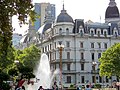 |  |  |  |
| Western side | ||||
Political significance
The Plaza de Mayo has always been a key place for politics in Buenos Aires. Its name honors the May Revolution of 1810, which began Argentina's path to independence from Spain in 1816.
In 1945, huge gatherings in the Plaza helped free Juan Domingo Perón, who later became president. Many other leaders have spoken to crowds there too. In 1955, the Plaza was bombed during one of Perón's speeches.
Later, in 1974, Perón had a disagreement with a group called the Montoneros, which led to trouble. In 1982, people celebrated when Argentina invaded the Falkland Islands, starting the Falklands War.
Since 1977, the Mothers of the Plaza de Mayo have met there to remember people who were taken away and never seen again during a difficult time in Argentina's history. The Plaza continues to be a place for important events and protests.
Today
A panorama of Plaza de Mayo. On the center you can see the May Pyramid
Today, Plaza de Mayo remains a key tourist attraction for visitors to Buenos Aires.
Many important places are around the Plaza: the Cabildo (the old city council), the Casa Rosada (where the executive branch of the federal government works), the Metropolitan Cathedral of Buenos Aires, the May Pyramid, the Equestrian monument to General Manuel Belgrano, the current city hall, and the Nación Bank. The financial area of Buenos Aires, called la City, is also nearby.
Images
Related articles


This article is a child-friendly adaptation of the Wikipedia article on Plaza de Mayo, available under CC BY-SA 4.0.
Images from Wikimedia Commons. Tap any image to view credits and license.