 Safekipedia
Renaissance architecture
Adapted from Wikipedia · Discoverer experience
Renaissance architecture is the style of building that grew in Europe between the early 1400s and early 1500s. It began in Florence and was led by thinkers like Filippo Brunelleschi. This style brought back ideas from ancient Greek and Roman architecture, such as balance, shape, and careful planning.
Buildings from this time often showed smooth, round shapes and strong, tall columns. Famous architects such as Leon Battista Alberti and Andrea Palladio helped change cities with their designs for churches, palaces, and public spaces. The style spread from Italy to places like France, Spain, and the Low Countries, mixing with local traditions.
Renaissance buildings focused on order and harmony. They used rows of columns, rounded arches, and dome shapes that looked calm and balanced. This way of building showed the power of leaders and the ideas of the time, linking art, learning, and strength.
Historiography
The word "Renaissance" comes from the Italian term rinascita, meaning "rebirth." It first appeared in a book by Giorgio Vasari in 1550. Later, the Swiss historian Jacob Burckhardt helped shape how we understand this period today through his book from 1860.
Historians often divide the Renaissance into three main phases in Italy. The Quattrocento (about 1400 to 1500) was a time when architects began studying ancient Roman and Greek ideas. They created buildings with new styles and organized spaces using math and geometry. An example is the Basilica of San Lorenzo, Florence by Filippo Brunelleschi.
The High Renaissance (about 1500 to 1525) saw architects using these ancient ideas more confidently. Donato Bramante was a key figure who applied classical designs to new buildings, like his Tempietto di San Pietro in Montorio, inspired by Roman temples.
Later came the Mannerist period (about 1520 to 1600), when architects experimented more freely. Michelangelo was known for using large columns called the "giant order" in his designs, such as the Piazza del Campidoglio in Rome. Over time, Renaissance styles evolved into the Baroque style, which spread across Europe and beyond.
History
Main article: Italian Renaissance
The Renaissance in architecture began in Italy during the 1400s. The city of Florence was the birthplace of this new style. Unlike older styles that changed slowly, Renaissance architecture was created on purpose by artists who wanted to copy the buildings of ancient Greece and Rome. This happened because people were rediscovering old writings and ideas from those times.
Italian artists liked to use clear and strong shapes in their buildings. Even though Italy didn’t fully use the Gothic style, which was popular in other parts of Europe, there were still plenty of old Roman buildings in places like Rome to inspire new designs. The city of Florence became very powerful and rich, which helped artists travel and share their ideas. Important leaders and families, like the Medici, supported artists and architects, giving them money and encouragement to create beautiful buildings. This mix of new ideas, rich support, and a love for old designs helped the Renaissance architecture style grow and spread.
Characteristics
The Renaissance was a time when architects studied old buildings from ancient Greece and Rome and used ideas from them in new ways. Buildings were made with balance and symmetry, often using square shapes and matching parts. Churches and homes were designed with columns, arches, and domes, which made the buildings look strong and beautiful.
One special feature of Renaissance buildings was the dome. The dome became very popular after it was used in famous buildings like Florence Cathedral and St. Peter's Basilica. Architects also decorated walls and ceilings with paintings and used special designs around doors and windows to make buildings look even more impressive.
Early Renaissance
Main article: Quatrocento
The Early Renaissance, also called the Quattrocento, saw some of the first great architects who changed how buildings were designed. The most important of these were Filippo Brunelleschi, Michelozzo, and Leon Battista Alberti.
Brunelleschi is often called the father of Renaissance architecture. He studied how people see the world and noticed patterns in shapes and sizes. He looked at old buildings from ancient Rome and saw that they followed simple rules. For example, Roman arches were always twice as wide as they were tall. Brunelleschi wanted buildings to follow these clear rules of balance and proportion.
One of Brunelleschi's most famous works is the large dome on Florence's cathedral. Though it looks like older Gothic styles on the outside, the way it is built inside shows Roman influence. Another important building he designed is the church of San Lorenzo, which shows his ideas about using repeating shapes and sizes to create harmony in a building.
Michelozzo worked for the powerful Medici family in Florence. His most well-known building is the Palazzo Medici Riccardi, which mixes Roman-style details with local Florentine tastes. Alberti wrote important books about architecture and designed several buildings. He combined new Renaissance ideas with older Gothic features in a way that respected local traditions while also bringing in new styles.
High Renaissance
Main article: High Renaissance
In the late 15th and early 16th centuries, famous architects like Antonio da Sangallo the Younger showed great skill in designing churches and palaces. Their buildings were more decorated, with beautiful statues and domes. This period, called the "High Renaissance," was a time when artists like Leonardo, Michelangelo, and Raphael were also creating their famous works.
Donato Bramante was an important architect who worked in both Milan and Rome. In Rome, he designed the Tempietto, a small, round temple that marks a very important spot. He also began plans to rebuild St. Peter's Basilica, though it was finished later by Michelangelo. Antonio da Sangallo the Younger built the large Farnese Palace, known for its grand size and elegant design. Raphael helped design buildings in Florence, including the Palazzo Pandolfini, known for its beautiful windows.
Mannerism
Main article: Mannerism § Architecture
Mannerism in architecture showed many different ideas in the works of famous artists like Michelangelo, Giulio Romano, Baldassare Peruzzi, and Andrea Palladio. These ideas helped lead to the Baroque style, where buildings were designed in new and exciting ways.
Baldassare Peruzzi was an architect from Siena who worked in Rome. One of his famous buildings is the Villa Farnesina, which has strong pillars and walls painted with pictures. Another well-known building is the Palazzo Massimo alle Colonne in Rome, which has a curved front and a special doorway that has been used to shelter people in need.
Giulio Romano worked with a famous artist and later designed a special building called the Palazzo Te in Mantua. This building has gardens, paintings, and surprising designs that make it feel magical and a little strange.
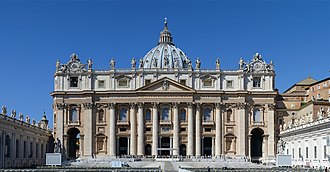
Michelangelo Buonarroti was a great artist who worked on many famous buildings. Two of his most important works are the Laurentian Library in Florence and St Peter's Basilica in Rome. St. Peter's was one of the greatest buildings of the Renaissance, and much of what we see today comes from Michelangelo's plans. His designs made the building strong and beautiful, with a huge dome that stands out.
Andrea Palladio was very important in shaping the style of buildings during the Renaissance. He worked mainly in Vicenza in the Veneto. One of his most famous homes is Villa Capra, also called "La Rotonda", which has a round center with four identical sides, each looking like a small temple. His buildings often used simple, clear designs inspired by ancient temples.
Progression from Early Renaissance through to Baroque
Main article: Baroque architecture
In Italy, the style of architecture moved smoothly from the early days of the Renaissance through to the Baroque period. Some people think that the design of the walls in the Laurentian Library shows that a famous artist helped start the Baroque style.
But this smooth change did not happen everywhere. For example, in places like England, it took longer for the Renaissance style to become popular. While leaders in Italy were building new structures, leaders in England were still adding beautiful designs in an older style to important buildings.
Later, the Baroque style began in Italy in the 1600s. Around the same time, people in England were just starting to learn about Renaissance rules, while Italians were already trying new and different ideas. After the return of the king to England in 1660, the style there quickly changed to Baroque, rather than slowly evolving like in Italy. In many parts of Europe, Baroque architecture appeared suddenly, replacing earlier local styles, especially in churches built during a big religious movement.
Spread in Europe
Main article: Northern Renaissance
The 1500s brought the Renaissance style to France, Spain, Portugal, England, Poland, Russia, and the Dutch Republic. These places adopted the style to show their new importance and culture. It started in Italy and slowly spread north.
Italian architects like Sebastiano Serlio in France and Aristotile Fioravanti in Russia helped share the style. Soon, architects from other countries began studying Italian designs and creating their own versions. Books with drawings of plans and designs played a big role in sharing the style across Northern Europe, written by authors like Androuet du Cerceau in France and Hans Vredeman de Vries in the Netherlands.
Baltic region
Main articles: Renaissance in Poland and Architecture of Estonia
The Renaissance reached the Baltic States — Estonia, Latvia, and Lithuania — quite late and didn’t leave a big mark. This time was busy politically, with the decline of the State of the Teutonic Order and the Livonian War.
In Estonia, influences came from Dutch, Swedish, and Polish sources. The Brotherhood of the Blackheads in Tallinn, designed by Arent Passer, is the only mostly intact Renaissance building. Other examples are mostly military buildings.
In Latvia, Renaissance style mixed with Polish-Lithuanian and Dutch designs. St. John's Church in Riga was partly rebuilt in this style. The House of the Blackheads is a major example, though it was destroyed in World War II and rebuilt later.
Lithuania was part of the Polish–Lithuanian Commonwealth. Renaissance influence grew under kings Sigismund I the Old and Sigismund II Augustus. The Palace of the Grand Dukes of Lithuania showed Italian influences, built by Italian architects.
Bohemia
Main article: Czech Renaissance architecture
Renaissance style first appeared in the Crown of Bohemia in the 1490s, making it one of the earliest places in the Holy Roman Empire to see it. The Gothic style stayed strong, especially in churches, but Renaissance ideas appeared in palace designs.
During the time of Rudolph II, Holy Roman Emperor, Prague became a center for late Renaissance art. However, few buildings from that time remain today.
Croatia
Main articles: Renaissance in Croatia and Architecture of Croatia
In the 1400s, Croatia was split into three parts. The Cathedral of St James in Šibenik started in the Gothic style but was finished in the Renaissance style. Its design is special because it doesn’t use mortar, relying on carefully fitted stones.
England
Main articles: Elizabethan architecture and Prodigy house
After early attempts, a local Renaissance style developed in England during the time of Elizabeth I. Influenced by the Low countries, it included features like the Dutch gable and decorative wall designs.
Inigo Jones brought a more classic Italian style to England. He designed buildings like the Queen's House at Greenwich and the Banqueting House, Whitehall, which introduced cleaner lines and symmetry.
France
Main article: French Renaissance architecture
As France was involved in wars in Italy in the early 1500s, the Renaissance style came back with new ideas and art treasures. The Loire Valley saw many new buildings, starting with the Château d'Amboise, where Leonardo da Vinci spent his last years. The style grew strong under Francis I.
Germany
Main article: German Renaissance
German thinkers and artists like Albrecht Dürer helped bring the Renaissance to Germany. Early examples include the Landshut Residence, Heidelberg Castle, and Johannisburg Palace in Aschaffenburg. The Weser Renaissance style is seen in buildings like Bremen City Hall.
Hungary
The Renaissance reached the Kingdom of Hungary after King Matthias Corvinus married Beatrice of Naples in 1476. Italian artists came to Buda. However, the Ottoman conquest of Hungary later destroyed many buildings. The only fully preserved Hungarian Renaissance work is the Bakócz Chapel in the Esztergom Basilica.
Habsburg Netherlands
Main article: Renaissance in the Low Countries
In the Habsburg Netherlands, Renaissance style mixed with Gothic elements. Cornelis Floris de Vriendt designed Antwerp City Hall, finished in 1564. This style, called the Flemish-Italian Renaissance or Floris style, influenced Northern Europe.
Dutch Republic
In the early 1600s, Hendrick de Keyser helped develop the “Amsterdam Renaissance” style. This included tall, narrow town houses, special Dutch gables, and decorative triangular tops on doors and windows.
Poland
Polish Renaissance architecture has three periods. The first (1500–50), called “Italian,” had many buildings designed by Italian architects. The second period (1550–1600) saw more common use of Renaissance style, with influences from the Netherlands. The third period (1600–50) saw the rise of Mannerist and Baroque styles, with buildings like Kalwaria Zebrzydowska park.
Portugal
Portugal’s Renaissance style developed slowly. The Manueline style mixed Renaissance and Gothic elements. Later, under King John III, more “pure” Renaissance buildings appeared, like the Chapel of Nossa Senhora da Conceição in Tomar.
Russia
Grand Prince Ivan III brought Renaissance ideas to Russia by inviting Italian architects. They helped rebuild the Cathedral of the Dormition in the Moscow Kremlin and designed other important buildings.
Scandinavia
Main article: Architecture of Denmark
Renaissance style in Scandinavia was influenced by Flemish design, with high gables. In Denmark, kings Frederick II and Christian IV built places like Kronborg Castle and Frederiksborg Castle. In Sweden, castles like Gripsholm Castle mixed medieval and Renaissance styles.
Spain
Main article: Spanish Renaissance architecture
In Spain, Renaissance style mixed with Gothic elements at first, called Plateresque. Later, under Philip II, the style became more classical, as seen in buildings like the palace of Charles V in Granada and El Escorial.
Spread in the Colonial Americas
Renaissance architecture traveled to many parts of the world during colonial times. In Bolivia, the Church of Curahuara de Carangas, built between 1587 and 1608, is famous for its beautiful decorations. In Brazil, important buildings include the Cathedral Basilica of Salvador, built between 1657 and 1746.
In the Dominican Republic, the House of the Five Medallions, built in 1540, shows a special Renaissance style. In Ecuador, the large Basilica and Convent of San Francisco in Quito, built between 1535 and 1650, also shows this style. In Mexico, the Cathedral of Mérida, Yucatán, built between 1562 and 1598, is one of the oldest cathedrals in the Americas. In Peru, several churches in Cusco, like Cusco Cathedral (started in 1539), began during this time.
Legacy
Main article: Renaissance Revival architecture
After the Renaissance, new styles like Baroque and Neoclassical architecture became popular. In the 19th century, people started to remember and copy Renaissance style again, calling it Renaissance Revival. This style was used for important buildings like banks and offices because it looked serious and reliable. Even today, we can still see ideas from Renaissance architecture in many modern buildings.
Images
Related articles



This article is a child-friendly adaptation of the Wikipedia article on Renaissance architecture, available under CC BY-SA 4.0.
Images from Wikimedia Commons. Tap any image to view credits and license.