 Safekipedia
Republikflucht
Adapted from Wikipedia · Discoverer experience
Republikflucht was the term used in the German Democratic Republic (East Germany) for leaving the country illegally to go to the Federal Republic of Germany (West Germany), West Berlin, or other countries outside the Warsaw Pact. Before the Berlin Wall was built in 1961, many people moved from the Soviet occupation zone and East Germany to the West. After the Wall was built, some still tried to escape secretly across the Iron Curtain until 1989.
Between 1984 and 1988, it is thought that around 30,000 people left East Germany each year. Before the Wall was built in 1961, the number of people leaving each year could be as high as 300,000. This showed how many people wanted to live in a different country with more freedom.
Legislation
Starting in 1979, East Germany had strict laws against leaving the country without permission. If someone crossed the border illegally or didn’t return from a trip abroad on time, they could be punished with up to two years in prison, a fine, or probation. In more serious cases, such as using weapons, forging documents, or committing the crime with others, the punishment could be much harsher — up to eight years in prison. These laws made it very difficult for people to leave East Germany.
History
Republikflucht is a German word that means "desertion from the republic" or "flight from the republic." It was first used in 1945, after World War II, to describe people moving from the Soviet-controlled part of Germany to the areas controlled by the United States, Britain, and France. When East Germany, also called the GDR, was created in 1949, the term continued to be used for people leaving East Germany for West Germany or West Berlin.
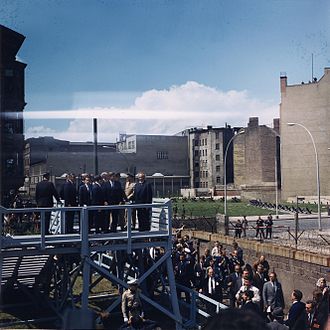
By the 1950s, East Germany made laws stricter to stop people from leaving. Many people still wanted to move to the west, and some tried risky ways to cross borders after the Berlin Wall was built in 1961. The Wall made it much harder to leave East Germany, and the number of people trying to escape dropped sharply.
Legacy
In 1993, three years after German reunification, the former East German leader Erich Honecker faced charges related to his time in office. Due to health issues, his trial was delayed, and he passed away in 1994. Similarly, the former Stasi chief Erich Mielke was also put on trial for related charges, but the case was later closed as he was deemed unfit to stand trial.
Related articles


This article is a child-friendly adaptation of the Wikipedia article on Republikflucht, available under CC BY-SA 4.0.
Images from Wikimedia Commons. Tap any image to view credits and license.