 Safekipedia
Songhay languages
Adapted from Wikipedia · Discoverer experience
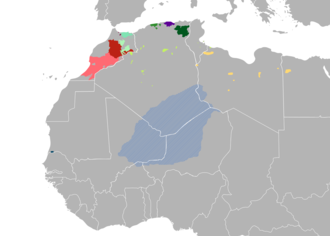
The Songhay, Songhai, or Ayneha languages are a group of closely related languages and dialects spoken along the middle stretches of the Niger River in West Africa. These languages are mainly used in countries such as Mali, Niger, Benin, Burkina Faso, and Nigeria. Important cities where these languages are spoken include Timbuktu, Djenné, Niamey, and Gao. For many years, Songhay languages have served as a common way for people in the area to talk to each other, just like how some languages are used worldwide today.
Even though the Songhay languages are related, some of them can be very different from each other. For example, the language spoken in Gao might sound completely different to someone who speaks the language in Niger. However, certain Songhay languages can be understood by many people in the same area.
People who study languages find the Songhay languages very interesting because it can be hard to say exactly where they come from in the big family of languages. Some experts think they belong to a group called Nilo-Saharan, while others believe they stand alone. This makes Songhay languages a special topic for language experts to explore and discuss.
Varieties
Researchers group the Songhay languages into two main types: Southern and Northern. Southern Songhay is found along the Niger River. Zarma (Djerma), the most spoken Songhay language with two or three million people, is important in southwestern Niger, including its capital, Niamey. Koyraboro Senni, spoken by around 400,000 people, is used in Gao, an old important city.
Northern Songhay includes dialects influenced by Berber languages and is spoken in the Sahara. Because of this influence, Northern Songhay is sometimes seen as a mix of languages.
Genetic affiliation
Diedrich Hermann Westermann, a missionary and linguist, was unsure whether the Songhay languages belonged to the Gur group or stood alone. Maurice Delafosse thought they were related to the Mande languages. Today, Songhay is usually grouped within the Nilo-Saharan language family, following Joseph Greenberg's ideas from 1963. Greenberg noticed similarities in about 70 words and pronouns between Songhay and Nilo-Saharan languages.
Some experts question this classification. Lacroix argued that many of Greenberg's examples were not strong enough and might be words borrowed from nearby Saharan languages. Others have looked at possible links to Mande languages, noting some shared words and grammar features. One idea is that Songhay might be a mix of Berber and Mande languages. However, not everyone agrees, and the exact family connection of Songhay remains a topic of discussion among experts.
Grammar
Songhay languages are mostly tonal and follow a special word order where the subject comes first, then the object, and finally the verb. One exception is Koyra Chiini, spoken in Timbuktu, which does not use tones and has a different word order where the verb comes right after the subject.
Songhay languages have a special word part called -ndi that can show when something is made to happen or when someone does something without being directly mentioned. Sometimes, verbs can even use this special word part twice to show both ideas at once. For example, ŋa-ndi-ndi can mean "the rice was made to be eaten by someone."
Reconstruction of Proto-Songhay
Here are some early forms of the Songhay language that scholars have studied:
Some early forms of the Eastern Songhay language include:
| Gloss | Proto-Songhay |
|---|---|
| person | *bòro |
| bird | *kídòw |
| scorpion, mosquito | *(n)děŋ |
| ashes | *bó:sú |
| stone, mountain | *tóndì |
| year | *gí:rí; *mán(n)à |
| yesterday | *bǐ: |
| ask | *hᘠ|
| bring | *kàte |
| thorn | *kárgí |
| skin | *kú:rú |
| blood | *kúdí |
| year | *gí:rí |
| Gloss | Proto-Eastern Songhay |
|---|---|
| thatch hut | *bùgù |
| armpit, wing | *fátá |
| thirst | *gèw |
| flank | *kéráw |
| mason wasp | *bímbín(í) |
| sweat | *súŋgáy |
Numerals
Here is a comparison of numbers used in different Songhay languages:
| Language | 1 | 2 | 3 | 4 | 5 | 6 | 7 | 8 | 9 | 10 |
|---|---|---|---|---|---|---|---|---|---|---|
| Korandje | affu* | jnka | jnzˁa | rˁəbʕa | χəmsa | sətta | səbʕa | tmənja | təsʕa | ʕəʃrˁa |
| Tadaksahak | a-ˈfːo / a-ˈfːoo-da | hiŋˈka | kaːˈrˤad | aˈkːoːz | ʃaˈmːuʃ | ʃaːˈdˤiʃ | iˈʃːa | iˈtˤːam | tˤaːˈsˤa | maːˈrˤa |
| Tasawaq | fó / a-fːó | hínká / à-hínká | hínzà / à-hínzà | táásì / à-tːáásì | xámsà | sítːà | sábàɣà | tàmáníyà | tísàɣà | ɣàsárà |
| Dendi | afɔ | hayinka / ahinka | ahinza | ataki | aɡu | ayidu | ayiye / ahiye | ayiyaku | ayiɡa | aweyi |
| Koyraboro Senni | affoo | ihinka | ihinza | itaatʃi | iɡɡuu | idduu | iyye | iyaaha | iyaɡɡa | iwoy |
| Koyra Chiini | foo / a-foo | hiŋka | hindʒa | taatʃi | ɡuu | iddu | iiye | yaaha | yaɡɡa | woy / wey |
| Zarma, Songhoyboro Ciine | àˈfó | ìˈhíŋká | ìˈhínzà | ìˈtaːcí | ìˈɡú | ˈíddù | ˈijjè | àˈhákˌkù | ˈjǽɡɡà | ìˈwéɪ |
Related articles


This article is a child-friendly adaptation of the Wikipedia article on Songhay languages, available under CC BY-SA 4.0.