 Safekipedia
South Slavs
Adapted from Wikipedia · Discoverer experience
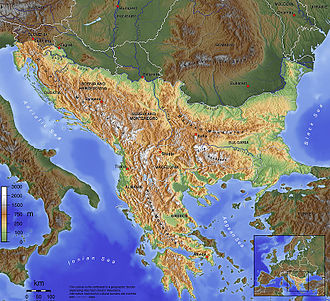
South Slavs are a group of people who speak South Slavic languages and live in a region of Southeast Europe. This area includes the eastern Alps and the Balkan Peninsula. They are separated from other Slavic groups by countries like Austria, Hungary, Romania, and the Black Sea. Today, South Slavs include Bosniaks, Bulgarians, Croats, Macedonians, Montenegrins, Serbs, and Slovenes.
In the 20th century, many South Slavic peoples were united in a country called Yugoslavia. This name comes from Serbo-Croatian and means "South Slavia" or "South Slavdom." The idea of Yugoslavia began in the late 1600s in Croatia, which was then part of the Habsburg monarchy. It became more important in the 1800s through the Illyrian movement. The Kingdom of Serbs, Croats, and Slovenes, later called the Kingdom of Yugoslavia, was created on December 1, 1918, after the State of Slovenes, Croats and Serbs joined with Serbia and Montenegro.
When Yugoslavia broke up in the early 1990s, several new independent countries were formed. The word "Yugoslavs" is sometimes used to mean South Slavs, but it usually does not include Bulgarians because Bulgaria was never part of Yugoslavia.
Terminology
The South Slavs have different names depending on the language they speak. In Serbian, Macedonian, and Montenegrin, they are called Južni Sloveni. In Bulgarian, they are called Yuzhni Slavyani. In Croatian and Bosnian, they are called Južni Slaveni, and in Slovene, they are called Južni Slovani. The word root jug- means "south".
Historically, they were also called Balkan Slavs. In earlier times, some people used the name Illyrians to describe them, a name that comes from an old Balkan group. Later, the idea of Yugoslavism developed, which aimed to bring all South Slavic lands together into one country. This led to the creation of Yugoslavia, although it did not include Bulgaria.
History
Main article: Slavic migrations to the Balkans
Early South Slavs
Main articles: Early Slavs, Sclaveni, and Antes (people)
Long ago, the original home of the Slavic people was thought to be in Central and Eastern Europe. Scholars often believe it was in the marshes of Ukraine, but some say it was north of the Lower Danube River. Not much was known about these people until around the 5th century when they started to move in different directions.
Writers from the time of the Roman Empire, like Jordanes and Procopius, wrote about the South Slavs in the 6th century. They described these people as tall, strong, and with dark skin and reddish hair. The Slavs lived in simple huts and often moved to new places. They believed in a god of lightning named Perun. They fought with spears and small shields but did not wear armor.
Most historians believe that Slavs moved into the Balkans during the 6th and 7th centuries. At first, they raided areas south of the Danube River, but later they began to settle there permanently. This was especially true after the 580s when they became more organized. By the 7th century, large Slavic communities had formed in the Balkans.
Middle Ages
See also: Saqaliba
By around 700 AD, Slavs had spread across most of Central and Southeast Europe, from Austria to Greece, and from the Adriatic Sea to the Black Sea. The Avars, who came from the Carpathian Mountains, controlled some Slavic tribes but their power faded by the early 7th century.
Bulgaria was the first major South Slavic state, formed in 681. It was a mix of Slavic tribes and Bulgars led by Khan Asparuh. Other Slavic groups, like the Serbs and Croats, also settled in the Balkans during this time.
In the 9th century, two brothers named Saints Cyril and Methodius created a special way to write in Slavic languages. This helped spread literacy and culture among the Slavs. Their work led to the development of written Slavic languages and literature, especially in places like Bulgaria and Dalmatia.
Early modern period
Through the spread of Islam, some Slavic communities became Muslim. These communities still exist today in places like Bosnia, southern Serbia, North Macedonia, and Bulgaria.
The idea of all Slavic people being united, called Pan-Slavism, began in the 17th century and grew stronger in the 19th century as nationalism rose in the Ottoman and Habsburg empires.
Population
Main article: Slavs § Population
The South Slavs are groups of people who speak similar languages and live in parts of Southeast Europe, including areas near the eastern Alps and the Balkan Peninsula. They are separated from other Slavic groups by countries like Austria, Hungary, Romania, and the Black Sea. Today, the South Slavs include groups such as Bosniaks, Bulgarians, Croats, Macedonians, Montenegrins, Serbs, and Slovenes.
In the 20th century, many of these groups lived together in a country called Yugoslavia, which brought most of them into one nation, except for Bulgarians and Bulgaria.
Languages
Main article: South Slavic languages
The South Slavic languages are one group of the Slavic language family, along with West Slavic and East Slavic languages. These languages are spoken in Slovenia, Croatia, Bosnia and Herzegovina, Montenegro, Serbia, North Macedonia, and Bulgaria. They are separated from other Slavic languages by areas where German, Hungarian, and Romanian are spoken.
South Slavic languages include several official languages. The languages spoken in Serbia, Croatia, Bosnia and Herzegovina, and Montenegro share many similarities and are often considered one language by experts, though today they are recognized as separate standards. Other dialects exist in different regions, adding to the rich variety of these languages. Bulgarian and Macedonian are also part of the South Slavic group, each with their own unique features.
Genetics
Main articles: Slavic migrations to the Balkans § Genetics, Genetic studies on Bosniaks, Genetic studies on Bulgarians, Genetic studies on Croats, and Genetic studies on Serbs
Studies from 2013 show that people who speak Serbo-Croatian share many common ancestors from about 1,500 years ago. This is linked to ancient movements of people, including the spread of Slavic groups into areas with fewer people, beginning around the sixth century.
More recent studies from 2014 and 2015 found that South Slavs, such as Bosniaks, Bulgarians, Croats, Macedonians, Montenegrins, Serbs, and Slovenes, share similar genetic traits. They are more closely related to East and West Slavs than to Greeks. These studies also show that South Slavs have a mix of ancestry from Balto-Slavic groups, making up between 55% and 70% of their genetic background. Research from 2006 suggests that the early Slavic groups began in the area of modern-day Ukraine and spread outward.
Images
Related articles



This article is a child-friendly adaptation of the Wikipedia article on South Slavs, available under CC BY-SA 4.0.
Images from Wikimedia Commons. Tap any image to view credits and license.