 Safekipedia
South Sudan
Adapted from Wikipedia · Discoverer experience
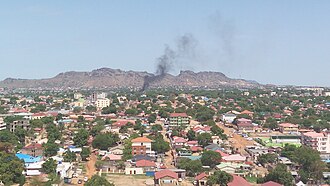
South Sudan, officially the Republic of South Sudan, is a landlocked country in East Africa. It shares borders with Sudan to the north, Ethiopia to the east, the Democratic Republic of the Congo to the southwest, Uganda to the south, Kenya to the southeast, and the Central African Republic to the west. The country's landscape includes vast plains, plateaus, savannahs, and the important Nile River system, which runs through a large swamp area called the Sudd. Juba, the capital and largest city, is home to many of South Sudan's 12.7 million people.
South Sudan became independent on July 9, 2011, after a referendum where 98.8% of people voted to split from Sudan. This followed long periods of conflict, including two major civil wars. Despite its recent history as a nation, South Sudan faces many challenges, including rebuilding after war and working to improve living conditions for its people.
The population of South Sudan is made up of many different ethnic groups, mostly from the Nilotic peoples. The country is very young, with about half of all people under 18 years old. Most people practice Christianity or traditional beliefs, with some following Islam. South Sudan is one of the least developed countries in the world, but it is working toward growth and development as a member of international groups such as the United Nations, African Union, and East African Community.
Etymology
The name Sudan refers to a region south of the Sahara, stretching from Western Africa to eastern Central Africa. It comes from the Arabic phrase bilād as-sūdān, meaning "Land of the Blacks". Arab traders, historians, and geographers were the first to use this term.
History
Main article: History of South Sudan
The Nilotic people of South Sudan—the Dinka, Anyuak, Bari, Acholi, Nuer, Shilluk, Kaligi (Arabic Feroghe), and others—first entered South Sudan before the tenth century. From the 15th to the 19th century, tribal migrations brought groups like the Anyuak, Dinka, Nuer, and Shilluk to their modern locations. The Zande, Mundu, Avukaya and Baka entered in the 16th century and established the region’s largest state.
British colonial policy focused more on the north, leaving the south without schools, hospitals, or roads. After Sudan’s independence in 1958, uprisings and civil wars followed, involving many groups such as the Dinka, Nuer, and Shilluk. The region faced serious neglect and destruction.
Between January 9 and 15, 2011, a referendum determined South Sudan’s independence from Sudan. With 98.83% voting for separation, South Sudan became independent on July 9, 2011, and joined the United Nations on July 14, 2011. Despite this, conflicts and disputes continued, including battles over oil fields and inter-ethnic warfare.
In September 2013, a power struggle between President Kiir and his former deputy Riek Machar led to the South Sudanese Civil War. The war caused widespread displacement and suffering. A peace agreement was signed in August 2015, but violence continued. In February 2020, Kiir and Machar agreed to a peace deal, forming a national unity government. Despite this, community-level violence persisted.
South Sudan joined the East Africa Community in 2016. Planned democratic elections, originally set for 2023, were postponed to December 2026. In 2025 and 2026, tensions escalated with renewed fighting between government forces and opposition groups, leading to civilian casualties and displacement.
Geography
Main article: Geography of South Sudan
South Sudan is located between latitudes 3° and 13°N, and longitudes 24° and 36°E. The land is covered with tropical forests, swamps, and grasslands. The White Nile flows through the country, passing by the city of Juba. The Sudd, formed by the White Nile, is known locally as the Bahr al Jabal, meaning "Mountain Sea".
The country has many protected areas with lots of wildlife. Bandingilo National Park is home to one of the largest wildlife migrations in the world. Other parks like Boma National Park, the Sudd wetland, and Southern National Park provide homes for animals such as hartebeest, kob, topi, buffalo, elephants, giraffes, and lions. These parks also support many other species, including bongo, giant forest hogs, red river hogs, forest elephants, chimpanzees, and monkeys.
South Sudan has a tropical climate with a rainy season from May to October and a drier season the rest of the year. Temperatures stay warm all year, ranging from about 20°C to 37°C. The country's many habitats include grasslands, savannas, floodplains, and wetlands, which support a rich variety of animals.
Government and politics
Main articles: Government of South Sudan and Politics of South Sudan
The government of South Sudan operates under a presidential system. The president serves as both head of state and head of government. The National Legislature has two houses: the National Legislative Assembly and the Council of States.
The country’s capital is Juba, though there have been plans to move the capital to a new, more central city called Ramciel. South Sudan is divided into ten states, grouped into three historical regions: Bahr el Ghazal, Equatoria, and Greater Upper Nile. The country maintains relationships with many nations and is a member of the United Nations and the African Union.
Economy
Main article: Economy of South Sudan
See also: List of companies based in South Sudan
The economy of South Sudan is one of the world's least developed, with very little existing infrastructure. The country exports timber and has many natural resources, including petroleum, iron ore, and copper. Its economy relies heavily on agriculture.
The oilfields in South Sudan have been very important since the late 20th century. Today, oil makes up more than 90% of the country's income. After South Sudan became independent in 2011, there were challenges in sharing oil revenue with Sudan. The country has large oil reserves, about four times that of Sudan, but relies on Sudan's pipelines and facilities to transport the oil. This led to disputes and, at one point, South Sudan stopped producing oil, which greatly affected its economy. In 2017, South Sudan started its first company to drill for oil.
South Sudan also faces serious economic problems, such as high inflation, which has sometimes reached over 300%. This makes it very hard for families to afford basic needs. The country is working to join the East African Community to improve trade and infrastructure. However, progress has been slow due to ongoing conflicts and economic challenges.
Main article: Transport in South Sudan
Road transport is the most common way to travel in South Sudan. The Nile River is also important for moving goods by water. There is a small railway network and several airports, with Juba Airport being the busiest, offering flights to nearby countries.
Main article: Food insecurity and famine in South Sudan
Since becoming independent in 2011, South Sudan has often faced serious food shortages. The civil war that started in 2013 made the situation much worse, disrupting farming and displacing many people. Famine was declared in some areas in 2017, affecting millions. Even with help from aid groups, many people still struggle to get enough food, especially during times of conflict and poor weather.
Further information: Water supply in South Sudan
See also: Sudanese nomadic conflicts
South Sudan has trouble providing clean water to its people. Although the White Nile flows through the country, many areas run out of water during the dry season. About half the population does not have access to safe drinking water. Many groups, both from inside and outside the country, are working to help improve water supply.
Demographics
Main article: Demographics of South Sudan
See also: List of cities in South Sudan
South Sudan has a population of approximately 11 million people. The country has faced many years of war, which has caused serious problems like destruction, displacement, and lack of development. Because of these challenges, many people have been forced to leave their homes.
The major ethnic groups in South Sudan include the Dinka, Nuer, Azande, Shilluk, and Bari. The country is home to around 800,000 expatriates from the Horn of Africa. South Sudan has seventy languages spoken, with English being the official language. Other widely spoken languages include Nuer, Bari, Dinka, and Zande.
Religion in South Sudan is diverse, with Christianity being the most practiced religion, followed by traditional indigenous beliefs and Islam. The country’s educational system follows an 8 + 4 + 4 system, with English as the language of instruction. Despite efforts to improve education, there is a severe shortage of teachers, especially in scientific and technical fields.
| Largest cities or towns in South Sudan According to the 2008 Census | ||||
|---|---|---|---|---|
| Rank | Name | State | Pop. | Juba Wau |
| 1 | Juba | Central Equatoria | 230,195 | |
| 2 | Wau | Western Bahr el Ghazal | 118,331 | |
| 3 | Malakal | Upper Nile | 114,528 | |
| 4 | Yambio | Western Equatoria | 105,881 | |
| 5 | Yei | Central Equatoria | 69,720 | |
| 6 | Renk | Upper Nile | 69,079 | |
| 7 | Aweil | Northern Bahr el Ghazal | 59,217 | |
| 8 | Maridi | Western Equatoria | 55,602 | |
| 9 | Bentiu | Unity | 41,328 | |
| 10 | Bor | Jonglei | 25,188 | |
Culture
Main article: Culture of South Sudan
See also: Tourism in South Sudan
South Sudan's culture has been shaped by its neighbors due to many years of civil war. Many South Sudanese people fled to countries like Ethiopia, Kenya, and Uganda, where they learned new languages and customs. Those who stayed in Sudan often adopted aspects of Sudanese culture, speaking languages like Juba Arabic or Sudanese Arabic.
Music is very important in South Sudan. Artists often sing in English, Swahili, Juba Arabic, or their own languages. Popular genres include Afro-beat, R&B, Zouk, reggae, folk, and hip hop. Some well-known musicians are Yaba Angelosi, De Peace Child, Dynamq, and Emmanuel Jal, who has performed internationally.
Sports
Main article: Sport in South Sudan
Traditional games and sports, like wrestling and mock battles, are popular in South Sudan. These were often played after harvests to celebrate and entertain. Today, association football is growing in popularity, with many programs helping young players improve. The South Sudan national association football team joined FIFA in 2012.
Basketball is also strong, with many South Sudanese players becoming famous around the world, such as Luol Deng. The South Sudan national basketball team began playing internationally in 2011. One South Sudanese athlete, Guor Marial, competed in the 2012 Olympics under the banner of Independent Olympic Athletes since South Sudan did not yet have its own Olympic committee. South Sudan joined the International Olympic Committee in 2016 and sent athletes to the 2016 Summer Olympics.
Images
Related articles


This article is a child-friendly adaptation of the Wikipedia article on South Sudan, available under CC BY-SA 4.0.
Images from Wikimedia Commons. Tap any image to view credits and license.