 Safekipedia
Tabulata
Adapted from Wikipedia · Discoverer experience
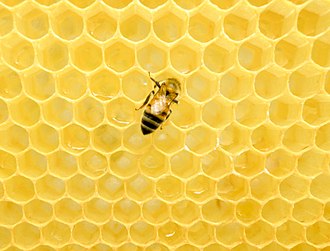
Tabulata, commonly known as tabulate corals, is a class of extinct corals. They almost always formed colonies of individual hexagonal cells called corallites, defined by a skeleton made of calcite. These cells looked similar to a honeycomb, with small pores joining adjacent cells.
One key feature of tabulate corals is their well-developed horizontal internal partitions called tabulae inside each cell, while vertical partitions called septa were reduced or absent. They were usually smaller than rugose corals and came in various shapes, from flat to conical to spherical.
Around 300 species of tabulate corals have been described. Some of the most common ones found as fossils include Aulopora, Favosites, Halysites, Heliolites, Pleurodictyum, Sarcinula, and Syringopora. These corals lived only during the Paleozoic era, from the Ordovician to the Permian periods. They were especially common in the shallow waters of the Silurian and Devonian periods. However, as sea levels rose in the Devonian, tabulate corals became less common and they finally went extinct in the Permian–Triassic extinction event.
Images
Related articles




This article is a child-friendly adaptation of the Wikipedia article on Tabulata, available under CC BY-SA 4.0.
Images from Wikimedia Commons. Tap any image to view credits and license.