 Safekipedia
Tanzania
Adapted from Wikipedia · Discoverer experience
Tanzania, officially the United Republic of Tanzania, is a country in East Africa within the African Great Lakes region. It is bordered by Uganda to the northwest, Kenya to the northeast, the Indian Ocean to the east, Mozambique and Malawi to the south, Zambia to the southwest, and Rwanda, Burundi, and the Democratic Republic of the Congo to the west. With a population of around 67.5 million, Tanzania is the most populous country located entirely south of the equator.
Important hominid fossils have been found in Tanzania, showing signs of early human history. The country has a rich mix of ethnic groups and languages, with over 120 different groups and more than 100 languages spoken. The main language used in government and education is Swahili, while English is also used, especially in business and higher education. Arabic is widely spoken in the Zanzibar area.
Tanzania is known for its beautiful landscapes, including Mount Kilimanjaro, the highest mountain in Africa. The country is home to three of the African Great Lakes: Lake Victoria, Lake Tanganyika, and Lake Malawi. Tanzania is a popular destination for tourists who enjoy safaris and exploring its natural wonders. It is also a member of many international groups, such as the United Nations, the African Union, and the East African Community.
Etymology
The name "Tanzania" comes from joining parts of the names of two places that joined together: Tanganyika and Zanzibar. When these places were becoming one country, a newspaper held a contest to choose a new name. Mohammed Iqbal Dar won the contest. He made the name by taking “Tan” from Tanganyika and “zan” from Zanzibar, adding “i” from his own name, and then adding “a”.
The name Tanganyika comes from Swahili words meaning “sail” and “wilderness”, which together mean “sail in the wilderness”. It may also refer to Lake Tanganyika.
The name Zanzibar comes from the name of a local group of people called the Zanj, and an Arabic word meaning “coast” or “shore”. The word Zanj comes from an old Arabic name for the East African coast.
History
Main articles: History of Tanzania and History of Zanzibar
Ancient
Tanzania is one of the oldest places where people have lived for a very long time. The Olduvai Gorge, in the Ngorongoro Conservation Area, a special place protected by the world, has old tools that show how people lived and made things long ago.
The first people to live in eastern Africa were small groups of hunters and gatherers called the Hadza and Sandawe of Tanzania.: page 17
Later, people from places like Ethiopia and Somalia moved into Tanzania. These people are the ancestors of groups like the Iraqw, Gorowa, and Burunge.: page 17
Archaeologists have found proof that people moved into Tanzania from places near the border of South Sudan and Ethiopia between 2,900 and 2,400 years ago.: page 18
Around the same time, people from West Africa called the Mashariki (Eastern) Bantu came to areas around Lake Victoria and Lake Tanganyika. They brought farming ways and grew yams. They moved across Tanzania between 2,300 and 1,700 years ago.
More people came from South Sudan about 500 to 1,500 years ago, like the Maasai.
People in Tanzania were good at making iron and steel. The Pare people made iron for others, and the Haya people made a special kind of furnace to create strong steel over 1,500 years ago.
People from places like the Persian Gulf and India visited the east coast of Africa a long time ago. Some people on the Swahili Coast followed Islam as early as the eighth or ninth century.
Medieval
People built farms and trade places along the Tanzanian coast from the very beginning of the first thousand years. At a place called Fukuchani on Zanzibar, scientists found proof of a village that farmed and fished from at least the sixth century. They found things like building pieces, shell beads, and iron pieces. There is also proof that they traded with faraway places, though most of their things came from nearby areas.
Trade became very important, and by the end of the tenth century, Zanzibar was a big trading town.
More ships from Egypt and Persia started trading in the Indian Ocean. This helped Swahili farmers build bigger villages to take part in the trade. These villages grew into early Swahili city-states. Gold from places like Mapungubwe and Zimbabwe in South Africa made Kilwa in Tanzania very rich. Kilwa traded with places far away and was very powerful until the Portuguese came in the late 15th century.
Colonial
Main articles: German East Africa and Tanganyika Territory
An leader from Oman named Said bin Sultan moved his capital to Zanzibar City in 1840. During this time, Zanzibar became a center for trading people, which was very wrong. Many people were taken from their homes and forced to work.
In 1885, Germany took control of the land that is now Tanzania (except Zanzibar) and called it German East Africa.
Between 1905 and 1907, many African tribes rose up against German rule because of unfair treatments like forced labor. This uprising was stopped very harshly, and many people suffered.
After World War I, the land that was German East Africa was given to Britain. It was called Tanganyika. The British ruled using a system where local leaders helped govern.
During World War II, about 100,000 people from Tanganyika joined the Allied forces to fight against bad leaders. They helped in many places.
In 1954, a man named Julius Nyerere started a group called the Tanganyika African National Union (TANU). This group wanted Tanganyika to be independent. In 1961, Tanganyika became independent, and Nyerere became the leader.
Modern
British rule ended on 9 December 1961. Elizabeth II was the queen of Tanganyika for the first year after independence. On 9 December 1962, Tanganyika became a republic with a president.
In 1964, after nearby Zanzibar became independent and had big changes in government, it joined with Tanganyika. The new country was called the United Republic of Tanzania.
President Nyerere worked hard to make all people in Tanzania feel like one group, no matter where they came from. He also started ideas about sharing wealth and helping everyone.
In 1967, Nyerere made a big speech called the Arusha Declaration, which talked about sharing and helping each other.
Tanzania stayed neutral in world affairs, meaning it didn’t pick sides between big powers. This helped Tanzania get help from many countries.
In the late 1970s, Tanzania’s economy had problems, partly because of a war with Uganda.
In 1992, Tanzania allowed more than one political party. In 1995, the leader Benjamin Mkapa was elected president.
The leaders of Tanzania since independence have been Julius Nyerere (1962–1985), Ali Hassan Mwinyi (1985–1995), Benjamin Mkapa (1995–2005), Jakaya Kikwete (2005–2015), John Magufuli (2015–2021), and Samia Hassan Suluhu since 2021.
Geography
Main articles: Geography of Tanzania and Zanzibar Archipelago
Tanzania is a large country in East Africa. It is the 13th largest country in Africa and the 31st largest in the world. It shares borders with Kenya and Uganda to the north, Rwanda, Burundi, and the Democratic Republic of the Congo to the west, and Zambia, Malawi, and Mozambique to the south. The country has a long coastline along the Indian Ocean and includes islands such as Unguja (Zanzibar), Pemba, and Mafia.
Tanzania is home to Mount Kilimanjaro, the highest mountain in Africa, and the floor of Lake Tanganyika, which is the lowest point in Africa. The country has many lakes, including Lake Victoria, Lake Tanganyika, and Lake Nyasa. It also features mountains, forests, and a large plateau in the center. The eastern coast is warm and humid, with the Zanzibar Archipelago nearby.
The climate in Tanzania changes a lot. In the mountains, temperatures stay cool, while other areas are warmer. The country has two rainy seasons: one from October to April and another from October to December and March to May. Tanzania sometimes faces strong storms and is also feeling the effects of climate change, which can bring more flooding and droughts.
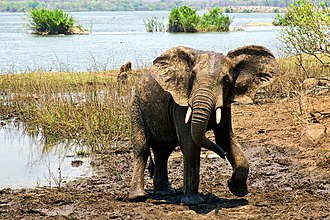
Tanzania has many wild animals and beautiful natural places. About 20% of Africa's warm-blooded animals live here, in 21 national parks and many protected areas. Famous places include the Serengeti, where wildebeest and other animals migrate each year, and Gombe Stream National Park, where chimpanzees were studied by Jane Goodall. Tanzania has many different kinds of birds, reptiles, and amphibians, and it is home to the largest number of lions in the world.
Main article: Wildlife of Tanzania
See also: List of protected areas of Tanzania
Government and politics
Main article: Politics of Tanzania
Constitution and elections
Main articles: Constitution of Tanzania and Elections in Tanzania
Tanzania is a country where one main party, the Chama Cha Mapinduzi (CCM), has been in power for a long time. This party has led the country since it gained independence in 1961.
John Magufuli won the presidential election in 2015 and served until his passing in 2021. Samia Suluhu Hassan then became the president. In the 2025 election, she was reelected, though some people were unhappy with the results.
Executive
Vice-President Emmanuel Nchimbi
Prime Minister Mwigulu Nchemba
The president of Tanzania and the members of the National Assembly are chosen by voters for five-year terms. The vice-president is also elected at the same time as the president. The president picks a prime minister from the National Assembly to help lead the government.
Legislature
All legislative power for mainland Tanzania is held by the National Assembly. It has 393 members, including elected representatives and others appointed to ensure fair representation.
Judiciary
See also: Chief Justice of Tanzania
Tanzania’s legal system is based on English common law. The country has a four-level court system, starting with Primary Courts and moving up to the Court of Appeal.
Zanzibar
Zanzibar has its own government with a president and a House of Representatives. The president and representatives are elected for five-year terms. The president chooses ministers to help run the government.
Administrative subdivisions
Main articles: Regions of Tanzania, Districts of Tanzania, and Subdivisions of Tanzania
Tanzania is divided into thirty-one regions, with twenty-six on the mainland and five in Zanzibar. These regions are further split into districts, some of which are urban areas with city or town councils.
Foreign relations
Main article: Foreign relations of Tanzania
Tanzania’s foreign policies focus on protecting its interests, promoting peace, and working with other nations. The country is part of many international groups, such as the United Nations, African Union, and East African Community.
International partnerships
Tanzania works closely with the United Nations and other organizations on issues like human rights, education, and health. It is also a member of the African Union and the East African Community, helping to build stronger ties among African nations.
Military
The Tanzania People’s Defence Force is the country’s army, navy, and air force. It operates under civilian control and includes volunteers and national service members.
Law enforcement
Main article: Law enforcement in Tanzania
The Tanzania Police Force is responsible for keeping public safety and controlling borders. It is overseen by government officials.
Human rights
Main article: Human rights in Tanzania
See also: Persecution of people with albinism and LGBT rights in Tanzania
Tanzania faces challenges with human rights, including issues for people with albinism and those who have different sexual orientations. The government works with international groups to address some of these concerns.
Economy
Main articles: Economy of Tanzania and Poverty in Tanzania
As of 2021, Tanzania's gross domestic product (GDP) was an estimated $71 billion (nominal), or $218.5 billion on a purchasing power parity (PPP) basis. GDP per capita (PPP) was $3,574.
From 2009 through to 2013, Tanzania's per capita GDP grew an average of 3.5% per year, higher than any other member of the East African Community (EAC) and exceeded by only nine countries in Sub-Saharan Africa.
Tanzania's largest trading partners in 2017 for its exports were India, Vietnam, South Africa, Switzerland, and China. Its imports totalled US$8.17 billion, with India, Switzerland, Saudi Arabia, China, and the United Arab Emirates being the biggest partners.
Tanzania weathered the Great Recession, which began in late 2008 or early 2009, relatively well. Strong gold prices, bolstering the country's mining industry, and Tanzania's poor integration into global markets helped to insulate the country from the downturn. Since the recession ended, the Tanzanian economy has expanded rapidly thanks to strong tourism, telecommunications, and banking sectors.
According to the United Nations Development Programme (UNDP), however, recent growth in the national economy has benefited only a few, leaving out the majority of the population. As of the latest survey in 2015/2016, 57.1 percent of the population is considered affected by multidimensional poverty. Tanzania's 2013 Global Hunger Index was worse than any other country in the EAC except Burundi. The proportion of persons who were undernourished in 2010–12 was also worse than any other EAC country except Burundi.
In 2020, the World Bank declared the rise of the Tanzanian economy from low income to lower middle income country, as its GNI per capita increased from US$1,020 in 2018 to US$1,080 in 2019.
Tanzania's economy grew 4.6 percent in 2022, and 5.2 percent in 2023.
Hunger and poverty
The Global Hunger Index previously ranked the situation as "alarming" with a score of 42 in the year 2000; since then the GHI has declined to 23.2. Children in rural areas suffer substantially higher rates of malnutrition and chronic hunger, although urban-rural disparities have narrowed as regards both stunting and underweight. Low rural sector productivity arises mainly from inadequate infrastructure investment; limited access to farm inputs, extension services and credit; limited technology as well as trade and marketing support; and heavy dependence on rain-fed agriculture and natural resources.
Approximately 68 percent of Tanzania's population live below the poverty line, with 32 percent of the population malnourished. The most prominent challenges Tanzania faces in poverty reduction are unsustainable harvesting of its natural resources, unchecked cultivation, climate change and water source encroachment, according to the United Nations Development Programme (UNDP).
There are very few resources for Tanzanians in terms of credit services, infrastructure or availability to improved agricultural technologies, which further exacerbates hunger and poverty in the country according to the UNDP. Tanzania ranks 159 out of 187 countries in poverty according to the United Nation's Human Development Index (2014).
The 2019 World Bank report showed that in the last 10 years, poverty has reduced by 8 percentage points, from 34.4% in 2007 to 26.4% in 2018. A further report showed a reduction to 25.7% in 2020.
Food and nutrition
Main article: Food security in Tanzania
Poor nutrition remains a persistent problem within Tanzania and varies hugely throughout the country's regions. USAID reports that 16% of children are underweight and 34% experience stunted growth as a result of malnutrition. 10 regions house 58% of children suffering from stunted growth while 50% of acutely malnourished children can be found in 5 regions. Over a 5-year period, the Mara district of Tanzania saw a 15% reduction in stunting in children under 5 years old, falling from 46% to 31% in 2005 and 2010 respectively. Dodoma, on the other hand, saw a 7% increase in the prevalence of stunting in this age group, rising from 50% in 2005 to 57% in 2010. Overall availability of food does not necessarily contribute to overall stunting figures. Iringa, Mbeya, and Rukwa regions, where overall availability of food is considered acceptable, still experience stunting incidents in excess of 50%. In some areas where food shortages are common, such as in the Tabora and Singida regions, stunting instances remain comparatively less than those seen in Iringa, Mbeya and Rukwa. The Tanzania Food and Nutrition Centre attributes these discrepancies to variance in maternal malnutrition, poor infant feeding practices, hygiene practices and poor healthcare services. Periods of drought can have significant impacts on the production of crops in Tanzania. Drought in East Africa has resulted in massive increases in the prices of food staples such as maize and sorghum, crops crucial to the nutrition of the majority of Tanzania's population. From 2015 to 2017 the price of maize when bought wholesale more than tripled, from TSh 400/= per kilogramme to 1,253/= per kilogramme.
Tanzania remains heavily agricultural, with 80% of the total population engaging in subsistence farming. Rural areas are subjected to increased food shortages in comparison to urbanised areas, with a survey carried out within the country in 2017 finding 84% of people in rural areas suffering food shortages for over 3 months compared to 64% of residents in cities. This disparity between rural and city nutrition can be attributed to various factors; increased nutritional needs due to manual labour, more limited access to food as a result of poor infrastructure, high-susceptibility to the damaging effects of nature and the "Agricultural Productivity Gap". The Agricultural Productivity Gap postulates that "value added per worker" is often much lower within the agricultural sector than that found within non-agricultural sectors. Furthermore, allocation of labour within the agricultural sector is largely ineffective.
Programmes targeting hunger
USAID programmes focusing on nutrition operate within the Morogoro, Dodoma, Iringa, Mbeya, Manyara, Songwe and Zanzibar regions of Tanzania. These "Feed the Future" programmes heavily invest in nutrition, infrastructure, policy, capacity of institutions, and agriculture that is identified by the organisation as a key area of economic growth in the country. A Tanzanian government-led initiative, "Kilimo Kwanza" or "Agriculture First", aims to encourage investment into agriculture within the private sector and hopes to improve agricultural processes and development within the country by seeking the knowledge of young people and the innovation that they can potentially provide. During the 1990s, around 25% of Tanzania's population were provided access to iodised oil aimed to target iodine deficiency within expecting mothers, as result of studies showing the negative effects of in-utero iodine deficiency on cognitive development in children. Research showed that children of mothers with access to the supplement achieved on average greater than a third of a year more education than those who did not.
Programmes led by the World Food Programme operate within Tanzania. The Supplementary Feeding Programme (SFP) aims to target acute malnutrition by supplying blended food fortified with vitamins to pregnant women and mothers to children under 5 on a monthly basis. Pregnant women and mothers to children under 2 have access to the Mother and Child Health and Nutrition Programme's "Super Cereal"—which is supplied with the intent of reducing stunting in children. World Food Programme supplementation remains the main food source for Tanzania's refugees. Super Cereal, Vegetable Oil, Pulses, and Salt are supplied as part of the Protracted Relief and Recovery Operation to meet the average person's minimum daily caloric requirement of 2,100 kcal. UNICEF state that continued investment in nutrition within Tanzania is of the utmost importance: Estimates predict that Tanzania stands to lose $20 billion by 2025 if nutrition within the country remains at its current level, however improvements in nutrition could produce a gain of around $4.7 billion
Save the Children, with the help of UNICEF and Irish Aid funding, created the Partnership for Nutrition in Tanzania (PANITA) in 2011. PANITA aims to use civil society organisations to target nutrition within the country. Alongside this, various sectors associated with nutrition are targeted, such as agriculture, water, sanitation, education, economic development, and social progress. PANITA is responsible for ensuring significant attention is given to nutrition in development plans and budgets created at the national and regional levels within Tanzania. Since its conception, PANITA has grown from 94 to 306 participating civil society organisations nationwide. Agriculture within Tanzania is targeted by the Irish Aid led initiative Harnessing Agriculture for Nutrition Outcomes (HANO), which aims to merge nutrition initiatives with agriculture in the Lindi District of the country. The project aims to reduce stunting by 10% in children aged 0 to 23 months.
Agriculture
Main article: Agriculture in Tanzania
The Tanzanian economy is heavily based on agriculture, which in 2013 accounted for 24.5 per cent of gross domestic product, provides 85% of exports, and accounted for half of the employed workforce. The agricultural sector grew 4.3 percent in 2012, less than half of the Millennium Development Goal target of 10.8%. 16.4 per cent of the land is arable, with 2.4 percent of the land planted with permanent crops. Tanzania's economy relies on farming, but climate change has impacted their farming.
Maize was the largest food crop on the Tanzania mainland in 2013 (5.17 million tonnes), followed by cassava (1.94 million tonnes), sweet potatoes (1.88 million tonnes), beans (1.64 million tonnes), bananas (1.31 million tonnes), rice (1.31 million tonnes), and millet (1.04 million tonnes). Sugar was the largest cash crop on the mainland in 2013 (296,679 tonnes), followed by cotton (241,198 tonnes), cashew nuts (126,000 tonnes), tobacco (86,877 tonnes), coffee (48,000 tonnes), sisal (37,368 tonnes), and tea (32,422 tonnes). Beef was the largest meat product on the mainland in 2013 (299,581 tonnes), followed by lamb/mutton (115,652 tonnes), chicken (87,408 tonnes), and pork (50,814 tonnes).
According to the 2002 National Irrigation Master Plan, 29.4 million hectares in Tanzania are suitable for irrigation farming; however, only 310,745 hectares were actually being irrigated in June 2011.
Industry, energy and construction
Main articles: Energy in Tanzania, Water supply and sanitation in Tanzania, and Natural resource and waste management in Tanzania
See also: List of companies of Tanzania
Songo Songo Gas Plant
Industry and construction is a major and growing component of the Tanzanian economy, contributing 22.2 per cent of GDP in 2013. This component includes mining and quarrying, manufacturing, electricity and natural gas, water supply, and construction. Mining contributed 3.3 per cent of GDP in 2013. The vast majority of the country's mineral export revenue comes from gold, accounting for 89 per cent of the value of those exports in 2013. Tanzania's gold production is 46 metric tonnes in 2015. It also exports sizeable quantities of gemstones, including diamonds and tanzanite. All of Tanzania's coal production, which totalled 106,000 short tons in 2012, is used domestically.
Further informationon the mineral exploration company: Rift Valley Resources
Only 15 percent of Tanzanians had access to electric power in 2011, rising to 35.2 per cent in 2018. The government-owned Tanzania Electric Supply Company Limited (TANESCO) dominates the electric supply industry in Tanzania. The country generated 6.013 billion kilowatt hours (kWh) of electricity in 2013, a 4.2 per cent increase over the 5.771 billion kWh generated in 2012. Generation increased by 63 percent between 2005 and 2012; Almost 18 percent of the electricity generated in 2012 was lost because of theft and transmission and distribution problems. The electrical supply varies, particularly when droughts disrupt hydropower electric generation; rolling blackouts are implemented as necessary. The unreliability of the electrical supply has hindered the development of Tanzanian industry. In 2013, 49.7 percent of Tanzania's electricity generation came from natural gas, 28.9 percent from hydroelectric sources, 20.4 percent from thermal sources, and 1.0 percent from outside the country. The government has built a 532 kilometres (331 mi) gas pipeline from Mnazi Bay to Dar es Salaam. This pipeline was expected to allow the country to double its electricity generation capacity to 3,000 megawatts by 2016. The government's goal is to increase capacity to at least 10,000 megawatts by 2025.
According to PFC Energy, 25 to 30 trillion cubic feet of recoverable natural gas resources have been discovered in Tanzania since 2010, bringing the total reserves to over 43 trillion cubic feet by the end of 2013. The value of natural gas actually produced in 2013 was US$52.2 million, a 42.7 percent increase over 2012.
Commercial production of gas from the Songo Songo Island field in the Indian Ocean commenced in 2004, thirty years after it was discovered there. Over 35 billion cubic feet of gas was produced from this field in 2013, with proven, probable, and possible reserves totalling 1.1 trillion cubic feet. The gas is transported by pipeline to Dar es Salaam. As of 27 August 2014, TANESCO owed the operator of this field, Orca Exploration Group Inc.
A newer natural gas field in Mnazi Bay in 2013 produced about one-seventh of the amount produced near Songo Songo Island but has proven, probable, and possible reserves of 2.2 trillion cubic feet. Virtually all of that gas is being used for electricity generation in Mtwara.
The Ruvuma and Kiliwani areas of Tanzania have been explored mostly by the discovery company that holds a 75 percent interest, Aminex, and has shown to hold in excess of 3.5 trillion cubic feet of natural gas. A pipeline connecting offshore natural gas fields to Tanzania's commercial capital Dar es Salaam was completed at the end of April 2015.
Tourism
Main article: Tourism in Tanzania
Travel and tourism contributed 17.5 per cent of Tanzania's gross domestic product in 2016 and employed 11.0 per cent of the country's labour force (1,189,300 jobs) in 2013. Overall receipts rose from US$1.74 billion in 2004 to US$4.48 billion in 2013, and receipts from international tourists rose from US$1.255 billion in 2010 to US$2 billion in 2016. In 2016, 1,284,279 tourists arrived at Tanzania's borders compared to 590,000 in 2005. The vast majority of tourists visit Zanzibar or a "northern circuit" of Serengeti National Park, the Ngorongoro Conservation Area, Tarangire National Park, Lake Manyara National Park, and Mount Kilimanjaro. In 2013, the most visited national park was Serengeti (452,485 tourists), followed by Manyara (187,773) and Tarangire (165,949).
Banking
The Bank of Tanzania is the central bank of Tanzania and is primarily responsible for maintaining price stability, with a subsidiary responsibility for issuing the banknotes and coins of the Tanzanian shilling. At the end of 2013, the total assets of the Tanzanian banking industry were TSh 19.5 trillion, a 15 per cent increase over 2012.
Transport
Main article: Transport in Tanzania
Most transport in Tanzania is by road, with road transport constituting over 75 per cent of the country's freight traffic and 80 percent of its passenger traffic. The Cairo-Cape Town Highway passes through Tanzania. The 181,191 kilometres (112,587 mi) road system is in generally poor condition. Tanzania has two railway companies: TAZARA, which provides service between Dar es Salaam and Kapiri Mposhi (in a copper-mining district in Zambia), and Tanzania Railways Limited, which connects Dar es Salaam with central and northern Tanzania. Rail travel in Tanzania often entails slow journeys with frequent cancellations or delays, and the railways have a deficient safety record.
Dar es Salaam has a huge project of rapid buses, Dar Rapid Transit (DART), that connects suburbs of Dar es Salaam city. The development of the DART system consists of six phases and is funded by the African Development Bank, the World Bank and the Government of Tanzania. The first phase began in April 2012, and it was completed in December 2015 and launched operations in May 2016.
Tanzania has four international airports, along with over 120 small airports or landing strips. Airport infrastructure tends to be in poor condition. Airlines in Tanzania include Air Tanzania, Precision Air, Fastjet, Coastal Aviation, and ZanAir. On February 14, 2026, Tanzania signed a memorandum of understanding with Liberia to increase the maritime industry of Tanzania with a sharing of Liberia's maritime expertise.
Communications
Main article: Telecommunications in Tanzania
In 2013, the communications sector was the fastest growing in Tanzania, expanding 22.8 per cent; however, the sector accounted for only 2.4 per cent of gross domestic product that year.
As of 2011, Tanzania had 56 mobile telephone subscribers per 100 inhabitants, a rate slightly above the sub-Saharan average. Very few Tanzanians have fixed-line telephones. Approximately 12 per cent of Tanzanians used the internet as of 2011, though this number is growing rapidly. The country has a fibre-optic cable network that replaced unreliable satellite service, but internet bandwidth remains very low.
Science and technology
Main article: Science and technology in Tanzania
Tanzania's first "National Science and Technology Policy" was adopted in 1996. The objective of the government's "Vision 2025" (1998) document was to "transform the economy into a strong, resilient and competitive one, buttressed by science and technology".
Under the umbrella of the One UN Initiative, UNESCO and Tanzanian government departments and agencies formulated a series of proposals in 2008 for revising the "National Science and Technology Policy". The total reform budget of US$10 million was financed from the One UN fund and other sources. UNESCO provided support for mainstreaming science, technology, and innovation into the new "National Growth and Poverty Reduction Strategy" for the mainland and Zanzibar, namely, Mkukuta II and Mkuza II, including in the field of tourism.
Tanzania's revised science policy was published in 2010. Entitled "National Research and Development Policy", it recognises the need to improve the process of prioritisation of research capacities, develop international co-operation in strategic areas of research and development, and improve planning for human resources. It also makes provisions for the establishment of a National Research Fund. This policy was, in turn, reviewed in 2012 and 2013.
In 2010, Tanzania devoted 0.38 per cent of GDP to research and development. The global average in 2013 was 1.7 per cent of GDP. Tanzania had 69 researchers (in headcounts) per million population in 2010. In 2014, Tanzania counted 15 publications per million inhabitants in internationally catalogued journals, according to Thomson Reuters' Web of Science (Science Citation Index Expanded). The average for sub-Saharan Africa was 20 publications per million inhabitants, and the global average was 176 publications per million inhabitants. Tanzania was ranked 121st in the Global Innovation Index in 2025, down from 97th in 2019.
Economic statistics controversy
Two articles in the Economist in July 2020 raised doubts about official claims of economic growth: "If Tanzania's economy grew by almost 7% in the fiscal year to the end of June 2019, why did tax revenue fall by 1%? And why has bank lending to companies slumped? Private data are bad, too. In 2019 sales at the biggest brewer fell by 5%. Sales of cement by the two biggest producers were almost flat. None of these things is likely if growth is storming ahead. The discrepancies are so large that it is hard to avoid the conclusion that the government is lying."
Tim Staermose, a proponent of African investment, took issue with these data: "Some of these statements by The Economist, based on the evidence I have gathered from primary sources – namely, the statutory financial reports that listed companies in Tanzania are legally obligated to release – are simply not true. Bank lending to companies as far as I can see has not, 'slumped.' The two biggest banks in Tanzania, which between them account for approximately 40% of the banking sector, both reported strong loan growth in 2019. ... As for cement sales being 'almost flat,' again, this is total nonsense. ... In 2019 Twiga sold 6% more cement by volume than it did in 2018. In the first six months of 2020, Twiga already sold 8% more cement than it had done by the same stage in 2019. Again, these numbers are very consistent with an economy that's reported to be growing at around 7% per annum. ... [On] the 5% fall in beer sales in 2019 ... the published 2019 annual report by Tanzania Breweries Limited (TBL) will tell you there were one-off circumstances that largely drove the decline ... [which] resulted in sales falling. But TBL's profits actually rose in 2019."
Demographics
Main article: Demographics of Tanzania
According to a 2024 estimate, Tanzania has a population of around 67.5 million people. In 2012, the population was 44,928,923. About 44% of the population is under 15 years old.
The population in Tanzania is spread unevenly. Most people live near the northern border or the coast, while many areas of the country have few people. The population density ranges from 12 people per square kilometer in the Katavi Region to 3,133 people per square kilometer in the Dar es Salaam Region.
About 70% of people live in rural areas, though this number has been decreasing. Dar es Salaam is the largest city and main commercial center. Dodoma is the capital and home to the National Assembly.
When Tanzania was formed in 1964, child mortality was high at 335 deaths per 1,000 births. Since then, this rate has dropped to 62 deaths per 1,000 births.
Tanzania has about 125 different ethnic groups. The Sukuma, Nyamwezi, Chagga, and Haya peoples each have more than one million members. Most people are of native African descent. There are also communities of Indian, Chinese, Arab, and Shirazi descent. A small Somali community lives mainly in cities and coastal areas.
Languages
Main article: Languages of Tanzania
Over 100 languages are spoken in Tanzania, making it one of the most linguistically diverse countries in East Africa. The main languages include Bantu, Cushitic, Nilotic, and Khoisan. Kiswahili is the national language, used in schools and government. English is used in higher education and business. Most people speak Kiswahili as a second language, and many educated people also speak English.
The Sandawe people speak a language related to the Khoe languages, while the Hadzabe people speak a language with unique click sounds. The Iraqw people speak a Cushitic language.
Religion
Main article: Religion in Tanzania
See also: Christianity in Tanzania and Islam in Zanzibar
Tanzania’s population is mostly Christian, Muslim, or follows traditional African religions. Exact numbers are not available, but estimates suggest around 63% are Christian and 34% are Muslim, with the rest following other beliefs. On Zanzibar, most people are Muslim.
Among Christians, the Catholic Church is the largest group. There are also Lutherans, Anglicans, Pentecostals, and Adventists. Other religious groups include Buddhists, Hindus, and Bahá'ís.
Education
Main article: Education in Tanzania
In 2015, about 78% of people aged 15 and older could read and write. Education is required until age 15. In 2020, about 97% of children finished primary school, but only about 28% completed secondary school.
The Tanzania Library Services Board runs many libraries across the country.
Health
Main article: Health in Tanzania
See also: Healthcare in Tanzania
In 2012, the average life expectancy was 61 years. Malaria and other diseases like diarrhoea and measles are common causes of death in young children. In 2025, Tanzania faced an outbreak of the Marburg virus, a serious disease similar to Ebola. The government worked with health organizations to control the spread.
Women
Main article: Women in Tanzania
Women and men have equal rights under the law in Tanzania. The government signed a treaty to prevent discrimination against women in 1985. Many women face challenges such as higher unemployment and fewer educational opportunities. The constitution requires that women make up at least 30% of elected officials in the National Assembly.
| Year | Millions |
|---|---|
| 1950 | 7.9 |
| 2000 | 35.1 |
| 2021 | 63.6 |
| 2024 | 67.5 |
Culture
Main article: Culture of Tanzania
Tanzania has rich and varied cultural traditions. Two art styles from the country, Tingatinga painting and vibrant canvas artworks, have gained worldwide attention. These paintings often show people, animals, and everyday life in bright colors.
The country’s literature is mostly spoken, with folktales, poems, and proverbs passed down through generations. Books are not always easy to find, but writers in Swahili and English have created many stories and poems that are enjoyed by people across Tanzania.
Music in Tanzania is always changing and varies by place and occasion. Traditional styles include ngoma (dance and drum music), dansi (urban jazz), taarab (poetry songs), and kwaya (church-inspired music). More recent styles like bongo flava mix local sounds with international genres such as reggae and hip hop. The national anthem, “Mungu Ibariki Afrika,” was originally written by a South African composer and adapted for use in Tanzania.
Tanzania also enjoys many sports. Football is especially popular, with teams like Young Africans F.C. and Simba S.C. being widely followed. Other sports such as basketball, netball, boxing, volleyball, athletics, and rugby are also played and enjoyed by many.
Main article: Music of Tanzania
Main article: Mass media in Tanzania
Main article: Cinema of Tanzania
Main article: Sport in Tanzania
Images
Related articles


This article is a child-friendly adaptation of the Wikipedia article on Tanzania, available under CC BY-SA 4.0.
Images from Wikimedia Commons. Tap any image to view credits and license.