
Timeline of Sydney
The following is a timeline of the history of the city of Sydney, New South Wales, Australia. This timeline shows the important events and changes that have shaped Sydney over many years. It helps us understand how the city grew from its early beginnings to become a busy and exciting place today. Because history is always growing, this list may not include every single event, and anyone can help by adding more information with details from trustworthy sources.
Pre-Colonial
- 50,000–45,000 years ago – Near Penrith, a western suburb of Sydney, many old stone tools were found. These tools show that people lived there a very long time ago.
- 30,000 years ago – Evidence from Parramatta in western Sydney shows that Aboriginal Australians used charcoal, stone tools, and maybe even campfires.
- 21,100–17,800 years ago – More stone tools were found near the Hawkesbury River and the Blue Mountains, as well as in a rock shelter near the Nepean River.
- 5,000–7,000 years ago – The Sydney rock engravings were created. These are drawings of people, animals, and symbols carved into rock.
- 4,000–2,000 BC – People made new kinds of stone tools like blades and spears. These tools could drill, scrape, cut, and grind materials, and were used for woodworking.
- 1,000–500 BC – Bone and shell tools were used, possibly for fishing with multi-pronged spears. Evidence of spear-throwing was found at Balmoral Beach.
- About 500 CE – A big wave, possibly a tsunami, likely happened.
18th–19th centuries
1770s–1790s
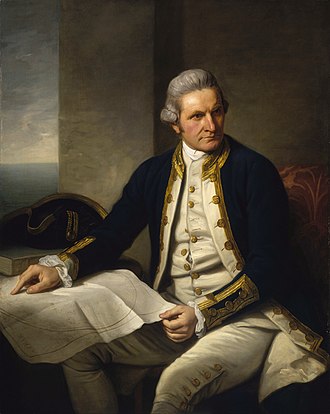
In 1770, Lieutenant James Cook sighted the east coast of Australia and landed at Kurnell. In 1788, the British government established a settlement at Botany Bay, later moving to Sydney Cove. This period saw the arrival of the First Fleet and the beginning of European settlement in Australia.
The late 1700s brought many changes, including the founding of Parramatta and the building of early structures. There were also interactions between settlers and indigenous peoples, as well as the introduction of new crops and animals.
1800s–1840s
The early 1800s were marked by the growth of Sydney as a colony. The University of Sydney was established in 1850, and the city saw the opening of important institutions like the Sydney Cricket Ground and the first railway in New South Wales.
This era also included significant events such as the crossing of the Blue Mountains in 1813, which opened up new lands for settlement, and the construction of key buildings like the Macquarie Lighthouse and St James' Church.
1850s–1890s
The mid-to-late 1800s were a time of great development for Sydney. The city expanded with new railways, bridges, and public buildings. The Sydney Observatory was built in 1858, and the first telephone exchange opened in 1881.
Important cultural institutions were also established, such as the Art Gallery of New South Wales in 1874 and the Sydney Free Public Library in 1869. The population grew significantly during this period, and Sydney became a more modern and bustling city.
20th century
1900s–1940s
The early 1900s brought many changes to Sydney. In 1901, the Commonwealth of Australia was created, and Sydney’s Edmund Barton became the first prime minister. The Royal Australian Historical Society was founded the same year. Sydney saw the rise of new buildings like the second Pyrmont Bridge and the Fort Macquarie Tram Depot.
The city continued to grow with new bridges, such as the Glebe Island Bridge, and cultural spots like Her Majesty’s Theatre. The Bronte Surf Club became the first surf club in Australia. By the 1920s, Sydney had electric street lighting, and important institutions like the Dental Hospital and Central railway station were established.
1950s–1990s
The latter half of the 20th century was a time of great development. In the 1950s, Sydney began to see the rise of television with ATN Channel 7 starting broadcasts. The Sydney Opera House competition was won by architect Jørn Utzon in 1957, though it would take many years to build.
The 1970s and 1980s brought major events like the opening of the Sydney Opera House in 1973 and the Sydney Harbour Bridge in 1932. The city also hosted the 2000 Summer Olympics, marking a high point in Sydney’s modern history. Throughout these decades, Sydney grew as a cultural, economic, and international hub.
21st century
2000s
In 2001, the Sydney Harbour Federation Trust was established, and the population reached 4,128,272. A drama film called Lantana showed relationships in Sydney suburbs. In 2002, architect Glenn Murcutt won the Pritzker Architecture Prize, and a festival for short plays called Short+Sweet began.
2003 saw the Lowy Institute for International Policy open in Sydney. An animated movie, Finding Nemo, featured fish escaping a Sydney dentist. The first season of a home renovation TV show, The Block, was filmed at Bondi. In 2004, Clover Moore started a long term as Lord Mayor of Sydney. In 2005, the Cross City Tunnel opened, and the Sydney Swans football team won a big game.
2010s
In 2010, the Sydney Desalination Plant began operating, and a young sailor, Jessica Watson, returned after sailing around the world alone. In 2011, there was a sad fire at a nursing home where eleven people died. By 2017, Sydney’s population reached five million. In 2019, the first line of Sydney Metro, a new fast train system, was completed.
2020s
The year 2020 brought very hot weather, with temperatures reaching 48.9 °C. The arrival of the Ruby Princess cruise ship led to many cases of a health issue. In 2021, Sydney faced serious lockdown measures. In 2022, Anthony Albanese, the Prime Minister, came from Sydney. Sadly, there was a shark attack at Little Bay. In 2024, a new train line opened between Chatswood, City, and Sydenham.
Pictures
Keep exploring


This article is a child-friendly adaptation of the Wikipedia article on Timeline of Sydney, available under CC BY-SA 4.0.
Images from Wikimedia Commons. Tap any image to view credits and license.