 Safekipedia
Two-state solution
Adapted from Wikipedia · Discoverer experience
The two-state solution is a way to solve the conflict between Israel and Palestine by creating two separate states from the same land. This idea suggests one state for the Jewish people and another for the Palestinian people. Many countries and the Palestinian Authority support this plan, but Israel does not agree to it right now, even though it has in the past.
The idea of two states was first suggested in 1937 by a British report. In 1947, the United Nations voted to split the land into two parts, which led to a war and the creation of Israel. Since then, many talks and meetings have tried to make the two-state solution happen, but they have not always succeeded. Today, there are still big disagreements about where the borders should be, what will happen to Jerusalem, and how to treat people who had to leave their homes.
Right now, there is no active negotiation for a two-state solution. Some leaders in Israel and Palestine support the idea, while others do not. After recent events in 2024, some countries started talking about the two-state solution again, but Israel’s government has pushed back against these ideas.
History
Main article: Israeli–Palestinian conflict
Main article: 2017 Hamas charter
Early ideas for solving the conflict between Israelis and Palestinians suggested creating two separate countries. In 1937, a British report suggested splitting the land into Jewish and Arab areas, but this plan was not accepted by Arab leaders.
In 1947, the United Nations suggested dividing Palestine into separate Jewish and Arab states. Jewish leaders accepted this plan, but Arab leaders did not. This led to fighting and later wars. Over time, many countries and leaders have supported the idea of two states as a way to bring peace to the region. Some groups, however, have not agreed to this idea.
Diplomatic efforts
Main article: Israeli–Palestinian peace process
Many countries have tried to help create peace between Israel and Palestine. In 1991, talks began at the Madrid Conference, leading to the Oslo Accords. These agreements divided some lands and set up rules for future talks, but they did not end the conflict. Later, in 2007, leaders from Israel, the Palestinian Authority, and the United States met in Annapolis to discuss a plan for two separate countries, but they could not agree.
In 2002, a plan called the Arab Peace Initiative was suggested, which many Arab countries supported. The United States also backed the idea of two states. More talks happened in 2013 and 2014, but again, no final agreement was reached. During this time, fighting between Palestinian groups split leadership between different areas.
Viability
Over time, the growth of areas where people live in certain parts of the land made it harder to create two separate countries for both groups. Some leaders and experts began to wonder if having two countries was still possible.
In 2012, a group from European countries said that ongoing changes made a two-country solution less likely. Some leaders in another country disagreed with this report. Later that year, a big meeting of countries agreed to recognize a new status for one group, but this led to more building in disputed areas, which some said made two countries harder to create.
In 2015, a leader said that during his time, a separate country for one group would not be created. After some big decisions in 2017, many experts started to think that two countries might not be possible anymore. Many of these experts worried about what might happen if two countries were not created.
Settlements in the West Bank
The United Nations says that settlements in West Bank, including East Jerusalem, are not allowed. In November 2023, about 700,000 Israeli people lived in these areas. Many of these settlements were built after the Oslo Accords.
These settlements make it hard to create two separate countries for Israel and Palestine. They take up land that Palestinians need, making it difficult for them to live and grow their farms. Some ideas have been suggested to help people who leave these settlements, like what happened when Israel left settlements in Gaza in 2005 and the Sinai Peninsula in 1982.
Public opinion in Israel and Palestine
Many people in both Israel and Palestine have supported the idea of creating two separate states to solve conflicts between the two groups. In 2002, a poll showed that 72% of both Palestinians and Israelis wanted peace based on old borders if both sides could agree. In 2013, about 70% of Palestinians in certain areas and 52% of Israelis supported the idea of an independent Palestinian state alongside Israel.
Support for two states changes depending on how questions are asked. Some polls show that many Palestinians and Israelis believe a peace agreement where both states live together peacefully is important. However, support has gone down over time. In 2021, only 39% of Palestinians supported the two-state solution, and support was even lower among younger Palestinians. By 2021, support among Israelis had also declined to around 42%.
Some leaders and experts still believe that two states is the best way to solve the long-standing conflict. They argue that it is the only solution that can bring long-term security and peace for both Israelis and Palestinians.
International positions regarding two-state solution
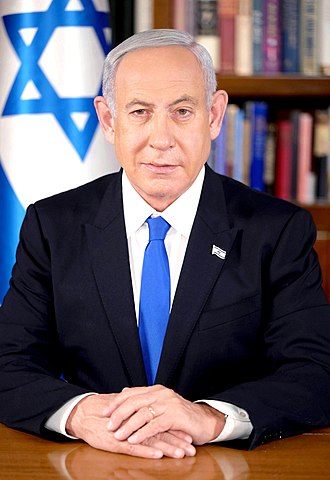
After the October 7 attacks and the Gaza war, many countries talked again about a two-state solution. This idea suggests creating two separate countries for Israelis and Palestinians to live in peace. However, Israel’s leader, Prime Minister Benjamin Netanyahu, did not agree with this plan.
Many countries around the world support the two-state solution. In September 2024, leaders from about 90 countries met to discuss how to make this idea happen. Groups like the G7, the European Union, and the Arab League also back this solution. Leaders from the United States, China, Germany, India, the United Kingdom, France, Italy, Latvia, North Korea, Canada, Australia, and New Zealand have all spoken in favor of creating two states. They believe it is the best way to bring lasting peace to the area.
Non-governmental supporters of a two-state solution
Many people and groups in different countries support the idea of creating two separate states to solve a disagreement between two groups of people.
In North America, a writer for the New York Times named Thomas Friedman has spoken strongly in support of a two-state idea and has said that the leader of one of the countries should not be against it. Some past leaders from Jewish groups also wrote to a leader of another country, asking for help in making this idea happen.
In the UK, a group called the Board of Deputies of British Jews has also said they support the idea of two states, where one country can be safe and the other can also work well.
Other solutions
Another idea is the binational solution, which could mean a country with two parts or one single country. There are also ideas like the three-state solution and the Jordanian option, sometimes called the "no-state solution".
The three-state solution is one more idea. In 2009, a newspaper said that Egypt and Jordan were worried about taking care of Gaza and the West Bank again. This would mean Gaza going back to Egypt and the West Bank going back to Jordan.
The "Jordanian option" talks about ways to solve the Israeli–Palestinian conflict with help from the Kingdom of Jordan. These ideas usually mean Jordan taking control of parts of the West Bank or making a group with a Palestinian state.
Some people have talked about giving Palestinian citizenship or places to live to Jewish settlers if Israel takes its soldiers out of the West Bank.
The New-state solution to the Israeli–Palestinian conflict suggests making a new city-state on the Sinai Peninsula by the Mediterranean Sea near Arish. This would create a democratic independent sovereign State of Palestine away from the State of Israel in what is now Egypt.
Images
Related articles


This article is a child-friendly adaptation of the Wikipedia article on Two-state solution, available under CC BY-SA 4.0.
Images from Wikimedia Commons. Tap any image to view credits and license.