
Ummah
The word Ummah comes from the Arabic language and means a group of people who share the same beliefs. In Islam, the Ummah refers to all Muslims around the world who are connected through their faith, no matter where they live or what their backgrounds are. It is like a big family that includes everyone who believes in the teachings of the Quran.
The idea of the Ummah is very important in Islam because it shows that Muslims are part of one large community. This community is based on shared values and teachings, not on borders or nationalities. Even though people may come from different countries, languages, or cultures, they are all part of the Ummah when they follow Islam.
The term Ummah is different from words that describe people based on their country or ancestry. For example, the word shaʻb refers to people who share the same land or history, like the citizens of a specific country. But the Ummah is bigger—it includes all Muslims together, no matter where they are from. Some people believe that all Muslims should work together as one nation, which is an idea called Pan-Islamism.
Islamic usage and origin
Further information: Enjoining good and forbidding wrong and Ma'ruf
The word Ummah Wāhidah from the Quran means "One Nation." It talks about all Muslims together as one big family. The Quran teaches that Muslims should help each other do good things and stop bad things. Long ago, a special agreement called the Constitution of Medina was made by Muhammad. It said that even people who were not Muslim, like Jews, Christians, and others living in Medina, were also part of this big family called the Ummah.
Emergence
Main articles: Muslim world and Caliphate
Before the idea of the ummah, Arab communities were mostly led by family ties and tribal connections. When Islam began, the idea of the ummah also appeared. This was the thought that a special messenger, Muhammad, had come to start a community for everyone, not just Arabs. Muhammad taught that the ummah should follow the commands of God instead of just family ties.
After Muhammad passed away in 632, leaders called caliphates began to guide the Islamic communities. These leaders helped create large groups of people from many backgrounds who followed Islam together.
Quran
The word ummah is mentioned 62 times in the Quran. It usually talks about groups of people who follow a shared belief or way of life under God's plan. At first, the word ummah was similar to the word qawm, meaning "people." The Quran teaches that every ummah has a messenger who brings a message from God, and all ummahs will face God's judgment.
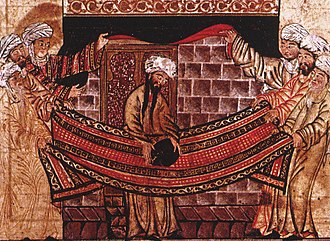
Over time, the meaning of ummah grew to mean a bigger religious community and finally the Muslim nation. Before it only meant Muslims, the ummah included Jewish and Christian communities too, calling them the People of the Book. The Constitution of Medina said all members, no matter their religion, were one ummah. As Muslims grew stronger in Medina, the ummah came to mean only Muslims. This change is shown by important events like the Kaaba being made holy again, Muslims being commanded to go on a pilgrimage to Mecca, and prayers being redirection of prayer from Jerusalem to Mecca.
The word ummah was used most in the later years of Mecca and in Medina. This shows that Muhammad was shaping the idea of the ummah to mean the true Muslim nation. In the early Meccan writings, ummah was linked to religion, but in Medina, it was more about how the ummah relates to religion. The last mention of ummah in the Quran calls Muslims the "best nation" and says that all messengers share one ummah under one God.
O messengers, eat from the good foods and work righteousness. Indeed, I, of what you do, am Knowing. And indeed this, your ummah (nation), is one ummah (nation), and I am your Lord, so fear Me. [Qur'an, Surah Al-Mu'minun (The Believers) (23:51–52)]
Mecca
At first, the new group of Muslims in Mecca did not plan to fight against the tribes already living there. The early Muslims did not have to change much about their old ways because the new group's ideas about right and wrong fit well with what people already believed. But what made this new community special was how important they thought these ideas were in everyday life.
Medina
Main article: First Islamic state
When Muhammad and the first people who believed in Islam had to leave Mecca, they were welcomed in Medina by a group called the Ansar. They had changed their beliefs to become Muslims. Even though Medina had many Jewish people and tribes with different beliefs, Muhammad and his followers were accepted without any trouble.
In Medina, Muhammad created something called the Constitution of Medina. This helped bring together people from different tribes and backgrounds into one big community, called the ummah. This meant that everyone, no matter their tribe or beliefs, was part of the same nation. The ummah was not just for one group of people but included many different kinds of people working together.
The Constitution of Medina made sure that all the tribes, including both Muslims and Jews, were treated fairly. It promised safety and support for everyone who joined the ummah. Even though people had different religions, they agreed to work together to protect each other and help each other. This showed that the ummah was more than just a religious group—it was a way for different people to live together peacefully.
Back to Mecca
After Muslims took control of Mecca, joining the ummah meant committing to Islam. This change happened because Islam started to focus more on being different from paganism, Judaism, and Christianity. It emphasized a community based on Abraham. To be part of the ummah, two main ideas were important: first, to worship only God, and second, to worship God correctly as part of a guided community. The new society focused on the relationships between people and God, and between people themselves. Muhammad helped hold this society together, and fighting among Muslim groups was not allowed. His vision was for a community that would make a difference in the world through their actions.
Keep exploring



This article is a child-friendly adaptation of the Wikipedia article on Ummah, available under CC BY-SA 4.0.