 Safekipedia
Walls of Babylon
Adapted from Wikipedia · Discoverer experience
The walls of Babylon were the city walls surrounding the ancient Mesopotamian city of Babylon, the political and religious centre of the Neo-Babylonian Empire. These massive walls protected the city and were an important symbol of its strength and power.
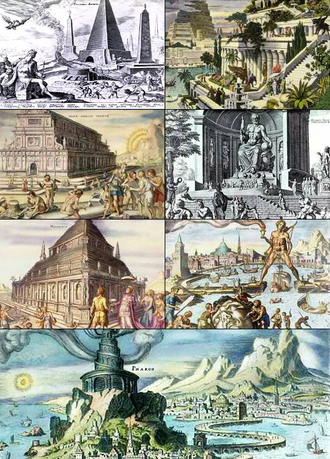
The walls of Babylon were included in many early versions of the Seven Wonders of the Ancient World. A study by Wilhelm Heinrich Roscher found that they were the second-most frequently chosen wonder, with only the Colossus of Rhodes being chosen more often. Ancient writers such as Herodotus, Strabo, and the author of the Book of Jeremiah all described these incredible structures.
They were by far the largest buildings in Babylon. The German archaeological team led by Robert Koldewey estimated that the walls were between 12 and 24 meters high and 17 to 22 meters thick. Today, the remains of Babylon are among the best understood from the 1st millennium BC, because the city walls can still be seen as earthworks even before modern excavations began in 1899.
Ancient descriptions
The ancient historian Herodotus described the walls of Babylon in his book Histories. He said the walls were very large, forming a square about 22 kilometers on each side. They were about 24 meters thick and 97 meters tall, made from baked brick.
Other writers like Strabo, Diodorus Siculus, and Quintus Curtius Rufus also wrote about these huge walls. The Bible also mentions the walls, saying they would one day be torn down.
History
The walls of Babylon were first built a long time ago, in the early second millennium BC. Ancient writings from the time of Hammurabi and his family talk about building city walls, gates, and moats.
Later, in the mid-first millennium BC, a king named Nabopolassar built two big walls called Imgur-Enlil and Nēmet-Enlil. His son, Nebuchadnezzar II, made the walls even bigger. The inner wall, Imgur-Enlil, was made of strong baked bricks, while the outer wall, Nēmet-Enlil, was a huge mudbrick rampart. A deep moat, filled with water from the Euphrates river, was built between the two walls to protect the city.
Archaeology, current status and reconstruction
The first careful excavations of Babylon’s walls were carried out by German archaeologist Robert Koldewey from 1899 to 1917. He dug deep into parts of the walls and mapped others. Later, Iraqi teams studied the Ishtar Gate and nearby walls, adding repairs and reconstructions.
Today, many parts of the walls are still visible, though some have been damaged by modern building. In Berlin, the Pergamon Museum displays copies of the Ishtar Gate and parts of the road leading to it, made from both original pieces and newer bricks. In Babylon itself, large reconstructions were done in the late 1970s and early 1980s, including parts of the city wall and gates, using durable baked bricks in some places.
Images
Related articles



This article is a child-friendly adaptation of the Wikipedia article on Walls of Babylon, available under CC BY-SA 4.0.
Images from Wikimedia Commons. Tap any image to view credits and license.