
Western Roman Empire
The Western Roman Empire refers to the western parts of the old Roman Empire when it was ruled separately from the eastern parts. This split happened officially in the year 395 when the empire was divided between two sons of Emperor Theodosius I. The western part was ruled from cities like Mediolanum and later Ravenna, while the eastern part was ruled from Constantinople.
The Western Roman Empire faced many challenges, including attacks from outside groups and inner problems. In 476, the western emperor Romulus Augustulus was forced to give up his position, and a leader named Odoacer took control of Italy. This event is often seen as the end of the Western Roman Empire, marking the start of a new time period called the Middle Ages.
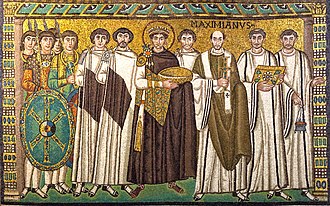
Even after this, the eastern part of the Roman Empire, known as the Byzantine Empire, tried to bring back control over some western lands. Emperor Justinian I succeeded in taking back areas such as North Africa, Italy, and parts of Hispania. However, keeping these areas was hard due to ongoing problems and new attacks. Over time, the influence of the eastern empire in western Europe grew weaker.
As the power of the old Roman Empire faded in the west, new leaders emerged. In the year 800, the Frankish king Charlemagne was crowned as Roman Emperor by the pope, starting what later became known as the Holy Roman Empire. This new empire was different from the old Roman Empire and had its own traditions and rules.
Background
Further information: History of the Roman Empire and First division of the Roman Empire
As the Roman Republic grew, the central government in Rome found it hard to manage faraway areas. Travel and communication were difficult, so leaders in distant places often made their own decisions. Governors had many jobs, like leading armies, collecting taxes, and managing their areas.
Before the Empire began, lands were shared among three leaders. One got lands in the east, including parts of modern-day Greece, Turkey, and Syria. Another got western lands, like Italy, France, and Spain. A third got a smaller area in northern Africa. Later, one leader took control of all these lands.
Even though the lands had different cultures, they worked together. But over time, problems like wars and leadership fights made the empire split into eastern and western parts. Leaders sometimes ruled together, but these plans often failed. The empire faced attacks from outside groups and inner fights for power.
History
Reign of Honorius
Honorius was the younger son of Theodosius I. He became co-emperor at age 9 in 393 and inherited the Western Roman throne at age 10 when his father died. The capital moved from Mediolanum to Ravenna in 401 for better defense. Despite this, the Western Empire struggled with invasions and internal conflicts.
The Western Empire faced many challenges during Honorius's reign. Military leaders often came from other cultures, and the Roman Senate did not provide enough resources to defend the empire properly. Honorius executed a key military leader due to fears of betrayal, which led to further problems and the sacking of Rome by outside forces in 410. This event shocked the empire, as it was the first time Rome had been captured by an outside enemy in many years.
Escalating barbarian conflicts
After Honorius died in 423, the Western Empire faced more struggles. A new emperor, Valentinian III, was installed with help from the Eastern Roman Empire. The Western Empire's military situation improved somewhat under the leadership of Aetius, who used allies to defend against invasions.
Pressure from outside groups led to the Vandal conquest of wealthy African provinces in 439. This caused economic problems for the Western Empire. Aetius tried to organize a counterattack but had to focus on defending against the Huns, who became a major threat under their leader Attila. Aetius gathered forces and stopped Attila from taking the city of Aurelianum. Though Attila invaded Italy in 452, negotiations and other factors caused him to retreat.
Internal unrest and Majorian
Valentinian III had Aetius killed and was later killed himself. This led to unrest and the proclamation of new emperors. One new emperor, Majorian, tried to strengthen the military and reclaim lost territories. He successfully defeated some groups in Gaul but lost his fleet before he could attack the Vandals in Africa. Majorian was later deposed and killed.
Collapse
The Western Empire weakened, with emperors often controlled by military leaders. One such leader, Ricimer, placed puppet emperors on the throne. The last of these, Romulus Augustulus, was deposed in 476 by Odoacer, a leader of mixed-culture soldiers in Italy. Though this event is often cited as the end of the Western Roman Empire, some argue that Roman influence continued in various forms.
Fall of the Empire
The deposition of Romulus Augustulus in 476 is commonly seen as the end of the Western Roman Empire. However, the previous emperor, Julius Nepos, continued to claim the title from Dalmatia until his death in 480. The Eastern Roman Emperor Zeno then ruled the entire Roman Empire as a single entity. Despite the end of the Western Empire, many Roman administrative practices continued under new rulers, and Roman cultural traditions persisted for centuries.
Political aftermath
After the fall of the Western Roman Empire, new kingdoms formed by Germanic groups continued to grow. These new kingdoms marked the shift from ancient Roman times to the Middle Ages. In places like Gaul and Italy, the new rulers often kept using Roman systems and ideas.
Some areas stayed under Roman control even after the Western Empire ended. A small state in Northern Gaul, called the Domain of Soissons, lasted until it was taken over by the Franks. The Franks later became a major power in the region. Over time, the Frankish Kingdom split into what would become France and Germany.
In Italy, Odoacer took control after the last Western Roman emperor left. He ruled using Roman ways and even used the name of the Roman emperor on coins. Later, a leader named Theoderic took over and mixed Roman and Gothic traditions. His rule helped keep some Roman traditions alive.
The Eastern Roman Empire, also called the Byzantine Empire, tried to bring back control over lost lands. Emperor Justinian led successful campaigns to reclaim parts of North Africa and Italy. These efforts brought Roman rule back to some areas for a time, though the lands faced hard times after wars and diseases.
Over the next few centuries, the focus of the Eastern Empire shifted, and control over Western Europe slowly faded. New kingdoms, like the Lombards in Italy and the Visigoths in Spain, took over. By the middle of the second millennium, the Western Roman Empire was just a memory, but its influence continued through the cultures and systems that followed.
Legacy
Further information: Legacy of the Roman Empire, Romance languages, Corpus Juris Civilis, Civil law (legal system), Latin alphabet, Literature, Bust (sculpture), Concrete, and Cities
When the Western Roman Empire ended, the leaders who took over kept many Roman laws and customs. Many of these new leaders were already Christians, which helped them fit in with the local Roman people. They followed Roman law more and more, and this law is the basis of many modern legal systems.
Latin did not disappear. It mixed with other languages to create new ones like Italian, French, Spanish, and Portuguese. These languages are spoken by hundreds of millions of people today. Latin also lives on in the Catholic Church and in areas like medicine and law.
The Catholic Church became very important after the Western Roman Empire fell. Church leaders helped keep order and even negotiated safety for Rome. Over time, much of Western Europe became Catholic and recognized the Pope as their leader.
The Roman Senate lasted for some time after the empire fell, but eventually disappeared. The building where they met was turned into a church.
List of Western Roman emperors
See also: List of Roman emperors § Dominate (284–476)
With junior colleagues and heirs are listed below the reign of each emperor.
Tetrarchy (286–313)
Main article: Tetrarchy
- Maximian: 286–305
- Constantius I: 293–305
Maximian was elevated to caesar by Diocletian in 285, after Diocletian defeated Carinus. He became Western emperor in 286, with the establishment of the Tetrarchy. On 1 May 305, both Maximian and Diocletian abdicated, leaving Constantius and Galerius as emperors.
- Constantius I: 305–306
- Severus II: 305–306
Constantius was elevated to caesar in 293, under Maximian. Constantius became the Western emperor in 305, after the abdication of Maximian. Constantius died on 25 July 306, leaving a highly contested succession in his wake.
- Severus II: 306–307
- Constantine I: 306–307
Valerius Severus was elevated to caesar by Constantius in 305, after the abdication of Maximian and Diocletian. After the death of Constantius in 306, Severus became Western emperor. Severus was forced to deal with the revolt of Maxentius, the son of Maximian. Maxentius invaded in early 307, and captured the Western Empire. He had Severus put to death soon after his capture.
Maxentius was proclaimed emperor in 306, in opposition to Valerius Severus, and ruled alongside his father Maximian. They succeeded in capturing the Western Empire in 307, and had Severus killed soon after. The Western Empire was invaded in 312 by Constantine, who on 28 October 312 decisively defeated Maxentius, who drowned when his forces were pushed back into the Tiber river. Maximian had relinquished the title of augustus in 308, but rebelled in Gaul once again in 310. He was defeated by Constantine shortly after.
- Licinius: 308–313
Licinius was made emperor of the Eastern Empire, and parts of the Western Empire, all of which was actually held by Maxentius, at the Council of Carnuntum, which was held in 308 in order to try to end the civil war in the Western Empire. Constantine invaded Licinius' section of the Western Empire in 313, and forced him to sign a treaty in which he forfeited his claim to the Western Empire, and only controlled the Eastern Empire. Licinius attempted twice to replace Constantine, first with Valerius Valens in 316 and then Martinian in 324, but they were both killed shortly after their elevation.
Constantinian dynasty (309–363)
Main article: Constantinian dynasty
- Constantine I: 306–337 (Sole emperor: 324–337).
- Crispus: 317–326
Constantine I was proclaimed augustus of the Western Empire by his father's troops on 25 July 306 and was accepted as caesar by Galerius later that year. In 307 Maximian accepted him to augustus (although Maximian himself was considered an usurper) and in 309 he proclaimed himself as the Western emperor, in opposition to Maxentius and Licinius. He ruled alone in the West from 312 and became sole Roman emperor following the defeat of Licinius at the Battle of Chrysopolis.
- Constantine II 337–340 (Emperor of Gaul, Britannia and Hispania: 337–340).
Constantine II was proclaimed caesar of the Eastern Empire in late 317. In 335, Constantine I allotted the inheritance his sons would receive after his death, which would take place two years later in 337, giving Constantine II the Praetorian prefecture of Gaul, which also included Britannia and Hispania. Constantine II's relationship with Constans I was tense, and in 340, Constantine took advantage of Constans absence from Italy and invaded it. However, in the same year, he was ambushed by Constans' forces in Aquilea, and was killed.
- Constans I 337–350 (Emperor of Italy and Africa: 337–340, Western emperor: 340–350).
Constans was given the Praetorian prefecture of Italy and Africa on the death of Constantine I. After Constantine II was killed in 340, while attempting to invade Constans' territory in Italy, Constans took control of the entire Western Empire. Constans was contemptuous of his army, who as a result proclaimed Magnentius as emperor in 350. Constans fled toward Hispania, but was captured and executed by an agent of Magnentius on the border.
- Magnentius 350–353 (Not recognized in the East)
- Vetranio: 350 (Rival emperor; recognized by Constantius II)
- Nepotianus: 350 (Rival emperor; recognized by the Roman Senate)
Magnentius was defeated by Constantius II at the Battle of Mursa Major in 351, but continued to rule Italy and Gaul until his final defeat at the Battle of Mons Seleucus.
- Constantius II 351–361 (Eastern emperor: 337–351, Sole emperor: 351–361).
- Constantius Gallus: 351–354
- Julian: 355–361
Constantius II was proclaimed caesar in 334, and became Eastern emperor in 337, after the death of Constantine I. After Constans was killed by the usurper Magnentius, Constantius laid claim to the Western Empire, and after defeating Magnentius took possession of it, becoming sole emperor. Constantius II died in 361, of a violent fever.
- Julian: 361–363 (Sole emperor).
Julian was proclaimed caesar in 355. He was proclaimed emperor by his troops shortly before Constantius' death. Julian died in March 363, of wounds sustained during the Battle of Samarra.
Non-dynastic (363–364)
- Jovian: 363–364 (Sole emperor).
When Julian died in 363, he left no heir, causing a succession crisis. The Roman Army elected Jovian as sole emperor. Jovian reigned only seven months, in which he signed a humiliating peace treaty with the Sasanian Empire, under Shapur II. In this agreement, Rome surrendered five provinces and 18 fortresses to the Sasanians, in exchange for a 30-year truce.
Valentinianic dynasty (364–392)
Main article: Valentinianic dynasty
- Valentinian I: 364–375
- Gratian: 367–375
After the death of Jovian, Valentinian I was elected. He divided the Empire between himself and his younger brother, Valens, giving himself the West and Valens the East. Valentinian spent much of his reign defending Gaul against repeated attacks by barbarian tribes, only leaving the region in 373. In 375, while meeting with the Quadi, he suffered a stroke brought on by rage.
- Gratian: 375–383
- Valentinian II: 375–383
Valentinian I elevated his son, Gratian, to augustus in 367, however after his death in 375 his leading generals elevated his much younger son, Valentinian II, to augustus alongside Gratian and Valens who was emperor in the East. Gratian showed a strong preference for the barbarian mercenaries in his army, especially his Alanic guard, which inflamed the Roman population, to the point that in 383, Roman troops in Britain declared Magnus Maximus emperor, in opposition to Gratian. Maximus landed troops in Gaul, and attacked Gratian's troops near Paris. Gratian was defeated, and fled to Lyon, where he was murdered on 25 August 383.
- Valentinian II: 383–392
After the death of Gratian, Valentinian II succeeded him, although he only controlled Italy itself, with all other Western Roman provinces recognizing Maximus. In 387 Maximus invaded Italy, to depose Valentinian. Valentinian fled to the court of Theodosius, where he succeeded in convincing Theodosius to attack Maximus, and to reinstate himself as Western emperor, which was done after Maximus was defeated in battle near Aquileia. Valentinian continued to rule the Western Empire until 392, when he was probably murdered by Arbogast.
- Magnus Maximus: 383–388
- Victor: 383/384–388
Magnus Maximus was elected emperor by his men in 383, in opposition to Gratian, and defeated him in battle in 383. Maximus was recognized as the Western emperor by Eastern emperor Theodosius I in 384, however this recognition was revoked by him when Maximus invaded Italy and deposed Valentinian II in 387. Valentinian II fled to the Eastern Roman Empire, and convinced Theodosius I to invade the Western Roman Empire and restore him to the Western Roman throne, which he did in 388. Maximus was defeated in battle near Aquileia, and executed.
Theodosian dynasty (392–455)
Main article: Theodosian dynasty
- Theodosius I: 394–395 (Eastern emperor: 379–394, sole emperor: 394–395)
Theodosius was proclaimed Eastern Emperor by Gratian on 19 January 379, after securing victory against invading barbarians along the Danube. He became sole emperor in August 394, after defeating the usurper Eugenius. Theodosius died of edema in January 395.
- Honorius: 395–423
- Constantine III: 409–411 (Not recognized by Eastern emperor but recognized by Honorius; accepted by the Senate)
- Constans II: 409–411 (Not recognized by Honorius and Eastern emperor; recognized only by Constantine III; not accepted by the Senate)
- Priscus Attalus: 409–410 (Not recognized by Honorius and Eastern emperor; accepted by the Senate)
- Constantius III: 421
- Constantine III: 409–411 (Not recognized by Eastern emperor but recognized by Honorius; accepted by the Senate)
Honorius became Western emperor in 395, after the death of his father Theodosius. His reign was beset by barbarian invasions, and for much of his early reign, until 408, he was controlled by Stilicho, whose influence over Honorius would create a standard for puppet Western Emperors. After 408 his reign was greatly influenced by the general Constantius, who briefly reigned as his co-emperor for a few months before dying of natural causes. He also faced the usurpation of Priscus Attalus, a senator who was proclaimed emperor at Rome in 409, and Constantine, who took over Britain and Gaul around the same time.
- Joannes: 423–425 (Not recognized by Eastern emperor; accepted by the Senate)
Valentinian III was designated Honorius' heir in 421, although he was not proclaimed caesar, only given the title of nobilissimus puer. In 423, after the death of Honorius, a usurper named Joannes rose up, forcing Valentinian III to flee with his family to the court of the Eastern emperor Theodosius II. Joannes was defeated by Theodosius in Ravenna.
- Valentinian III: 425–455
Valentinian III was killed on 16 March 455, by a friend of Aetius, whom Valentinian had killed.
Non-dynastic (455–480)
The following last emperors of the West were all accepted by the Senate but only two of them (Anthemius and Julius Nepos) were recognized in the East. In fact, these two emperors were installed by the Eastern emperor.
- Petronius Maximus: 455 (Not recognized by Eastern emperor)
Petronius Maximus became the Western Roman emperor on 17 March 455, after assassinating Valentinian III. During his short reign, he provoked Gaiseric, the Vandal king, into invading the Western Empire and sacking Rome, by breaking a marriage agreement made between Gaiseric and Valentinian III. Maximus and his son Palladius attempted to flee on 31 May 455, however they were apprehended by a group of peasants, and were killed.
- Avitus: 455–456 (Not recognized by Eastern emperor)
Avitus was proclaimed Western emperor on 9 July 455, with the support of the Visigoth King Theodoric II. While he held support from the Visigoths, his rule alienated both the Roman Senate and people. In 456 Ricimer, a senior officer, had Avitus deposed, and ruled the Western Empire through a series of puppet emperors until his death in 472.
- Majorian: 457–461 (Not recognized by Eastern emperor)
Majorian was proclaimed Western emperor on 28 December 457. On 7 August 461, Majorian was compelled to abdicate, and reportedly died five days later of dysentery.
- Libius Severus: 461–465 (Not recognized by Eastern emperor)
Libius Severus was proclaimed Western emperor on 19 November 461. His rule, even as a puppet emperor, extended little beyond Italy, with Aegidius splitting off from the Western Empire, and establishing the Kingdom of Soissons. Libius Severus incited the hostility of the Vandals, who invaded Italy and Sicily.
- Anthemius: 467–472
Anthemius was proclaimed Western emperor on 12 April 467 by Leo I. Under Anthemius, the Western Empire, which had become increasingly isolated from the Eastern Empire, grew closer, although this collaboration came too late to save the Western Empire. Anthemius' friendly attitude towards the Eastern Empire angered Ricimer, who deposed him in March or April of 472.
- Olybrius: 472 (Not recognized by Eastern emperor)
Olybrius was proclaimed emperor in April 472. His brief reign, lasting only five or six months, was dominated by Gundobad, who had replaced his uncle Ricimer as the true power behind the throne, after the former's death. Olybrius died in October or November 472, of edema.
- Glycerius: 473–474 (Not recognized by Eastern emperor)
After the death of both Olybrius and Ricimer, Glycerius was proclaimed Western emperor by the Western Roman army, on 3 or 5 May 473. He was deposed by Julius Nepos in July 474, and sent to live in a monastery, where he remained until his death.
- Julius Nepos: 474–475 (In exile 475–480)
The Eastern Roman Empire had rejected the coronation of both Olybrius and Glycerius, instead supporting Julius Nepos, magister militum in Dalmatia as Western Roman emperor. Nepos, with support from the East, deposed Glycerius in the spring of 474. Orestes, magister militum of Nepos, deposed him a year later in 475, forcing Nepos to flee Ravenna to his estates in Dalmatia. Orestes crowned his son Romulus as Western emperor, though the Eastern Empire and the Western possessions outside of Italy maintained recognition of Nepos as the legitimate Emperor. Nepos continued to rule as "Western emperor" in exile in Dalmatia until his murder in 480 and would be the last holder of the title.
- Romulus Augustus: 475–476 (Not recognized by Eastern emperor)
Romulus Augustus was crowned as Western emperor after his father Orestes deposed Julius Nepos. The rule of Romulus would be brief; in the autumn of 476 the foederati under the control of Odoacer rebelled when their demands for a third of the land of Italy were ignored. Orestes was captured and executed on 28 August of the same year and Romulus was deposed by Odoacer a week later. Romulus was spared and allowed to live in the Castellum Lucullanum in Campania, where he might have been alive as late as AD 507.
With the deposition of Romulus Augustus by Odoacer, direct Roman control ceased to exist in Italy. Odoacer assumed control of the peninsula as a de jure representative of Western Roman emperor Nepos. With the death of Nepos in 480, the Eastern Roman emperor Zeno abolished the title and position of Western Roman emperor and assumed the role of Odoacer's sovereign. The position of Roman emperor would never again be divided, though some new candidates for the position of Western emperor were proposed during and after the Eastern Roman re-conquests of the sixth century, such as Belisarius in 540 and Germanus in 582.
Pictures
Keep exploring




This article is a child-friendly adaptation of the Wikipedia article on Western Roman Empire, available under CC BY-SA 4.0.
Images from Wikimedia Commons. Tap any image to view credits and license.