Safekipedia

Apollo 11

Explorer · ages 7 and underAdapted from Wikipedia
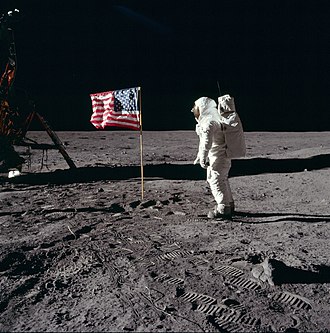
Astronaut Buzz Aldrin on the Moon in 1969, with Neil Armstrong and the Lunar Module Eagle reflected in his helmet visor.

What Was Apollo 11?

Apollo 11 was an American spaceflight in July 1969. It was the first mission to land humans on the Moon. It was the fifth crewed mission of NASA's Apollo program.

The crew was Neil Armstrong, Michael Collins, and Edwin "Buzz" Aldrin. They started their trip on July 16 from Kennedy Space Center in Florida.

Landing on the Moon

On July 20, Armstrong and Aldrin landed on the Moon in the Lunar Module called Eagle. They landed in the Sea of Tranquility. Armstrong was the first person to walk on the Moon. Aldrin followed him.

Collins stayed high above the Moon in the spacecraft Columbia. The two men collected lunar samples, which are rocks and dust from the Moon. They also planted an American flag.

The crew came safely home to Earth on July 24. They landed in the Pacific Ocean.

Why People Remember It

The mission was the high point of the Space Race. This was a friendly contest between the United States and the Soviet Union that grew out of the Cold War. President John F. Kennedy had set this big goal.

Many people watched the Moon walk on television. Armstrong said, "That's one small step for a man, one giant leap for mankind."

The crew received the Presidential Medal of Freedom for their hard work. Today, Columbia is kept at the National Air and Space Museum in Washington, D.C.

Quiz time!

3 questions about Apollo 11

Question 1 of 3

What was special about Apollo 11?

Pictures

Astronaut Buzz Aldrin salutes the American flag on the Moon during the Apollo 11 mission in 1969.
A silver Robbins medallion that flew on the Apollo 11 mission to the Moon in 1969. Neil Armstrong gave it to fellow astronaut Wally Schirra.
The Apollo 11 Saturn V rocket lifts off from Kennedy Space Center on July 16, 1969, carrying astronauts Neil Armstrong, Michael Collins, and Buzz Aldrin toward the Moon.
The official patch for the Apollo 11 mission, which landed the first humans on the Moon in 1969.
President John F. Kennedy giving his famous speech at Rice University in Texas in 1962, where he talked about America's goal of reaching the Moon.
Astronauts Charles Duke, James Lovell, and Fred Haise act as spacecraft communicators at the Johnson Space Center in Houston, keeping in touch with the Apollo 11 crew during their historic Moon landing on July 20, 1969.
The inside of the Apollo 11 Command Module Columbia, showing its control panels and instruments, on display at the National Air and Space Museum.
The Saturn V rocket SA-506, which carried the Apollo 11 spacecraft to the Moon, rolls slowly out of the Vehicle Assembly Building on its way to Launch Complex 39A at Kennedy Space Center in 1969.
The Apollo 11 Command and Service Modules photographed from the Lunar Module while orbiting the Moon, with craters and the Sea of Fertility visible below.
The Apollo 11 Lunar Module Eagle, shown in landing position, photographed from the Command and Service Module Columbia while orbiting the Moon.
An orbital photo from NASA's Lunar Reconnaissance Orbiter shows the Apollo 11 landing site, including West Crater and its boulders. The lunar module's descent stage, left behind by the Eagle crew, appears in the upper left.
Buzz Aldrin's bootprint in the powdery surface of the Moon, photographed during the Apollo 11 mission in 1969. Scientists studied it to learn how strong the lunar soil is.
A map of the Moon showing the possible landing sites considered for Apollo 11. The site that was finally chosen is marked as site 2.
A girl holding The Washington Post newspaper stating "'The Eagle Has Landed' – Two Men Walk on the Moon"
Apollo 11 Astronauts - New York City - August 13, 1969
Columbia on display in the Milestones of Flight exhibition hall at the National Air and Space Museum

Keep exploring

This article is a child-friendly adaptation of the Wikipedia article on Apollo 11, available under CC BY-SA 4.0.

Images from Wikimedia Commons. Tap any image to view credits and license.