Safekipedia

Joan of Arc

Explorer · ages 7 and underAdapted from Wikipedia
Jeanne d'Arc, a gilded bronze statue by Emmanuel Frémiet (1874, Place des Pyramides)

Who Was Joan of Arc?

Joan of Arc is a patron saint of France. People honor her as a brave defender of the French nation. She said that God guided her, and many people saw her as a savior of France.

A Young Girl from a Village

Joan was born in a farming family at Domrémy, a small village in north-east France. As a young girl, she helped at home, worked in the fields, and looked after the animals. She said that she had visions of the archangel Michael, Saint Margaret, and Saint Catherine. These visions gave her courage to help Charles VII of France.

A Helper for the King

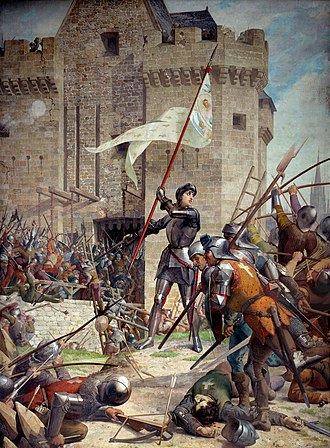
Charles VII sent Joan with an army to the siege of Orléans. Her arrival gave hope to the tired French soldiers, and the English gave up after nine days. Joan helped the French win an important victory at Patay. Then she brought Charles to Reims, where he was crowned king. These victories came during the Hundred Years' War, which was a difficult time when countries did not get along.

A Sad Ending and a Happy Memory

Joan was put on trial by Bishop Pierre Cauchon on charges of heresy. She passed away at about nineteen years old. Later, a church court said that her trial had been unfair. After the French Revolution, she became a national symbol of France.

Honored Around the World

In 1920, Joan of Arc was canonized by Pope Benedict XV. Many people still honor her today. She appears in numerous cultural works, including books, music, paintings, and films, so people all over the world know her story.

Quiz time!

3 questions about Joan of Arc

Question 1 of 3

Which country is Joan of Arc a patron saint of?

Pictures

Jean-Jacques Scherrer's painting shows Joan of Arc entering Orléans after her victory over the English, greeted with cheers by the people of the city.
A 15th-century manuscript from the National Library of France, with the Latin title of the trial that cleared Joan of Arc's name, calling her "Joan of Arc, known as the Maid."
A portrait of Charles VII of France, the king who ruled from 1422 to 1461, painted by Jean Fouquet and displayed at the Louvre Museum.
A 15th-century illustration from a French manuscript showing the coronation of King Charles VII at Reims Cathedral in 1429, with Joan of Arc holding a banner nearby.
An illustration of Joan of Arc riding on horseback, from a 1504 manuscript called Les vies des femmes célèbres (The Lives of Famous Women).
A painting by Louis Maurice Boutet de Monvel showing the trial of Joan of Arc, part of a series of artworks about her life.
A 15th-century manuscript painting of Bishop Pierre Cauchon, who led the church court that tried Joan of Arc in 1431.
A medieval manuscript painting from the book Vigiles du roi Charles VII, showing Joan of Arc, a French heroine, at the time of her death in 1431.
A life-size plaster sculpture in Noyon Cathedral showing a scene from the trial that cleared Joan of Arc's name, made by sculptor Émile Pinchon.
Joan of Arc, shown in awe as she receives a vision from the Archangel Michael, in this 1876 painting by Eugène Thirion.
A drawing of Joan of Arc made in 1429, found in the records of the Parliament of Paris, kept in the French National Archives.
A test image file showing how a transparent PNG overlay can be placed on a map.
France, 1429  Under the obedience of Charles VII of France  Under the obedience of Henry VI of England  Possessions of Philip III of Burgundy

Keep exploring

This article is a child-friendly adaptation of the Wikipedia article on Joan of Arc, available under CC BY-SA 4.0.

Images from Wikimedia Commons. Tap any image to view credits and license.