Orchestra
What Is an Orchestra?
An orchestra is a large group of musicians who play instruments together. Orchestras often play jazz and classical music. They bring together instruments from different families.
The word orchestra comes from a Greek word. It was the name for a space in front of the stage in ancient Greek theatre.
The Four Sections
Most orchestras have four main groups. The string section has the violin and the double bass. The woodwind section has the flute and the clarinet.
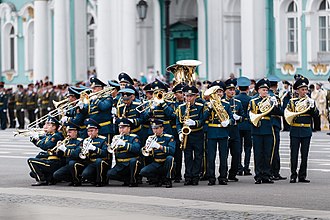
The brass section has the trumpet and the tuba. The percussion section has drums and cymbals. Some orchestras also have a piano.
A big orchestra can have seventy to more than one hundred musicians. A smaller group, called a chamber orchestra, has about fifty musicians or fewer.
The Conductor
Orchestras are usually led by a conductor. The conductor moves the hands and arms to guide the musicians. Often, the conductor holds a short wooden stick called a conductor's baton.
The conductor brings everyone together and helps set the speed of the music. The conductor also helps shape how the group sounds.
Orchestras Over Time
Orchestras grew larger over time. During the 1700s and 1800s, some orchestras became bigger than ever. The biggest ones had as many as 120 players in the works of Richard Wagner and later Gustav Mahler.
Orchestras play many kinds of music, including symphonies. They can also play music for operas and ballets.

Quiz time!
3 questions about Orchestra
What is an orchestra?
Pictures
Keep exploring


This article is a child-friendly adaptation of the Wikipedia article on Orchestra, available under CC BY-SA 4.0.
Images from Wikimedia Commons. Tap any image to view credits and license.