
Planetary nebula
Planetary Nebulae: Beautiful Clouds in Space
Planetary nebulae are glowing clouds of gas that come from stars like our Sun. When a star gets older, it throws off its outer layers. This makes a shiny shell of light around the hot core left behind. Even though we call them "planetary," they are not related to planets. A long time ago, astronomers thought they looked like planets through their telescopes, and the name stayed.
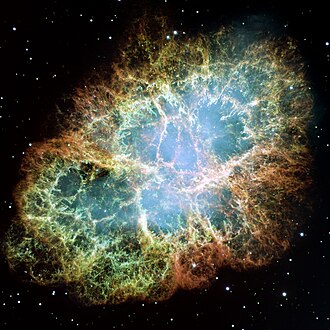
These glowing clouds only last for a short time—maybe a few thousand years. The Hubble Space Telescope has shown us that planetary nebulae come in many amazing shapes and colors. Some look like rings, and others have complex patterns. Scientists think that magnetic fields and winds may help create these different shapes.
Planetary nebulae are important because they spread new materials into space. This helps to build new stars and planets. One day, our own Sun will become a planetary nebula, sharing its elements with the Milky Way.
The first planetary nebula ever found was the Dumbbell Nebula in the constellation of Vulpecula. It was seen by Charles Messier in 1764 and listed as M27 in his catalogue of fuzzy objects in the night sky. Today, with better telescopes, we can see that planetary nebulae often have very beautiful shapes.
Planetary nebulae help our galaxy by adding heavier elements. As stars get older, they make heavier elements. They then blow these elements into space. These elements add to the Milky Way's supply of materials. When new stars form from this enriched material, they have more of these heavier elements. This affects how stars change and react over time.
Planetary nebulae are usually about one light year wide. They are made of very thin gas. The gas is heated by the hot star in the center. Only about 20% of these nebulae are perfectly round. They can have many different shapes. Some look like rings or have two lobes. Others are irregular. Scientists think the shapes might be influenced by magnetic fields or by companion stars orbiting the central star. These nebulae are found mostly in the plane of the Milky Way, especially near the Galactic Center.
Fun Shapes and Pictures
Here are some pictures of beautiful planetary nebulae:
Pictures
Keep exploring



This article is a child-friendly adaptation of the Wikipedia article on Planetary nebula, available under CC BY-SA 4.0.
Images from Wikimedia Commons. Tap any image to view credits and license.