 Safekipedia
In geometry, a quasiregular polyhedron is a special type of uniform polyhedron. It has two different kinds of regular faces that appear in an alternating pattern around each vertex. These shapes are both vertex-transitive and edge-transitive. This means you can move any vertex or edge to any other by a symmetry of the shape. They are more symmetrical than semiregular polyhedra, but not as symmetrical as regular polyhedra.
There are only two convex quasiregular polyhedra: the cuboctahedron and the icosidodecahedron. These shapes were named by the astronomer Kepler. Their faces are related to the faces of two dual pairs of regular polyhedra: the cube and octahedron for the cuboctahedron, and the icosahedron and dodecahedron for the icosidodecahedron. Each quasiregular polyhedron can be described using a special symbol called a Schläfli symbol. This symbol helps explain their symmetry and face arrangements.
Quasiregular patterns are not just for three dimensions. Flat patterns, called tilings, of the plane can also be quasiregular. One example is the trihexagonal tiling, where two different regular shapes fit together in a repeating pattern. Similar patterns can also exist on curved surfaces. This shows how these ideas go beyond simple solid shapes.
Wythoff construction
A quasiregular polyhedron can be described using a Wythoff symbol, which looks like p | q r. This helps show how the polyhedron is built. If either q is 2 or q equals r, then the shape is actually a regular polyhedron.
There is also a Coxeter-Dynkin diagram that helps us see how quasiregular polyhedra relate to each other. It shows the connection between two special shapes that are like mirror images of each other.
Main article: Wythoff symbol
Main article: Coxeter-Dynkin diagram
Regular (p | 2 q) and quasiregular polyhedra (2 | p q) are created from a Wythoff construction with the generator point at one of 3 corners of the fundamental domain. This defines a single edge within the fundamental domain. |
| Schläfli symbol | Coxeter diagram | Wythoff symbol | |
|---|---|---|---|
| { p , q } {\displaystyle {\begin{Bmatrix}p,q\end{Bmatrix}}} | {p,q} |     | q | 2 p |
| { q , p } {\displaystyle {\begin{Bmatrix}q,p\end{Bmatrix}}} | {q,p} | | p | 2 q |
| { p q } {\displaystyle {\begin{Bmatrix}p\\q\end{Bmatrix}}} | r{p,q} | or   | 2 | p q |
The convex quasiregular polyhedra
Further information: Rectification (geometry)
There are two special 3D shapes called quasiregular polyhedra. The first is the cuboctahedron. It has triangle and square faces that change around each corner. The second is the icosidodecahedron. It has triangle and pentagon faces. Both shapes are fair and balanced. Every corner looks the same and every edge is the same length.
These shapes are linked to pairs of regular polyhedra. The cuboctahedron is linked to the cube and octahedron. The icosidodecahedron is linked to the icosahedron and dodecahedron. They can be made by changing the corners of these regular shapes. This reduces each original edge to its midpoint.
| Regular | Dual regular | Quasiregular common core | Vertex figure |
|---|---|---|---|
 Tetrahedron {3,3}  3 | 2 3 |  Tetrahedron {3,3} 3 | 2 3 |  Tetratetrahedron r{3,3} 2 | 3 3 | 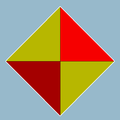 3.3.3.3 |
 Cube {4,3}  3 | 2 4 | 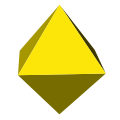 Octahedron {3,4} 4 | 2 3 |  Cuboctahedron r{3,4} 2 | 3 4 |  3.4.3.4 |
 Dodecahedron {5,3}  3 | 2 5 |  Icosahedron {3,5} 5 | 2 3 |  Icosidodecahedron r{3,5} 2 | 3 5 |  3.5.3.5 |
| Regular | Dual regular | Quasiregular combination | Vertex figure |
|---|---|---|---|
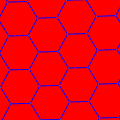 Hexagonal tiling {6,3}  6 | 2 3 | 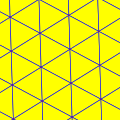 Triangular tiling {3,6} 3 | 2 6 | 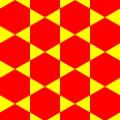 Trihexagonal tiling r{6,3} 2 | 3 6 |  (3.6)2 |
| Regular | Dual regular | Quasiregular combination | Vertex figure |
|---|---|---|---|
 {4,4} 4 | 2 4 | 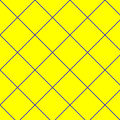 {4,4} 4 | 2 4 |  r{4,4} 2 | 4 4 |  (4.4)2 |
 h{6,3} 3 | 3 3   = =  |
| Regular | Dual regular | Quasiregular combination | Vertex figure |
|---|---|---|---|
 Heptagonal tiling {7,3}  7 | 2 3 |  Triangular tiling {3,7} 3 | 2 7 | 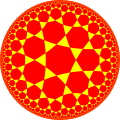 Triheptagonal tiling r{3,7} 2 | 3 7 | 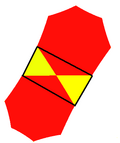 (3.7)2 |
Nonconvex examples
Coxeter, H.S.M. and others (1954) also call some star polyhedra quasiregular. These shapes look like regular polyhedra but have star-like forms.
Two key examples come from pairs of regular Kepler–Poinsot solids: the great icosidodecahedron and the dodecadodecahedron. There are also nine hemipolyhedra, special forms made by changing regular polyhedra. Finally, there are three ditrigonal forms based on the regular dodecahedron. In flat patterns, this idea continues with four star tilings that include apeirogons as special shapes.
| Regular | Dual regular | Quasiregular common core | Vertex figure |
|---|---|---|---|
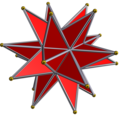 Great stellated dodecahedron {5/2,3}   3 | 2 5/2 |  Great icosahedron {3,5/2} 5/2 | 2 3 |  Great icosidodecahedron r{3,5/2} 2 | 3 5/2 |  3.5/2.3.5/2 |
 Small stellated dodecahedron {5/2,5} 5 | 2 5/2 |  Great dodecahedron {5,5/2} 5/2 | 2 5 | 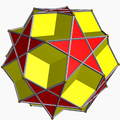 Dodecadodecahedron r{5,5/2} 2 | 5 5/2 |  5.5/2.5.5/2 |
| Quasiregular (rectified) | 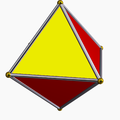 Tetratetrahedron |  Cuboctahedron |  Icosidodecahedron | Great icosidodecahedron | Dodecadodecahedron |
|---|---|---|---|---|---|
| Quasiregular (hemipolyhedra) |  Tetrahemihexahedron 3/2 3 | 2 | 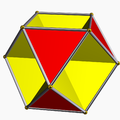 Octahemioctahedron 3/2 3 | 3 |  Small icosihemidodecahedron 3/2 3 | 5 |  Great icosihemidodecahedron 3/2 3 | 5/3 | 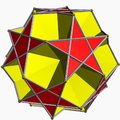 Small dodecahemicosahedron 5/3 5/2 | 3 |
| Vertex figure |  3.4.3/2.4 |  3.6.3/2.6 |  3.10.3/2.10 |  3.10/3.3/2.10/3 |  5/2.6.5/3.6 |
| Quasiregular (hemipolyhedra) | 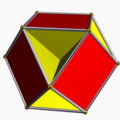 Cubohemioctahedron 4/3 4 | 3 |  Small dodecahemidodecahedron 5/4 5 | 5 |  Great dodecahemidodecahedron 5/3 5/2 | 5/3 |  Great dodecahemicosahedron 5/4 5 | 3 | |
| Vertex figure |  4.6.4/3.6 |  5.10.5/4.10 |  5/2.10/3.5/3.10/3 | 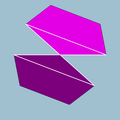 5.6.5/4.6 |
| Image | Faceted form Wythoff symbol Coxeter diagram | Vertex figure |
|---|---|---|
| Ditrigonal dodecadodecahedron 3 | 5/3 5  or or   | (5.5/3)3 | |
| Small ditrigonal icosidodecahedron 3 | 5/2 3  or or | (3.5/2)3 | |
| Great ditrigonal icosidodecahedron 3/2 | 3 5  or or | ((3.5)3)/2 |
| Original rectified tiling | Edge diagram | Solid | Vertex Config | Wythoff | Symmetry group |
|---|---|---|---|---|---|
Square tiling | 4.∞.4/3.∞ 4.∞.-4.∞ | 4/3 4 | ∞ | p4m | ||
Triangular tiling | (3.∞.3.∞.3.∞)/2 | 3/2 | 3 ∞ | p6m | ||
Trihexagonal tiling | 6.∞.6/5.∞ 6.∞.-6.∞ | 6/5 6 | ∞ | |||
| ∞.3.∞.3/2 ∞.3.∞.-3 | 3/2 3 | ∞ |
Quasiregular duals
Some people think that the shapes made by flipping quasiregular solids should also be called quasiregular because they share the same symmetries. These flipped shapes are special because they treat their edges and faces the same, but not their vertices. They are known as edge-transitive Catalan solids. The convex ones include:
- The rhombic dodecahedron, which has two kinds of vertices that alternate. Eight vertices have three rhombic faces each, and six vertices have four rhombic faces each.
- The rhombic triacontahedron, which also has two kinds of alternating vertices. Twenty vertices have three rhombic faces each, and twelve vertices have five rhombic faces each.
Additionally, the cube, which is usually considered a regular shape, can be viewed as quasiregular if we color its vertices alternately. These special shapes all have rhombic faces, and this pattern continues in tilings like the rhombille tiling.
| Cube V(3.3)2  | Rhombic dodecahedron V(3.4)2 | Rhombic triacontahedron V(3.5)2 | Rhombille tiling V(3.6)2 | V(3.7)2 | V(3.8)2 |
Quasiregular polytopes and honeycombs
In higher dimensions, a quasiregular polytope or honeycomb has regular pieces and special points where these pieces meet. All these meeting points are the same, and there are two kinds of pieces that take turns around each point.
In four-dimensional space, the regular 16-cell can be viewed as quasiregular. It is made of alternating tetrahedron and tetrahedron pieces. In three-dimensional space, the only quasiregular structure is the alternated cubic honeycomb, made of alternating tetrahedral and octahedral pieces. In hyperbolic three-dimensional space, there is a quasiregular honeycomb made of alternating tetrahedral and icosahedral pieces.
Images
This article is a child-friendly adaptation of the Wikipedia article on Quasiregular polyhedron, available under CC BY-SA 4.0.
Images from Wikimedia Commons. Tap any image to view credits and license.