 Safekipedia
In geometry, a uniform polyhedron is a special 3D shape made of regular polygons as its faces. It is called "uniform" because it is vertex-transitive. This means any corner can be moved to any other corner without changing the shape. All the corners are congruent, meaning they are all the same size and shape.
Uniform polyhedra can be regular, quasi-regular, or semi-regular. They do not have to be convex, so some are star-shaped. There are two endless groups of uniform polyhedra: prisms and antiprisms. There are also 75 other special uniform polyhedra. These include the famous 5 Platonic solids like the regular tetrahedron, 13 Archimedean solids like the cuboctahedron, 4 Kepler–Poinsot polyhedra like the small stellated dodecahedron, and 53 uniform star polyhedra, including the snub dodecadodecahedron.
The shapes that are the "dual" of uniform polyhedra, called dual polyhedra, are special too. They are face-transitive and have regular vertex figures. The dual of a regular polyhedron is also regular, and the dual of an Archimedean solid is a Catalan solid. The idea of a uniform polyhedron is part of a bigger idea called a uniform polytope, which includes shapes in more than three dimensions.
Definition
Uniform polyhedra are special 3D shapes made of regular polygons. In these shapes, each corner, or vertex, looks the same. This means you can move any vertex to any other vertex and the shape will look identical.
There are different types of uniform polyhedra. Some are regular, meaning every face, edge, and vertex are the same. Others are quasi-regular or semi-regular, which have different rules about how their faces and edges match up. These shapes can sometimes fit together perfectly.
History
The study of uniform polyhedra started a long time ago with the ancient Greeks. They looked at five special shapes called Platonic solids. In these shapes, every face, edge, and vertex looks the same. Famous thinkers like Plato and Euclid studied these shapes.
Later, more mathematicians found new and more complicated shapes. Archimedes discovered 13 special solids that mix different regular polygons. In the 1500s, Piero della Francesca found some of these shapes again and worked out their properties. As time went on, other mathematicians like Kepler and Coxeter added more to what we know, finding new star-shaped polyhedra and listing all of these interesting geometric shapes.
Uniform star polyhedra
Main article: Uniform star polyhedron
Uniform star polyhedra are special shapes in geometry. There are 57 different forms that are not regular solids and look different from everyday shapes. These shapes are made using a method called Wythoff constructions and are linked to special triangles known as Schwarz triangles, except for one shape called the great dirhombicosidodecahedron.
Convex forms by Wythoff construction
Convex uniform polyhedra can be named using Wythoff construction from regular shapes. These polyhedra have regular polygons as faces and are symmetric. This means any vertex can be moved to any other vertex by turning the shape.
The Wythoff construction uses different symmetry groups. For example, a cube is a regular polyhedron and also a square prism. The octahedron is a regular polyhedron, a triangular antiprism, and also a rectified tetrahedron. Many shapes can look different in various constructions with different colors. The construction also works for shapes that cover the surface of a sphere, like hosohedra and dihedra. These symmetry groups come from reflectional point groups in three dimensions.
| Johnson name | Parent | Truncated | Rectified | Bitruncated (tr. dual) | Birectified (dual) | Cantellated | Omnitruncated (cantitruncated) | Snub |
|---|---|---|---|---|---|---|---|---|
| Coxeter diagram |     | |   | | |  | |   |
| Extended Schläfli symbol | { p , q } {\displaystyle {\begin{Bmatrix}p,q\end{Bmatrix}}} | t { p , q } {\displaystyle t{\begin{Bmatrix}p,q\end{Bmatrix}}} | { p q } {\displaystyle {\begin{Bmatrix}p\\q\end{Bmatrix}}} | t { q , p } {\displaystyle t{\begin{Bmatrix}q,p\end{Bmatrix}}} | { q , p } {\displaystyle {\begin{Bmatrix}q,p\end{Bmatrix}}} | r { p q } {\displaystyle r{\begin{Bmatrix}p\\q\end{Bmatrix}}} | t { p q } {\displaystyle t{\begin{Bmatrix}p\\q\end{Bmatrix}}} | s { p q } {\displaystyle s{\begin{Bmatrix}p\\q\end{Bmatrix}}} |
| {p,q} | t{p,q} | r{p,q} | 2t{p,q} | 2r{p,q} | rr{p,q} | tr{p,q} | sr{p,q} | |
| t0{p,q} | t0,1{p,q} | t1{p,q} | t1,2{p,q} | t2{p,q} | t0,2{p,q} | t0,1,2{p,q} | ht0,1,2{p,q} | |
| Wythoff symbol (p q 2) | q | p 2 | 2 q | p | 2 | p q | 2 p | q | p | q 2 | p q | 2 | p q 2 | | | p q 2 |
| Vertex figure | pq | q.2p.2p | (p.q)2 | p. 2q.2q | qp | p. 4.q.4 | 4.2p.2q | 3.3.p. 3.q |
| Tetrahedral (3 3 2) |  3.3.3 |  3.6.6 |  3.3.3.3 |  3.6.6 |  3.3.3 |  3.4.3.4 |  4.6.6 | 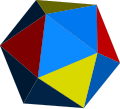 3.3.3.3.3 |
| Octahedral (4 3 2) |  4.4.4 |  3.8.8 |  3.4.3.4 |  4.6.6 | 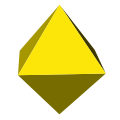 3.3.3.3 |  3.4.4.4 | 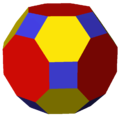 4.6.8 |  3.3.3.3.4 |
| Icosahedral (5 3 2) |  5.5.5 |  3.10.10 |  3.5.3.5 | 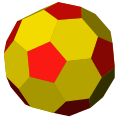 5.6.6 |  3.3.3.3.3 | 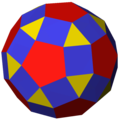 3.4.5.4 |  4.6.10 | 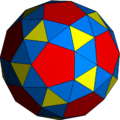 3.3.3.3.5 |
| (p 2 2) | Parent | Truncated | Rectified | Bitruncated (tr. dual) | Birectified (dual) | Cantellated | Omnitruncated (cantitruncated) | Snub |
|---|---|---|---|---|---|---|---|---|
| Coxeter diagram |  | | | | | | |  |
| Extended Schläfli symbol | { p , 2 } {\displaystyle {\begin{Bmatrix}p,2\end{Bmatrix}}} | t { p , 2 } {\displaystyle t{\begin{Bmatrix}p,2\end{Bmatrix}}} | { p 2 } {\displaystyle {\begin{Bmatrix}p\\2\end{Bmatrix}}} | t { 2 , p } {\displaystyle t{\begin{Bmatrix}2,p\end{Bmatrix}}} | { 2 , p } {\displaystyle {\begin{Bmatrix}2,p\end{Bmatrix}}} | r { p 2 } {\displaystyle r{\begin{Bmatrix}p\\2\end{Bmatrix}}} | t { p 2 } {\displaystyle t{\begin{Bmatrix}p\\2\end{Bmatrix}}} | s { p 2 } {\displaystyle s{\begin{Bmatrix}p\\2\end{Bmatrix}}} |
| {p,2} | t{p,2} | r{p,2} | 2t{p,2} | 2r{p,2} | rr{p,2} | tr{p,2} | sr{p,2} | |
| t0{p,2} | t0,1{p,2} | t1{p,2} | t1,2{p,2} | t2{p,2} | t0,2{p,2} | t0,1,2{p,2} | ht0,1,2{p,2} | |
| Wythoff symbol | 2 | p 2 | 2 2 | p | 2 | p 2 | 2 p | 2 | p | 2 2 | p 2 | 2 | p 2 2 | | | p 2 2 |
| Vertex figure | p2 | 2.2p.2p | p. 2.p. 2 | p. 4.4 | 2p | p. 4.2.4 | 4.2p.4 | 3.3.3.p |
| Dihedral (2 2 2) |  {2,2} |  2.4.4 | 2.2.2.2 | 4.4.2 | 2.2 | 2.4.2.4 |  4.4.4 |  3.3.3.2 |
| Dihedral (3 2 2) |  3.3 |  2.6.6 | 2.3.2.3 |  4.4.3 | 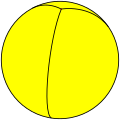 2.2.2 | 2.4.3.4 |  4.4.6 | 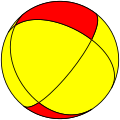 3.3.3.3 |
| Dihedral (4 2 2) | 4.4 | 2.8.8 | 2.4.2.4 | 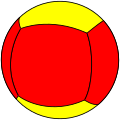 4.4.4 |  2.2.2.2 | 2.4.4.4 |  4.4.8 |  3.3.3.4 |
| Dihedral (5 2 2) |  5.5 | 2.10.10 | 2.5.2.5 |  4.4.5 |  2.2.2.2.2 | 2.4.5.4 |  4.4.10 |  3.3.3.5 |
| Dihedral (6 2 2) | 6.6 | 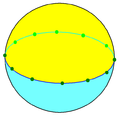 2.12.12 | 2.6.2.6 |  4.4.6 |  2.2.2.2.2.2 | 2.4.6.4 |  4.4.12 |  3.3.3.6 |
| # | Name | Graph A3 | Graph A2 | Picture | Tiling | Vertex figure | Coxeter and Schläfli symbols | Face counts by position | Element counts | ||||
|---|---|---|---|---|---|---|---|---|---|---|---|---|---|
Pos. 2 (4) | Pos. 1 (6) | Pos. 0 (4) | Faces | Edges | Vertices | ||||||||
| 1 | Tetrahedron |  |  |  |  |  | {3,3} |  {3} | 4 | 6 | 4 | ||
| Birectified tetrahedron (same as tetrahedron) | | |  |  | | t2{3,3}={3,3} | {3} | 4 | 6 | 4 | |||
| 2 | Rectified tetrahedron Tetratetrahedron (same as octahedron) |  |  |  |  |  | t1{3,3}=r{3,3} | {3} | {3} | 8 | 12 | 6 | |
| 3 | Truncated tetrahedron |  |  |  |  |  | t0,1{3,3}=t{3,3} |  {6} | {3} | 8 | 18 | 12 | |
| Bitruncated tetrahedron (same as truncated tetrahedron) | | |  |  | | t1,2{3,3}=t{3,3} | {3} | {6} | 8 | 18 | 12 | ||
| 4 | Cantellated tetrahedron Rhombitetratetrahedron (same as cuboctahedron) |  |  |  |  |  | t0,2{3,3}=rr{3,3} | {3} |  {4} | {3} | 14 | 24 | 12 |
| 5 | Omnitruncated tetrahedron Truncated tetratetrahedron (same as truncated octahedron) |  |  |  |  |  | t0,1,2{3,3}=tr{3,3} | {6} | {4} | {6} | 14 | 36 | 24 |
| 6 | Snub tetratetrahedron (same as icosahedron) |  |  |  |  |  | sr{3,3} | {3} |  2 {3} | {3} | 20 | 30 | 12 |
| # | Name | Graph B3 | Graph B2 | Picture | Tiling | Vertex figure | Coxeter and Schläfli symbols | Face counts by position | Element counts | ||||
|---|---|---|---|---|---|---|---|---|---|---|---|---|---|
Pos. 2 (6) | Pos. 1 (12) | Pos. 0 (8) | Faces | Edges | Vertices | ||||||||
| 7 | Cube |  |  |  |  |  | {4,3} | {4} | 6 | 12 | 8 | ||
| Octahedron |  |  |  |  | | {3,4} | {3} | 8 | 12 | 6 | |||
| Rectified cube Rectified octahedron (Cuboctahedron) |  |  |  |  | | {4,3} | {4} | {3} | 14 | 24 | 12 | ||
| 8 | Truncated cube |  |  |  |  |  | t0,1{4,3}=t{4,3} |  {8} | {3} | 14 | 36 | 24 | |
| Truncated octahedron |  |  |  |  | | t0,1{3,4}=t{3,4} | {4} | {6} | 14 | 36 | 24 | ||
| 9 | Cantellated cube Cantellated octahedron Rhombicuboctahedron |  |  |  |  |  | t0,2{4,3}=rr{4,3} | {4} | {4} | {3} | 26 | 48 | 24 |
| 10 | Omnitruncated cube Omnitruncated octahedron Truncated cuboctahedron |  |  |  |  |  | t0,1,2{4,3}=tr{4,3} | {8} | {4} | {6} | 26 | 72 | 48 |
| Snub octahedron (same as Icosahedron) |  |  |  |  | | =  s{3,4}=sr{3,3} | {3} | {3} | 20 | 30 | 12 | ||
| Half cube (same as Tetrahedron) | | | | | |  =  h{4,3}={3,3} | 1/2 {3} | 4 | 6 | 4 | |||
| Cantic cube (same as Truncated tetrahedron) | | | | | | = h2{4,3}=t{3,3} | 1/2 {6} | 1/2 {3} | 8 | 18 | 12 | ||
| (same as Cuboctahedron) | | | | | |  = rr{3,3} | 14 | 24 | 12 | ||||
| (same as Truncated octahedron) | | | | | | = tr{3,3} | 14 | 36 | 24 | ||||
| Cantic snub octahedron (same as Rhombicuboctahedron) | | |  | | | s2{3,4}=rr{3,4} | 26 | 48 | 24 | ||||
| 11 | Snub cuboctahedron |  |  |  |  |  | sr{4,3} | {4} | 2 {3} | {3} | 38 | 60 | 24 |
| # | Name | Graph (A2) | Graph (H3) | Picture | Tiling | Vertex figure | Coxeter and Schläfli symbols | Face counts by position | Element counts | ||||
|---|---|---|---|---|---|---|---|---|---|---|---|---|---|
Pos. 2 (12) | Pos. 1 (30) | Pos. 0 (20) | Faces | Edges | Vertices | ||||||||
| 12 | Dodecahedron |  |  |  |  |  | {5,3} |  {5} | 12 | 30 | 20 | ||
| Icosahedron |  |  |  |  | | {3,5} | {3} | 20 | 30 | 12 | |||
| 13 | Rectified dodecahedron Rectified icosahedron Icosidodecahedron |  |  |  |  |  | t1{5,3}=r{5,3} | {5} | {3} | 32 | 60 | 30 | |
| 14 | Truncated dodecahedron |  |  |  |  |  | t0,1{5,3}=t{5,3} |  {10} | {3} | 32 | 90 | 60 | |
| 15 | Truncated icosahedron |  |  |  |  |  | t0,1{3,5}=t{3,5} | {5} | {6} | 32 | 90 | 60 | |
| 16 | Cantellated dodecahedron Cantellated icosahedron Rhombicosidodecahedron |  |  |  |  |  | t0,2{5,3}=rr{5,3} | {5} | {4} | {3} | 62 | 120 | 60 |
| 17 | Omnitruncated dodecahedron Omnitruncated icosahedron Truncated icosidodecahedron |  |  |  |  |  | t0,1,2{5,3}=tr{5,3} | {10} | {4} | {6} | 62 | 180 | 120 |
| 18 | Snub icosidodecahedron |  |  |  |  |  | sr{5,3} | {5} | 2 {3} | {3} | 92 | 150 | 60 |
| # | Name | Picture | Tiling | Vertex figure | Coxeter and Schläfli symbols | Face counts by position | Element counts | ||||
|---|---|---|---|---|---|---|---|---|---|---|---|
| Pos. 2 (2) | Pos. 1 (2) | Pos. 0 (2) | Faces | Edges | Vertices | ||||||
| D2 H2 | Digonal dihedron, digonal hosohedron |  | {2,2} |  {2} | 2 | 2 | 2 | ||||
| D4 | Truncated digonal dihedron (same as square dihedron) |  | t{2,2}={4,2} | {4} | 2 | 4 | 4 | ||||
| P4 | Omnitruncated digonal dihedron (same as cube) |  |  | | t0,1,2{2,2}=tr{2,2} | {4} | {4} | {4} | 6 | 12 | 8 |
| A2 | Snub digonal dihedron (same as tetrahedron) | |  | | sr{2,2} | 2 {3} | 4 | 6 | 4 | ||
| # | Name | Picture | Tiling | Vertex figure | Coxeter and Schläfli symbols | Face counts by position | Element counts | ||||
|---|---|---|---|---|---|---|---|---|---|---|---|
| Pos. 2 (2) | Pos. 1 (3) | Pos. 0 (3) | Faces | Edges | Vertices | ||||||
| D3 | Trigonal dihedron |  | {3,2} | {3} | 2 | 3 | 3 | ||||
| H3 | Trigonal hosohedron |  | {2,3} | {2} | 3 | 3 | 2 | ||||
| D6 | Truncated trigonal dihedron (same as hexagonal dihedron) |  | t{3,2} | {6} | 2 | 6 | 6 | ||||
| P3 | Truncated trigonal hosohedron (Triangular prism) |  |  |  | t{2,3} | {3} | {4} | 5 | 9 | 6 | |
| P6 | Omnitruncated trigonal dihedron (Hexagonal prism) |  |  |  | t0,1,2{2,3}=tr{2,3} | {6} | {4} | {4} | 8 | 18 | 12 |
| A3 | Snub trigonal dihedron (same as Triangular antiprism) (same as octahedron) |  |  | | sr{2,3} | {3} | 2 {3} | 8 | 12 | 6 | |
| P3 | Cantic snub trigonal dihedron (Triangular prism) | | | | s2{2,3}=t{2,3} | 5 | 9 | 6 | |||
| # | Name | Picture | Tiling | Vertex figure | Coxeter and Schläfli symbols | Face counts by position | Element counts | ||||
|---|---|---|---|---|---|---|---|---|---|---|---|
| Pos. 2 (2) | Pos. 1 (4) | Pos. 0 (4) | Faces | Edges | Vertices | ||||||
| D4 | square dihedron | | {4,2} | {4} | 2 | 4 | 4 | ||||
| H4 | square hosohedron |  | {2,4} | {2} | 4 | 4 | 2 | ||||
| D8 | Truncated square dihedron (same as octagonal dihedron) | t{4,2} | {8} | 2 | 8 | 8 | |||||
| P4 | Truncated square hosohedron (Cube) |  |  | | t{2,4} | {4} | {4} | 6 | 12 | 8 | |
| D8 | Omnitruncated square dihedron (Octagonal prism) |  |  |  | t0,1,2{2,4}=tr{2,4} | {8} | {4} | {4} | 10 | 24 | 16 |
| A4 | Snub square dihedron (Square antiprism) |  |  |  | sr{2,4} | {4} | 2 {3} | 10 | 16 | 8 | |
| P4 | Cantic snub square dihedron (Cube) | | | | s2{4,2}=t{2,4} | 6 | 12 | 8 | |||
| A2 | Snub square hosohedron (Digonal antiprism) (Tetrahedron) | | | | s{2,4}=sr{2,2} | 4 | 6 | 4 | |||
| # | Name | Picture | Tiling | Vertex figure | Coxeter and Schläfli symbols | Face counts by position | Element counts | ||||
|---|---|---|---|---|---|---|---|---|---|---|---|
| Pos. 2 (2) | Pos. 1 (5) | Pos. 0 (5) | Faces | Edges | Vertices | ||||||
| D5 | Pentagonal dihedron |  | {5,2} | {5} | 2 | 5 | 5 | ||||
| H5 | Pentagonal hosohedron |  | {2,5} | {2} | 5 | 5 | 2 | ||||
| D10 | Truncated pentagonal dihedron (same as decagonal dihedron) | t{5,2} | {10} | 2 | 10 | 10 | |||||
| P5 | Truncated pentagonal hosohedron (same as pentagonal prism) |  |  |  | t{2,5} | {5} | {4} | 7 | 15 | 10 | |
| P10 | Omnitruncated pentagonal dihedron (Decagonal prism) |  |  |  | t0,1,2{2,5}=tr{2,5} | {10} | {4} | {4} | 12 | 30 | 20 |
| A5 | Snub pentagonal dihedron (Pentagonal antiprism) |  |  |  | sr{2,5} | {5} | 2 {3} | 12 | 20 | 10 | |
| P5 | Cantic snub pentagonal dihedron (Pentagonal prism) | | | | s2{5,2}=t{2,5} | 7 | 15 | 10 | |||
| # | Name | Picture | Tiling | Vertex figure | Coxeter and Schläfli symbols | Face counts by position | Element counts | ||||
|---|---|---|---|---|---|---|---|---|---|---|---|
Pos. 2 (2) | Pos. 1 (6) | Pos. 0 (6) | Faces | Edges | Vertices | ||||||
| D6 | Hexagonal dihedron | | {6,2} | {6} | 2 | 6 | 6 | ||||
| H6 | Hexagonal hosohedron |  | {2,6} | {2} | 6 | 6 | 2 | ||||
| D12 | Truncated hexagonal dihedron (same as dodecagonal dihedron) |  | t{6,2} | {12} | 2 | 12 | 12 | ||||
| H6 | Truncated hexagonal hosohedron (same as hexagonal prism) | |  | | t{2,6} | {6} | {4} | 8 | 18 | 12 | |
| P12 | Omnitruncated hexagonal dihedron (Dodecagonal prism) |  |  |  | t0,1,2{2,6}=tr{2,6} | {12} | {4} | {4} | 14 | 36 | 24 |
| A6 | Snub hexagonal dihedron (Hexagonal antiprism) |  |  |  | sr{2,6} | {6} | 2 {3} | 14 | 24 | 12 | |
| P3 | Cantic hexagonal dihedron (Triangular prism) | | | | = h2{6,2}=t{2,3} | 5 | 9 | 6 | |||
| P6 | Cantic snub hexagonal dihedron (Hexagonal prism) | | | | s2{6,2}=t{2,6} | 8 | 18 | 12 | |||
| A3 | Snub hexagonal hosohedron (same as Triangular antiprism) (same as octahedron) | | | | s{2,6}=sr{2,3} | 8 | 12 | 6 | |||
Wythoff construction operators
The Wythoff construction is a way to make uniform polyhedra. It starts with a regular polygon and adds new faces in a symmetrical way. These operators help build different uniform polyhedra. They make sure all vertices are the same and the faces are regular polygons. This is important for studying geometry and understanding the symmetry of 3D shapes.
| Operation | Symbol | Coxeter diagram | Description |
|---|---|---|---|
| Parent | {p,q} t0{p,q} | | Any regular polyhedron or tiling |
| Rectified (r) | r{p,q} t1{p,q} | | The edges are fully truncated into single points. The polyhedron now has the combined faces of the parent and dual. Polyhedra are named by the number of sides of the two regular forms: {p,q} and {q,p}, like cuboctahedron for r{4,3} between a cube and octahedron. |
| Birectified (2r) (also dual) | 2r{p,q} t2{p,q} | | The birectified (dual) is a further truncation so that the original faces are reduced to points. New faces are formed under each parent vertex. The number of edges is unchanged and are rotated 90 degrees. A birectification can be seen as the dual. |
| Truncated (t) | t{p,q} t0,1{p,q} | | Each original vertex is cut off, with a new face filling the gap. Truncation has a degree of freedom, which has one solution that creates a uniform truncated polyhedron. The polyhedron has its original faces doubled in sides, and contains the faces of the dual. |
| Bitruncated (2t) (also truncated dual) | 2t{p,q} t1,2{p,q} | | A bitruncation can be seen as the truncation of the dual. A bitruncated cube is a truncated octahedron. |
| Cantellated (rr) (Also expanded) | rr{p,q} | | In addition to vertex truncation, each original edge is beveled with new rectangular faces appearing in their place. A uniform cantellation is halfway between both the parent and dual forms. A cantellated polyhedron is named as a rhombi-r{p,q}, like rhombicuboctahedron for rr{4,3}. |
| Cantitruncated (tr) (Also omnitruncated) | tr{p,q} t0,1,2{p,q} | | The truncation and cantellation operations are applied together to create an omnitruncated form which has the parent's faces doubled in sides, the dual's faces doubled in sides, and squares where the original edges existed. |
| Operation | Symbol | Coxeter diagram | Description |
|---|---|---|---|
| Snub rectified (sr) | sr{p,q} | | The alternated cantitruncated. All the original faces end up with half as many sides, and the squares degenerate into edges. Since the omnitruncated forms have 3 faces/vertex, new triangles are formed. Usually these alternated faceting forms are slightly deformed thereafter in order to end again as uniform polyhedra. The possibility of the latter variation depends on the degree of freedom. |
| Snub (s) | s{p,2q} | | Alternated truncation |
| Cantic snub (s2) | s2{p,2q} | | |
| Alternated cantellation (hrr) | hrr{2p,2q} | | Only possible in uniform tilings (infinite polyhedra), alternation of For example, |
| Half (h) | h{2p,q} | | Alternation of , same as    |
| Cantic (h2) | h2{2p,q} | | Same as |
| Half rectified (hr) | hr{2p,2q} | | Only possible in uniform tilings (infinite polyhedra), alternation of , same as    or or    For example, =  or or |
| Quarter (q) | q{2p,2q} | | Only possible in uniform tilings (infinite polyhedra), same as    For example, = or  |
Images
This article is a child-friendly adaptation of the Wikipedia article on Uniform polyhedron, available under CC BY-SA 4.0.
Images from Wikimedia Commons. Tap any image to view credits and license.