 Safekipedia
Marine life
Adapted from Wikipedia · Discoverer experience
Marine life, also known as sea life or ocean life, refers to all the living things that live in salt water habitats. These include animals, plants, algae, fungi, microorganisms, and viruses in oceans, seas, and other salty or brackish waters. Scientists have documented over 242,000 marine species, with many more still waiting to be discovered. The study of marine life involves many areas of science, especially marine biology.
Oceans cover about 90% of Earth's living space and were the birthplace of life on our planet. The earliest life forms were simple creatures that lived near deep sea hydrothermal vents. Over time, more complex life evolved in the oceans. Today, marine species range from tiny plankton to the enormous blue whale.
Marine life plays a crucial role in our world. Tiny plants and bacteria in the ocean produce much of the oxygen we breathe and help remove carbon dioxide from the atmosphere. Some marine animals, like fish that travel long distances, help move energy and nutrients across different parts of the planet. Others, like corals, build reefs that create new land and protect shorelines. All these creatures are important parts of Earth's ecosystems.
Water
See also: Hydrosphere
Water is essential for all life. It can exist as a solid, liquid, and gas, which makes it unique on Earth. Our planet has lots of surface water, mostly in oceans, but also in lakes, rivers, and underground. The deepest part of the ocean is the Challenger Deep in the Mariana Trench, which is very deep.
Most of Earth's water is salty, found in oceans, while a small amount is fresh water, stored in ice or glaciers. Oceans play a big role in controlling Earth's climate. Besides Earth, moons like Europa and Enceladus might have hidden oceans that could possibly support life.
Evolution
Further information: Evolutionary history of life and Timeline of evolutionary history of life
The Earth is about 4.54 billion years old, and the earliest signs of life appeared around 3.5 billion years ago. Scientists have found tiny fossils in rocks from Western Australia and other evidence in Western Greenland. All living things on Earth share a common ancestor, meaning they all came from one original source long ago.
Over time, life has changed and evolved. Simple cells were the first forms of life, and later, more complex cells developed. Around 610 million years ago, the first animals with many cells appeared in the oceans. A big burst of new animal life happened about 530 million years ago, called the Cambrian explosion. Plants and animals slowly moved onto land about 500 million years ago, with insects becoming very successful. Today, there are estimates of between 10 million to 14 million species on Earth, but only about 1.2 million have been named by scientists.
Microorganisms
Main article: Marine microorganism
Microorganisms make up about 70% of the marine biomass. A microorganism, or microbe, is a tiny organism too small to be seen without a microscope. It can be made of one cell or many cells. Microorganisms include bacteria, archaea, most protozoa such as algae, fungi, and some tiny animals like rotifers.
Microorganisms are very important for recycling nutrients in nature because they help break things down. Some microorganisms can cause diseases in plants and animals. They play a big role in the ocean, where they are involved in processes like creating oxygen and recycling carbon and other important elements.
Microscopic sea life is very diverse and we still have a lot to learn about it, especially the role of tiny viruses in the ocean. Many ocean viruses are harmless to plants and animals but they are very important for controlling the growth of bacteria and recycling carbon in the sea. The tiny particles released when these viruses break down bacteria can help feed other tiny sea creatures and plants.
A lot of tiny living things float around in the air above weather systems, but most of them come from the ocean. Scientists found that every day, hundreds of millions of viruses and tens of millions of bacteria fall down on every square meter of Earth’s surface.
Tiny organisms live almost everywhere, even in very deep or very hot places. Some have been found more than 10,900 meters deep in the ocean, and others live inside rocks under the sea floor. The hottest place where we know tiny life can survive is at 122°C (252°F). Scientists have also found tiny life under the ice in Antarctica.
Marine viruses
Main article: Marine viruses
Viruses are tiny infectious agents that cannot live on their own and need to get inside the cells of other organisms to multiply. They can infect animals, plants, and even tiny sea creatures like bacteria and archaea. The average virus is about one one-hundredth the size of a typical bacterium. Most viruses are too small to see with a regular microscope, so we need special electron microscopes to see them.
Viruses have probably existed since the first living cells appeared. We still don’t know exactly where they came from because they don’t leave fossils behind. Scientists study their DNA or RNA to learn more about their history.
Some viruses are thought to have evolved from small pieces of DNA called plasmids, while others may have come from bacteria. In the history of life, viruses are important for moving genes between different species, which helps create genetic diversity.
Bacteriophages (phages)
Bacteriophages, or phages, are viruses that infect bacteria and archaea. Marine phages are very common and diverse, and they are one of the most numerous biological entities in the ocean because their hosts, bacteria, are very abundant in the sea. There are usually between 1 million to 10 million viruses in every milliliter of seawater. Phages are important because they help control harmful algal blooms, which can damage other sea life. The number of viruses in the ocean gets smaller the further you go from the shore and the deeper you go, where there are fewer host organisms to infect.
There are also archaeal viruses that infect archaea. These viruses have unique shapes and are best studied in heat-loving archaea.
Viruses are important for moving genes between different species, which helps increase genetic diversity and drive evolution. They may have played a key role in the early evolution of life on Earth.
Marine bacteria
Further information: Marine prokaryotes and Bacterioplankton
Bacteria are a large group of tiny, single-celled organisms. They were among the first life forms on Earth and can be found almost everywhere, including in soil, water, very hot or very radioactive places, and deep inside the Earth. Bacteria can live on their own or in relationships with other organisms, sometimes helping them and sometimes harming them.
Bacteria were first thought to be a type of plant, but we now know they are different. Unlike animal cells, bacterial cells do not have a nucleus or many membrane-bound structures. The group of bacteria and similar organisms called archaea split from bacteria a long time ago. This split happened when ancient bacteria entered into relationships with the ancestors of eukaryotic cells, leading to the development of mitochondria and chloroplasts in plants and algae.
The largest known bacterium, Thiomargarita namibiensis, can actually be seen without a microscope and can grow up to 0.75 mm long.
Marine archaea
Further information: Marine prokaryotes
Archaea are another group of single-celled microorganisms. They were once classified as bacteria, but we now know they are different. Archaea have unique features that set them apart from both bacteria and eukaryotes, including special lipids in their cell membranes and genes that are more similar to those of eukaryotes.
Archaea are very common in the oceans and may be one of the most abundant groups of organisms on the planet. They play important roles in the carbon and nitrogen cycles.
Marine protists
Main article: Marine protists
Protists are eukaryotes that are not plants, animals, or fungi. They are usually single-celled and microscopic, but some can be large. Protists are very diverse and are found in many marine environments. They include groups like diatoms, radiolarians, and dinoflagellates.
Some protists, like diatoms, produce a lot of the world’s oxygen. Others, like zooxanthellae, live inside coral and help them survive. Protists can be very small, but there are also large single-celled protists, like the giant amoeba, which can be up to 5 mm long, and the xenophyophore, which can have a shell up to 20 cm across.
Marine microanimals
See also: Microanimal and Ichthyoplankton
Many animals start life as tiny microscopic stages, such as eggs or larvae. Some tiny marine animals, like certain cnidarians called Myxozoa, are unicellular even as adults. Other tiny adult marine animals include microscopic arthropods, crustaceans like copepods, cladocera, and tardigrades (water bears), as well as nematodes, rotifers, and loricifera.
Copepods are especially important because they contribute a lot to the productivity of the ocean and help with carbon cycling. Even though mites are usually not thought of as sea creatures, many species of the family Halacaridae live in the ocean.
Protists according to how they get food | |||||||
|---|---|---|---|---|---|---|---|
| Type of protist | Description | Example | Other examples | ||||
| Plant-like | Algae (see below) | Autotrophic protists that make their own food without needing to consume other organisms, usually by using photosynthesis | Red algae, Cyanidium sp. | Green algae, brown algae, diatoms and some dinoflagellates. Plant-like protists are important components of phytoplankton discussed below. | |||
| Animal-like | Heterotrophic protists that get their food consuming other organisms | Radiolarian protist as drawn by Haeckel | Foraminiferans, and some marine amoebae, ciliates and flagellates. | ||||
| Fungus-like | Saprotrophic protists that get their food from the remains of organisms that have broken down and decayed | Marine slime nets form labyrinthine networks of tubes in which amoeba without pseudopods can travel | Marine lichen | ||||
| Mixotropes | Various | Mixotrophic and osmotrophic protists that get their food from a combination of the above | Euglena mutabilis, a photosynthetic flagellate | Many marine mixotrophs are found among protists, including among ciliates, Rhizaria and dinoflagellates | |||
Fungi
See also: Marine fungi, Mycoplankton, and Evolution of fungi
Over 1,500 types of fungi live in the ocean. They can be found on seaweed, animals, or feeding on dead material like wood and plants. Many of these fungi have special parts on their spores that help them stick to surfaces. They are also found in sea foam and near hot water areas in the deep sea.
Mycoplankton are tiny fungi that float in ocean water. They help break down waste and recycle nutrients, just like tiny plants and animals do. A small cup of seawater can contain thousands of these fungal cells, especially near coastlines where there is more food from land. Marine fungi come in two main types: simpler fungi that live in water and more complex ones that float like tiny threads. Some fungi even work together with tiny plants in a helpful partnership called lichens.
Origin of animals
Further information: Marine invertebrates, Origin of eukaryotes, Evolutionary origin of animals, Avalon explosion, and Cambrian explosion
The earliest animals were marine invertebrates, meaning that vertebrates came later. Animals are multicellular eukaryotes and differ from plants, algae, and fungi because they lack cell walls. Marine invertebrates live in marine environments and do not have a vertebral column. Some have developed shells or hard exoskeletons.
The oldest animal fossils might belong to the genus Dickinsonia, which lived between 571 million and 541 million years ago. These fossils look like ribbed ovals and spent most of their lives anchored to the sediment. Besides Dickinsonia, early animal fossils include cnidarians (such as coral, jellyfish, sea anemones, and Hydra). The Ediacara biota, which lived during the last 40 million years before the Cambrian period, were the first animals larger than a few centimeters. These creatures had a quilted appearance and included possible early molluscs (Kimberella), echinoderms (Arkarua), and arthropods (Spriggina, Parvancorina).
Body plans and phyla
Invertebrates are grouped into different phyla, which can be thought of as ways of grouping organisms by their body plan. A body plan describes the shape or morphology of an organism, such as its symmetry, segmentation, and the arrangement of its appendages. The concept of body plans originally focused on vertebrates, but there are many body plans among invertebrates. Modern zoologists recognize 35 different phyla.
Earliest animals
The deepest-branching animals—the earliest to appear in evolution—are marine non-vertebrate organisms. The first animal phyla include Porifera, Ctenophora, Placozoa, and Cnidaria. None of these groups show bilateral symmetry.
Marine sponges
Sponges belong to the phylum Porifera. They are multicellular organisms with bodies full of pores and channels that allow water to flow through them. Sponges do not have nervous, digestive, or circulatory systems. Instead, they rely on water flow to obtain food and oxygen and remove waste. Most sponges feed on bacteria and other particles in the water, though some host photosynthesizing microbes or even prey on small crustaceans.
Ctenophores
Ctenophores, or comb jellies, are a phylum of marine animals. They are the largest non-colonial animals that swim using cilia (tiny hair-like structures). Ctenophores come in various shapes and sizes, from a few millimeters to 1.5 meters. They often play a significant role in the ocean's plankton.
Placozoa
Placozoa have the simplest body structure of all animals. They are small, flat organisms living in marine environments, with only a few thousand cells arranged in layers. They move by crawling along the seafloor and feed on tiny particles.
Marine cnidarians
Cnidarians include corals, sea anemones, jellyfish, and hydrozoans. They are found only in water, mostly in the ocean. Cnidarians have specialized stinging cells they use to catch prey. Their bodies can either swim (like jellyfish) or stay in one place (like corals and sea anemones).
Bilateral invertebrate animals
Some of the earliest bilaterians were wormlike, and the original bilaterian may have been a bottom-dwelling worm with a single body opening. A bilaterian body can be thought of as a cylinder with a gut running between two openings, the mouth and the anus. Animals with this bilaterally symmetric body plan have a head and a tail end, as well as a back and a belly; therefore they also have a left side and a right side.
Having a front end means that this part of the body encounters stimuli, such as food, favoring the development of a head with sense organs and a mouth. The body stretches back from the head, and many bilaterians have muscles that constrict the body, making it longer, and an opposing set of muscles that shorten the body; these enable soft-bodied animals to move. They also have a gut that extends through the body from mouth to anus. Many bilaterian groups have primary larvae which swim and have an apical organ containing sensory cells. However, there are exceptions to each of these characteristics.
Protostomes
Protostomes are a group of animals. They are distinguished from deuterostomes by the way their embryos develop. In protostomes the first opening that develops becomes the mouth, while in deuterostomes it becomes the anus.
Marine worms
Worms form a number of phyla. Different groups of marine worms are related only distantly, so they are found in several different phyla such as the Annelida (segmented worms), Chaetognatha (arrow worms), Phoronida (horseshoe worms), and Hemichordata. All worms, apart from the Hemichordata, are protostomes.
The typical body plan of a worm involves long cylindrical tube-like bodies and no limbs. Marine worms vary in size from microscopic to over 1 metre in length for some marine polychaete worms and up to 58 metres for the marine nemertean worm. Some marine worms occupy parasitic niches, living inside the bodies of other animals, while others live freely in the marine environment or by burrowing underground. Many of these worms have specialized tentacles used for exchanging oxygen and carbon dioxide and also may be used for reproduction. Some marine worms are tube worms, such as the giant tube worm which lives in waters near underwater volcanoes. Platyhelminthes (flatworms) form another worm phylum which includes a class of parasitic tapeworms.
Nematodes (roundworms) constitute a further worm phylum with tubular digestive systems and an opening at both ends. Over 25,000 nematode species have been described, of which more than half are parasitic. They are ubiquitous in marine, freshwater and terrestrial environments, where they often outnumber other animals in both individual and species counts. They are found in every part of the Earth's lithosphere, from the top of mountains to the bottom of oceanic trenches. By count they represent 90% of all animals on the ocean floor.
Marine molluscs
Molluscs form a phylum with about 85,000 extant recognized species. They are the largest marine phylum in terms of species count, containing about 23% of all the named marine organisms. Molluscs have more varied forms than other invertebrate phyla. They are highly diverse, not just in size and in anatomical structure, but also in behavior and in habitat.
The mollusc phylum is divided into taxonomic classes. These classes include gastropods, bivalves and cephalopods, as well as other lesser-known but distinctive classes. Gastropods with protective shells are referred to as snails, whereas gastropods without protective shells are referred to as slugs. Gastropods are by far the most numerous molluscs in terms of species. Bivalves include clams, oysters, cockles, mussels, scallops, and numerous other families.
Cephalopods include octopus, squid and cuttlefish. About 800 living species of marine cephalopods have been identified. They are found in all oceans, but there are no fully freshwater cephalopods.
Molluscs have such diverse shapes that many textbooks base their descriptions of molluscan anatomy on a generalized or hypothetical ancestral mollusc. This generalized mollusc is unsegmented and bilaterally symmetrical with an underside consisting of a single muscular foot. Beyond that it has three further key features. Firstly, it has a muscular cloak called a mantle covering its viscera and containing a significant cavity used for breathing and excretion. A shell secreted by the mantle covers the upper surface. Secondly (apart from bivalves) it has a rasping tongue called a radula used for feeding. Thirdly, it has a nervous system including a complex digestive system using microscopic, muscle-powered hairs called cilia to exude mucus. The generalized mollusc has two paired nerve cords. The brain, in species that have one, encircles the esophagus. Most molluscs have eyes and all have sensors detecting chemicals, vibrations, and touch.
Marine arthropods
Arthropods have an exoskeleton, a segmented body, and jointed appendages. They form a phylum which includes insects, arachnids, myriapods, and crustaceans. Arthropods are characterized by their jointed limbs and cuticle made of chitin, often mineralized with calcium carbonate. The arthropod body plan consists of segments, each with a pair of appendages. The rigid cuticle inhibits growth, so arthropods replace it periodically by moulting. Their versatility has enabled them to become the most species-rich members of all ecological guilds in most environments.
Extant marine arthropods range in size from the microscopic crustacean to the Japanese spider crab. Arthropods' primary internal cavity is a hemocoel, which accommodates their internal organs, and through which their haemolymph circulates; they have open circulatory systems. Like their exteriors, the internal organs of arthropods are generally built of repeated segments. Their nervous system is "ladder-like", with paired ventral nerve cords running through all segments and forming paired ganglia in each segment. Their heads are formed by fusion of varying numbers of segments, and their brains are formed by fusion of the ganglia of these segments and encircle the esophagus. The respiratory and excretory systems of arthropods vary, depending as much on their environment as on the subphylum to which they belong.
Deuterostomes
In deuterostomes the first opening that develops in the growing embryo becomes the anus, while in protostomes it becomes the mouth. Deuterostomes form a superphylum of animals and are the sister clade of the protostomes.
Echinoderms
Echinoderms is a phylum which contains only marine invertebrates. The phylum contains about 7000 living species, making it the second-largest grouping of deuterostomes, after the chordates.
Adult echinoderms are recognizable by their radial symmetry (usually five-point) and include starfish, sea urchins, sand dollars, and sea cucumbers, as well as the sea lilies. Echinoderms are found at every ocean depth, from the intertidal zone to the abyssal zone. They are unique among animals in having bilateral symmetry at the larval stage, but five-fold symmetry as adults.
Echinoderms are important both biologically and geologically. Biologically, there are few other groupings so abundant in the biotic desert of the deep sea, as well as shallower oceans. Most echinoderms are able to regenerate tissue, organs, limbs, and reproduce asexually; in some cases, they can undergo complete regeneration from a single limb. Geologically, the value of echinoderms is in their ossified skeletons, which are major contributors to many limestone formations, and can provide valuable clues as to the geological environment.
Hemichordates
Hemichordates form a sister phylum to the echinoderms. They are solitary worm-shaped organisms rarely seen by humans because of their lifestyle. They include two main groups, the acorn worms and the Pterobranchia. Pterobranchia form a class containing about 30 species of small worm-shaped animals that live in secreted tubes on the ocean floor. Acorn worms form a class containing about 111 species that generally live in U-shaped burrows on the seabed.
Acorn worms are more highly specialized and advanced than other worm-like organisms. They have a circulatory system with a heart that also functions as a kidney. Acorn worms have gill-like structures they use for breathing, similar to the gills of fish. Therefore, acorn worms are sometimes said to be a link between classical invertebrates and vertebrates.
Marine chordates
The chordate phylum has three subphyla, one of which is the vertebrates. The other two subphyla are marine invertebrates: the tunicates (salps and sea squirts) and the cephalochordates (such as lancelets). Invertebrate chordates are close relatives to vertebrates.
Vertebrate animals
Main article: Marine vertebrate
Vertebrates are animals with a backbone, which gives their bodies shape, support, and protection. Marine vertebrates include fish and animals that returned to the sea from land, like whales and seals.
Marine fish
Further information: Fish, diversity of fish, and evolution of fish
Fish breathe by taking oxygen from water through their gills and have scales on their skin. They use fins to move and balance in water. There are over 33,000 kinds of fish, with about 20,000 living in the sea.
Jawless fish
Early fish did not have jaws, but most went extinct when fish with jaws appeared. Two groups survived: hagfish and lampreys. Hagfish are eel-shaped fish that produce slime and have a skull but no backbone. Lampreys have a toothed mouth and can sometimes attach to other fish.
Cartilaginous fish
Main article: Cartilaginous fish
These fish, like sharks and rays, have skeletons made of cartilage instead of bone. The Greenland shark is one of the longest-living animals, and the manta ray is the largest ray in the world.
Bony fish
Bony fish have skeletons made of bone. They include fish with fleshy fins and those with rayed fins. One group, teleosts, makes up most fish today and includes diverse shapes and sizes, from tiny gobies to large ocean sunfish.
Marine tetrapods
See also: Tetrapods and evolution of tetrapods
Tetrapods are four-limbed animals that evolved from fish about 400 million years ago. Some later returned to live in the sea, including reptiles, birds, and mammals.
Reptiles
Main article: Marine reptile
See also: Evolution of reptiles
Marine reptiles include sea turtles, sea snakes, and the marine iguana. Some, like ichthyosaurs, evolved to live entirely in the ocean and had flippers for swimming.
Birds
Main article: Seabird
Marine birds, or seabirds, are adapted to ocean life. Examples include albatross, penguins, and gannets. They often nest in large groups and can travel great distances.
Mammals
Main article: Marine mammal
See also: Evolution of cetaceans, Evolution of sirenians, and List of marine mammal species
Marine mammals include seals, dolphins, whales, and manatees. They have adapted to life in water in different ways. Some, like whales, are fully aquatic, while others, like seals, return to land for certain activities.
Primary producers
Main article: marine primary production
See also: evolution of photosynthesis
Primary producers are organisms that make their own food instead of eating other organisms. They are the starting point in the food chain for other creatures that need to eat to survive. Most marine primary producers use a process called photosynthesis, using sunlight to turn water and carbon dioxide: 186–187 into sugars for energy.
The main marine primary producers are cyanobacteria, algae, and marine plants. They are important because they create much of the oxygen and food that support nearly all marine life. Algae can be very small, like tiny cells floating in the water, or large seaweeds that grow in coastal areas. These plants and bacteria help keep the ocean healthy and full of life.
Plankton and trophic interactions
Further information: Plankton, Bacterioplankton, Ichthyoplankton, and Mycoplankton
Plankton are tiny plants and animals that float in the water. They can't swim against the current, so they move with the water. Plankton are very important because they are food for many bigger sea animals, like fish and whales. There are two main types of plankton: phytoplankton and zooplankton.
Phytoplankton are like plants. They make their own food using sunlight. They are mostly tiny algae and live near the surface of the ocean where the sun shines. Phytoplankton are the start of the ocean food chain because they are eaten by zooplankton.
Zooplankton are like animals. They eat phytoplankton and other small plants or animals. Zooplankton include tiny creatures like copepods, krill, and even the young of bigger animals like fish and squid. Many sea animals start life as zooplankton before they grow up.
Other interactions
Marine life interacts with Earth's systems in many important ways. The oceans are full of water that mixes with nutrients and other substances, creating cycles that move these materials around the planet. These cycles are powered by living things in the water as well as natural forces like sunlight, tides, and movements deep within the Earth.
Land also affects marine life. Coastlines have shallow areas called continental shelves where many plants and animals live. Winds and ocean currents can bring nutrient-rich water from deep below to these areas, helping tiny plants called phytoplankton grow in large numbers. Water from the land, carried by rivers, mixes with ocean water in places called estuaries, creating homes for unique plants and animals. Some fish, like salmon and eels, travel between freshwater rivers and the ocean, which can affect how life in both places changes over time.
Main article: Marine biogeochemical cycles, biological pump, and blue carbon
See also: Marine sediment and Protist shells
See also: Freshwater ecosystem and Continental shelf pump
Main types of biogenic ooze | |||||||
|---|---|---|---|---|---|---|---|
| type | mineral forms | protist responsible | name of skeleton | description | |||
| Siliceous ooze | SiO2 quartz glass opal chert | diatoms | 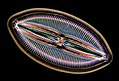 | frustule | Individual diatoms range in size from 0.002 to 0.2 mm. | ||
| radiolarians |  | skeleton | Radiolarians are protozoa with diameters typically between 0.1 and 0.2 mm that produce intricate mineral skeletons, usually made of silica | ||||
| Calcareous ooze | CaCO3 calcite aragonite limestone chalk | foraminiferans | 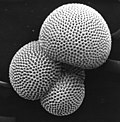 | test | There are about 10,000 living species of foraminiferans, usually under 1 mm in size. | ||
| coccolithophores | 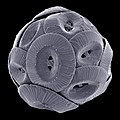 | coccolith | Coccolithophores are spherical cells usually less than 0.1 mm across, enclosed by calcareous plates called coccoliths. Coccoliths are important microfossils. They are the largest global source of biogenic calcium carbonate, and make significant contributions to the global carbon cycle. They are the main constituent of chalk deposits such as the white cliffs of Dover. | ||||
Anthropogenic impacts
Main article: Human impact on marine life
Human activities have a big effect on marine life and marine habitats. Things like overfishing, pollution, acidification, and introducing invasive species can change marine ecosystems and food webs. These changes might affect the variety of life in the ocean and could have results we don't even know about yet for biodiversity and the future of marine life.
Biodiversity and extinction events
Biodiversity, or the variety of life on Earth, has developed over more than three billion years through evolution. For most of Earth's history, life was simple, made up of tiny single-celled organisms like archaea, bacteria, and protozoans. About 600 million years ago, more complex multicellular organisms began to appear rapidly in an event called the Cambrian explosion.
Many species that ever lived are no longer around today. In fact, more than 99 percent of all species that existed have gone extinct. These extinctions happen at different rates and sometimes happen very quickly in what we call mass extinction events. These events cause big drops in the number of species alive at the time. The worst of these was the Permian-Triassic extinction event, which happened 251 million years ago. Today, humans are causing another major loss of species, known as the Holocene extinction.
Investigating and exploring marine life
Scientists use many tools to study and learn about marine life in the ocean. They use special underwater robots called Autonomous Underwater Vehicles (AUVs) that can explore the ocean without anyone on board. There are also Research vessels (R/Vs), which are ships equipped with labs, that help carry equipment and researchers to different parts of the sea. Other tools include deep-towed vehicles, manned submersibles, and remotely operated vehicles (ROVs), all of which help scientists discover more about the underwater world.
Images
This article is a child-friendly adaptation of the Wikipedia article on Marine life, available under CC BY-SA 4.0.
Images from Wikimedia Commons. Tap any image to view credits and license.