 Safekipedia
Afar triple junction
Adapted from Wikipedia · Adventurer experience
The Afar triple junction is a special place where three huge pieces of Earth's outer layer, called plates, meet. These plates are the Nubian, Somali, and Arabian plates. This area shows us how new ocean floors can form, as the land pulls apart in a process called continental rifting. Here, three important cracks in the Earth's surface come together: the Red Sea Rift, the Aden Ridge, and the East African Rift.
These three cracks form what we call a triple junction. One crack stretches north through the Red Sea to the Dead Sea. Another crack goes east through the Gulf of Aden and connects to a ridge in the Indian Ocean. Both of these cracks lie below sea level and look similar to ridges under the ocean.
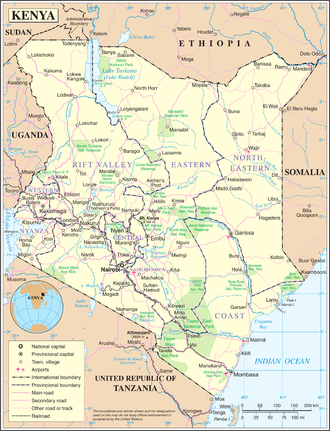
The third crack runs south for a long distance, passing through several countries including Kenya, Uganda, the Democratic Republic of Congo, Rwanda, Burundi, Tanzania, Zambia, Malawi, and ending in Mozambique. This southern crack is known as the East African Rift. In the Afar region, the ground moves in complicated ways, including a small independent piece of land called the Danakil (or Arrata) microplate.
Doming and rifting
A rift happens when the Earth's outer layer stretches and gets thinner because hotter material from deep inside the Earth rises up. This can create new land and change the shape of the surface.
The place where three pieces of Earth's crust meet is called the triple rift. It started forming a long time ago. Today, one piece, the Arabian plate, is moving away from another piece, the African plate. At the same time, hot material from deep inside the Earth is rising, making the land swell up in big rounded shapes called domes. Scientists have studied these domes a lot, especially one in Kenya.
The East African Rift is an active area where two smaller parts of the African plate are moving apart. This happens because there is extra heat from deep inside the Earth under Kenya and the Afar region. The rift has two parts: one with lots of volcanic activity and another with deep valleys that hold lakes. The land in this area is stretching at a rate of about 6 millimetres every year.
The Red Sea Rift is the area where the African and Arabian plates are moving apart, running along the Red Sea. There are many volcanoes in this rift, and the land is stretching at a rate of 7 to 17 millimetres every year.
The Aden Ridge is another place where two plates are moving apart, stretching from the triple rift to a place called the Owen fracture zone. The land here is spreading at about 17 millimetres every year.
Before rifting started, Africa was one big piece of land. As it began to split, it tore into three smaller pieces. The Afar Depression is a low area that formed because of this stretching. It has had many times when the land swelled up and then sank back down, creating valleys and faults in the ground. This area covers a large space and is still spreading at a rate of 6 to 17 millimetres every year.
Implications of volcanism
The East African Rift System has many active volcanoes. Layers of old volcanic rock, called flood basalts, help scientists learn about past eruptions. These layers are about 30 million years old and show activity before the Earth's crust split apart.
Tomography
Seismic tomography uses data from movements inside Earth to make images of what is below the surface. These images show different areas moving at different speeds. Some models show a slow-moving area deep under southern Africa. Scientists think this slow area might be a hot upwelling of material from deep inside Earth, called a plume.
Potential opening of an ocean basin
Horsts and grabens are found in this area. They show that the Earth's crust is stretching. This stretching might help create a new ocean basin. Special faults, called listric faults, help this stretching occur.
Some scientists believe the East African Rift might not form a new ocean in the future. Currently, there are no signs that this will happen. There is also a chance that a subduction zone could form along the edge of the Somali plate. This would mean the ocean floor might start moving under the land.
Related articles



This article is a child-friendly adaptation of the Wikipedia article on Afar triple junction, available under CC BY-SA 4.0.
Images from Wikimedia Commons. Tap any image to view credits and license.