 Safekipedia
Black hole
Adapted from Wikipedia · Adventurer experience
A black hole is an astronomical body that is squeezed so tightly that nothing, not even light, can escape its strong gravity. Albert Einstein’s ideas about space and time helped us understand how these objects form. When a lot of mass gets squished into a tiny area, it creates a place from which nothing can get out. The edge of this place is called the event horizon.
People first thought about black holes in the 1700s, but scientists did not know they were real until the 1960s. The first black hole most scientists agreed on was Cygnus X-1, found in 1971.
Most black holes form when very big stars collapse at the end of their life cycle. They can get bigger by pulling in nearby matter. There are also huge black holes, called supermassive black holes, at the centers of most galaxies.
We cannot see black holes directly. But we can know they are there by how they change the things around them. For example, material falling toward a black hole can shine very brightly. Also, the way stars move around an invisible object can show that a black hole is there. This is how scientists found that Sagittarius A*, at the center of our Milky Way galaxy, is a supermassive black hole.
History
Main article: History of black hole physics
The idea of a body so massive that even light could not escape was first proposed in the late 18th century by English astronomer and clergyman John Michell and independently by French scientist Pierre-Simon Laplace. Both suggested very large stars instead of the modern idea of an extremely dense object.
Michell's idea, in a short part of a letter published in 1784, calculated that a star with the same density but 500 times the radius of the sun would not let any emitted light escape; the surface escape velocity would exceed the speed of light. Michell correctly thought that such invisible bodies might be found through their effect on nearby visible objects. In 1796, Laplace made a suggestion that a star could be invisible if it were large enough. Franz Xaver von Zach asked Laplace for a mathematical analysis, which Laplace provided and published in von Zach's journal Allgemeine Geographische Ephemeriden.
General relativity
See also: History of general relativity
In 1905, Albert Einstein showed that the laws of electromagnetism are the same for observers moving at different speeds. The laws of mechanics had already been shown to work the same way. However, the theory of gravitation was still to be included.
In 1907, Einstein proposed his equivalence principle, the idea that inertial mass and gravitational mass have a common cause. Using this principle, Einstein predicted the redshift and the lensing effect of gravity on light; his prediction of gravitational lensing was half of what the full theory would predict. By 1915, Einstein refined these ideas into his general theory of relativity, which explained how matter affects spacetime, which in turn affects the motion of other matter. This formed the basis for black hole physics.
Singular solutions in general relativity
Only a few months after Einstein published the field equations describing general relativity, astrophysicist Karl Schwarzschild applied the idea to stars. He assumed spherical symmetry with no spin and found a solution to Einstein's equations. A few months later, Johannes Droste, a student of Hendrik Lorentz, independently gave the same solution. At a certain radius from the center of the mass, the Schwarzschild solution became singular, meaning that some of the terms in the Einstein equations became infinite. The nature of this radius, later known as the Schwarzschild radius, was not understood at the time.
Many physicists of the early 20th century were sceptical of the existence of black holes. In a 1926 popular science book, Arthur Eddington critiqued the idea of a star with mass compressed to its Schwarzschild radius as a flaw in the theory of general relativity. In 1939, Einstein used his theory to try to prove that black holes were impossible. His work relied on increasing pressure or force balancing gravity so that the object would not collapse. He missed the idea that collapse would drive the system below this limit.
Gravity vs degeneracy pressure
By the 1920s, astronomers had found a number of white dwarf stars that were too cool and dense to be explained by the cooling of ordinary stars. In 1926, Ralph Fowler showed that these stars are not like main-sequence stars, where thermal pressure balances gravity. Instead, a type of quantum-mechanical pressure balances gravity. In 1931, Subrahmanyan Chandrasekhar studied the new state of matter that results from this balance, called electron-degenerate matter, discovering that it is stable below a certain limiting mass. By 1934 he showed that this explained white dwarf stars. When Chandrasekhar announced his results, Eddington pointed out that stars above this limit would be so dense that light could not escape, a conclusion he considered unlikely. Eddington and, later, Lev Landau argued that some unknown mechanism would stop the collapse.
In the 1930s, Fritz Zwicky and Walter Baade studied stellar novae, focusing on bright ones they called supernovae. Zwicky suggested that supernovae produced stars with the density of atomic nuclei—neutron stars—but this idea was largely ignored at the time. In 1939, based on Chandrasekhar's work, but using general relativity, J. Robert Oppenheimer and George Volkoff predicted that neutron stars below a certain mass limit, later called the Tolman–Oppenheimer–Volkoff limit, would be stable due to neutron degeneracy pressure. Above that limit, they reasoned that gravitational contraction would not stop.
John Archibald Wheeler and two of his students resolved questions about the model behind the Tolman–Oppenheimer–Volkoff (TOV) limit. In 1965, Harrison and Wheeler developed the equations of state relating density to pressure for cold matter all the way through electron degeneracy and neutron degeneracy. Masami Wakano and Wheeler then used the equations to compute the equilibrium curve for stars, relating mass to circumference. They found no additional features that would stop black holes from forming.
Birth of modern model
The modern idea of black holes was created by Robert Oppenheimer and his student Hartland Snyder in 1939. In the paper, Oppenheimer and Snyder solved Einstein's equations for an imploding star, then described the results from far outside the star. The collapse starts as one might expect: the star material rapidly falls inward. However, as the density of the star increases, gravitational time dilation increases and the collapse, viewed from afar, seems to slow down until the star reaches its Schwarzschild radius, where it appears frozen in time.
In 1958, David Finkelstein identified the Schwarzschild surface as an event horizon. This means that events inside the black hole cannot affect events outside the black hole. Finkelstein created a new reference frame to include the point of view of infalling observers. By 1962 the two points of view were reconciled, convincing many that implosion into a black hole made sense.
Golden age
The era from the mid-1960s to the mid-1970s was when general relativity and black holes became popular subjects of research.
In this period, solutions to the equations of general relativity under various different physical constraints were discovered. In 1963, Roy Kerr found the exact solution for a rotating black hole. Two years later, Ezra Newman found the axisymmetric solution for a black hole that is both rotating and electrically charged.
In the late 1960s and early 1970s scientists from research groups formed by Yakov Zeldovich, John Archibald Wheeler and Dennis W. Sciama discovered important mathematical properties of black hole models. In 1967, Werner Israel showed that any non-spinning, uncharged collapsing star gives a spherically symmetric black hole. In 1972, Richard H. Price found that the asymmetry was converted into gravitational waves. It took many physicists to produce a body of work that became known as the no-hair theorem, which states that a black hole is completely described by the three parameters of the Kerr–Newman metric: mass, angular momentum, and electric charge.
At first, it was thought that the strange mathematical singularities found in each of the black hole solutions only appeared due to the assumption that a black hole would be perfectly spherically symmetric. However, in 1965, Roger Penrose proved that general relativity predicts that singularities appear in all black holes.
Astronomical observations also made great progress during this era. In 1967, Antony Hewish and Jocelyn Bell Burnell discovered pulsars and by 1969, these were shown to be rapidly rotating neutron stars. Until that time, neutron stars, like black holes, were regarded as just theoretical ideas, but the discovery of pulsars showed their physical relevance and increased interest in all types of compact objects that might be formed by gravitational collapse. However, experimental evidence confirming a black hole was very difficult to obtain and ultimately required efforts from many astronomers. X-ray telescope observations by Riccardo Giacconi's team in 1971 showed that Cygnus X-1 emitted x-rays in rapid, sporadic fashion consistent with a compact source. This became the first candidate black hole. Optical spectroscopy and detailed astrophysical models for Cygnus X-1 were consistent with a binary system of a massive star and compact star generating x-rays as gas from the massive but ordinary star was sucked into its invisible companion. By 1974 the object was widely considered to be a black hole.
Work by James Bardeen, Carter, and Hawking in the early 1970s led to the formulation of black hole thermodynamics. These laws describe the behaviour of a black hole in a manner analogous to the laws of thermodynamics. Jacob Bekenstein strengthened this analogy with the properties of mass, surface area, and surface gravity for a black hole related to the thermodynamical concepts of energy, entropy, and temperature respectively. The analogy was completed when Hawking, in 1974, showed that quantum field theory implies that black holes should radiate like a black body with a temperature proportional to the surface gravity of the black hole, predicting the effect now known as Hawking radiation.
Modern research and observation
While Cygnus X-1, a stellar-mass black hole, was generally accepted by the scientific community as a black hole by the end of 1973, it would be decades before a supermassive black hole would gain the same broad recognition. The idea that such objects might exist began with models suggesting that powerful quasars or active galactic nuclei in the center of galaxies were powered by accreting supermassive black holes. When the Hubble Space Telescope launched in the 1990s, optical studies of the center of galaxy Messier 87 showed it must have a large concentration of mass. The two candidates for this mass were a black hole and a dense cluster of stars. In 1995, interferometric microwave spectra from the Very Long Baseline Array observed H
2O masers as they orbited the center of NGC 4258, a galaxy with a similar central mass. The orbital parameters ruled out dense stellar clusters as an explanation for galactic nuclei, making supermassive black holes the only plausible explanation.
In 1999, David Merritt proposed the M–sigma relation, which related the dispersion of the velocity of matter in the center bulge of a galaxy to the mass of the supermassive black hole at its core. Subsequent studies confirmed this correlation. Around the same time, based on telescope observations of the velocities of stars at the center of the Milky Way galaxy, independent work groups led by Andrea Ghez and Reinhard Genzel concluded that the compact radio source in the center of the galaxy, Sagittarius A*, was likely a supermassive black hole.
In late 2015, the LIGO Scientific Collaboration and Virgo Collaboration made the first direct detection of gravitational waves, named GW150914, representing the first observation of a black hole merger. At the time of the merger, the black holes were approximately 1.4 billion light-years away from Earth and had masses roughly 30 and 35 times that of the Sun. In 2017, Rainer Weiss, Kip Thorne, and Barry Barish, who had spearheaded the project, were awarded the Nobel Prize in Physics for their work. Since the initial discovery in 2015, hundreds more gravitational waves have been observed.
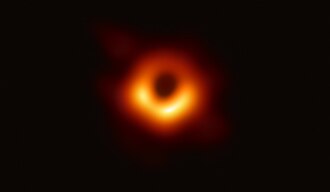
On 10 April 2019, the first direct image of a black hole and its vicinity was published, following observations made by the Event Horizon Telescope (EHT) of the supermassive black hole in Messier 87's galactic centre. In 2022, the Event Horizon Telescope collaboration released an image of the black hole in the center of the Milky Way galaxy, Sagittarius A*; the data had been collected in 2017.
In 2020, the Nobel Prize in Physics was awarded for work on black holes. Andrea Ghez and Reinhard Genzel shared one-half for their discovery that Sagittarius A* is a supermassive black hole. Penrose received the other half for his work showing that the mathematics of general relativity requires the formation of black holes.
Etymology
In December 1967, someone in the audience reportedly suggested the phrase black hole at a lecture by John Wheeler; Wheeler adopted the term for its brevity and "advertising value", and Wheeler's stature in the field ensured it quickly caught on. However, the term was used by others around that time. Science writer Marcia Bartusiak traces the term black hole to physicist Robert H. Dicke, who in the early 1960s reportedly compared the phenomenon to the Black Hole of Calcutta, notorious as a prison where people entered but never left alive. The term was used in print by Life and Science News magazines in 1963, and by science journalist Ann Ewing in her article "'Black Holes' in Space", dated 18 January 1964, which was a report on a meeting of the American Association for the Advancement of Science held in Cleveland, Ohio.
Definition
A black hole is a special place in space where gravity is so strong that nothing, not even light, can escape from it. Scientists find black holes by measuring the mass of objects and using ideas about how gravity can pull matter together. If an object has more mass than three times that of the sun and is very small, it is likely a black hole. You can also think of a black hole as a spot where space is being pulled in faster than light can move.
Properties
Black holes are special objects in space where gravity is very strong. Not even light can escape from a black hole. They form when a lot of mass is squeezed into a very small area. Once a black hole forms, it has three main properties: mass, electric charge, and how fast it spins. These three properties decide what a black hole looks like.
The simplest black hole has only mass and does not spin or carry any electric charge. These are called Schwarzschild black holes. There are also rotating black holes and black holes with electric charge. Scientists study these black holes using math. They can learn about a black hole’s spin by watching the light from stars and gas around it, or by studying waves from colliding black holes.
Classification
Black holes come in different sizes and form in different ways. One type, called a stellar black hole, forms when a big star collapses. These black holes can be about 10 to 100 times the mass of the Sun. Another type, called a supermassive black hole, is much larger and can be found at the center of most big galaxies, including our own Milky Way. These supermassive black holes have masses of more than a million times the mass of the Sun.
There are also ideas about smaller black holes called primordial black holes that might have formed very early in the universe, and even rarer ones called intermediate-mass black holes that are bigger than stellar black holes but smaller than supermassive ones. Scientists think these might form in special places in space or when smaller black holes combine together.
| Class | Approx. mass | Approx. radius |
|---|---|---|
| Ultramassive black hole | 109–1011 M☉ | >1,000 AU |
| Supermassive black hole | 106–109 M☉ | 0.001–400 AU |
| Intermediate-mass black hole | 102–105 M☉ | 103 km ≈ REarth |
| Stellar black hole | 2–150 M☉ | 30 km |
| Micro black hole | up to MMoon | up to 0.1 mm |
Structure
Black holes look invisible because nothing can escape their strong gravity. But they can make the area around them very bright. This happens because their gravity pulls nearby gas and stars very fast, creating heat and light that we can see.
External geometry
Some black holes shoot out narrow beams of fast-moving particles called relativistic jets. These jets can travel millions of light-years from the black hole and are often seen coming from spinning black holes with strong magnetic fields.
When gas falls toward a black hole, it usually forms a flat, spinning disk called an accretion disk. As the gas gets closer to the black hole, it heats up and glows, releasing lots of light. The colour of this light can change depending on how close the gas is to the black hole.
Very close to the black hole, there is a point called the innermost stable circular orbit (ISCO). Inside this point, anything that gets too close to the black hole will spiral in and be pulled in. For spinning black holes, this point moves closer if the object is orbiting in the same direction as the black hole spins.
Around a black hole, there is also a photon sphere where light can orbit the black hole. If light gets too close to this sphere, it will be pulled into the black hole. From far away, this creates a dark shadow that we can see, like the shadow of the black hole against the stars.
Near a spinning black hole, space and time get twisted, creating an area called the ergosphere. In this area, nothing can stay still; everything gets pulled along with the spinning black hole.
The part of space closest to the black hole’s edge is called the plunging region. Here, anything falling in moves very fast toward the black hole, getting very hot and glowing.
Radius
The size of a black hole’s edge, called the Schwarzschild radius, depends on its mass. For a black hole with the mass of our Sun, this edge would be about 3 kilometers across. But for a black hole with the mass of millions of Suns, this edge would be much larger.
Event horizon
The event horizon is the edge of the black hole past which nothing can escape, not even light. To someone far away, anything falling into a black hole would seem to slow down and fade away as it gets closer to this edge. But to someone falling in, they would not notice anything special as they cross the event horizon.
Internal geometry
Inside a rotating or charged black hole, there is another surface called the Cauchy horizon. If someone falls into a black hole, they might hit this inner surface and feel strong forces.
At the very center of a black hole, there is a point where space and time break down completely. This is called a singularity. For a non-spinning black hole, this is a single point, but for a spinning black hole, it looks more like a ring. Anything that falls in will eventually reach this point.
Some theories suggest that black holes might not actually have singularities, but instead have a very dense, but not infinite, core.
Formation
Black holes are formed when very large stars collapse under their own gravity. This can happen when a star runs out of fuel and can no longer support itself, leading to a powerful explosion called a supernova. Sometimes, two smaller stars called neutron stars can merge and create a black hole, too.
Other ideas about how black holes might form include very dense areas in the early universe collapsing, or tiny black holes forming in high-energy collisions. These tiny black holes, if they ever formed, would disappear very quickly and not cause any danger.
Evolution
After a black hole forms, it can change in different ways. It might grow by taking in matter from nearby stars or other black holes. This process is called accretion of matter. It can also shrink slowly over time through a process called Hawking radiation. In this process, tiny particles escape from the black hole.
When matter gets close to a black hole, it moves very fast and heats up. This creates bright light that we can sometimes see from Earth. Scientists study these bright lights to learn more about black holes. Some of the biggest and brightest lights in space are powered by supermassive black holes at the centers of galaxies.
Observational evidence
Millions of black holes may exist in our galaxy, the Milky Way. They form when stars collapse. Because black holes do not give off light, scientists look for clues from the stars and gas around them.
Scientists study black holes by watching how stars move around the center of our galaxy. These stars orbit an invisible object, suggesting a giant black hole is there. They also use special telescopes to look at the dark area around black holes. Scientists detect black holes by observing how their gravity affects nearby matter. They also measure ripples in space caused by black holes moving together. These methods help confirm that black holes exist.
Areas of investigation
Black holes are special objects in space. Once a black hole forms, it can be described by three things: its mass, its charge, and how it spins. This means that other details about what made the black hole might seem to disappear. But black holes can slowly lose energy by sending out special kinds of energy called Hawking radiation. This radiation doesn’t carry extra details about what made the black hole, so it looks like some information is gone forever. Scientists are still trying to understand this puzzle.
We have found very bright objects called quasars that are powered by huge black holes. These quasars existed when the universe was very young—less than a billion years old. These giant black holes are a mystery because they grew so fast. Scientists think they might have started from smaller black holes that merged together, or from special clouds of gas that collapsed directly into black holes. There are also ideas that these black holes could have formed in special ways right after the universe began. Scientists are still exploring how these giant black holes formed so early.
See also: Exotic star
While most scientists agree that there are very large black holes, there are some ideas about other types of extremely dense objects that might look similar. For example, some think that objects made of special kinds of matter, like quark matter, could stop collapsing before becoming a black hole. There are also ideas about stars made of dark energy or very slowly collapsing stars that might look like black holes but work in different ways. These are still just theories, and scientists continue to study them.
In fiction
Black holes have inspired many artists and scientists. In her book Conjuring the Void: the Art of Black Holes, Lynn Gamwell shows how art and science work together. She uses black holes to explain how art helps us understand science, and how science can influence art. Some science fiction films show black holes using ideas from real science. These films create images that look like those from the Event Horizon Telescope. Stories about black holes also help teach science.
In science fiction, black holes appear in many ways. Even before we called them "black holes," stories included objects that acted like them. Today, writers and filmmakers use the strange effects of black holes, such as time moving differently near them. Sometimes, black holes are used as gateways to travel faster than light.
Images
Related articles


This article is a child-friendly adaptation of the Wikipedia article on Black hole, available under CC BY-SA 4.0.
Images from Wikimedia Commons. Tap any image to view credits and license.