
Hawking radiation
Hawking radiation is a special kind of energy that comes from just outside a black hole. The idea was created by the famous scientist Stephen Hawking in 1974. Before this, scientists thought that once energy or light got too close to a black hole, it could never escape.
According to Hawking's idea, this radiation happens because of tiny, invisible forces called quantum effects. The radiation is very faint and too weak for our best telescopes to see right now.
If Hawking radiation is real, it would slowly take away mass and energy from black holes. Over a very long time, this could make black holes shrink and eventually disappear. Very small black holes would disappear faster than big ones. If these tiny black holes exist somewhere in space, they might end in a burst of energy, but we haven't seen this happen yet.
Background
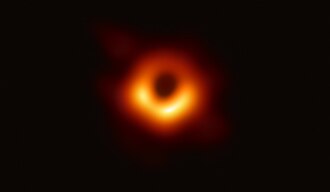
Modern black holes were first predicted by Einstein’s theory of general relativity. We now have strong evidence for these amazing objects, called black holes, because of their very strong pull of gravity.
A black hole can form when enough matter or energy is squeezed into a tiny space. This makes the speed needed to escape faster than light. Since nothing can go that fast, nothing inside a certain distance from the black hole can get out. This distance marks the event horizon, the edge around the black hole where even light cannot escape.
Discovery
In 1971, scientists Yakov Zeldovich and Alexei Starobinsky suggested that rotating black holes might create and send out particles. In 1972, Jacob Bekenstein proposed that black holes should have a kind of disorder called entropy.
At first, Stephen Hawking did not agree with this idea. But after talking with Zeldovich in 1973, he combined these thoughts with his own work. In 1974, Hawking showed that black holes could send out tiny bits of energy. This showed that black holes are not completely black — they can slowly lose energy and shrink over time. This effect is now called Hawking radiation. It was supported by Bekenstein’s earlier work.
Hawking radiation happens because of tiny changes in empty space. These changes can create pairs of particles, with one staying near the black hole and the other escaping far away.
Emission process
Hawking radiation happens because of special rules in physics called the Unruh effect and the equivalence principle. Near a black hole, someone would need to move very fast to stay away. When moving fast, a person would see tiny bits of energy, like heat, around the black hole. Some of these bits can escape far away, and this is what we call Hawking radiation.
A Schwarzschild black hole follows specific rules that help scientists understand these tiny bits of energy. These rules show that the temperature of the radiation depends on the size of the black hole. Smaller black holes give off more radiation, but the radiation from big black holes is very weak and hard to detect.
Greybody factors
Greybody factors are special numbers that help us learn about the light or energy a black hole gives off. This light is a little different from the light of a perfect, glowing object because of tiny, invisible forces. These forces let a black hole send out radiation that looks almost like the light from a perfect glowing object near the black hole.
These greybody factors change based on the energy and spinning of the particles the black hole sends out. They also change depending on the type of particle. For black holes with an electric charge, the factors can also change based on the charge of the particles.
Black hole evaporation
When particles escape, a black hole loses a little bit of its energy and mass. Because mass and energy are linked, this means a black hole can only exist for a certain amount of time. The time it takes for a black hole to disappear depends on its starting size — bigger black holes last much longer.
For a black hole about the size of the Sun, it would take more than 1067 years to vanish — far longer than the age of our universe. Very small black holes, formed soon after the universe began, might have already disappeared. Only the tiniest of these could vanish quickly, and even then, they need to be much smaller than Earth.
Problems and extensions
Trans-Planckian problem
The trans-Planckian problem is a challenge in understanding Hawking radiation. It happens because Hawking's idea includes tiny particles very close to the black hole. These particles have very short wavelengths, shorter than the Planck length, which is a limit in physics.
When we look at these particles moving away from the black hole, their energy seems to grow very large as they get very close to the edge. This makes their wavelengths very tiny. Since we don't fully understand physics at such tiny sizes, some people find Hawking's idea hard to accept.
But many now think this problem is just a math trick in how we describe black holes. Similar things happen with other ideas in physics. There are also other ways to explain Hawking radiation that try to fix this problem.
Large extra dimensions
Usually, black holes need to be very heavy. But if there are extra, very small dimensions in space, the rules change. In these models, black holes could be much lighter and still work. The time it takes for such tiny black holes to disappear would be very short, about 10−26 seconds.
In loop quantum gravity
Studies using a theory called loop quantum gravity look at the area around a black hole's edge. This theory shows that black holes might give off radiation in slightly different patterns than Hawking first thought. If we could see X-rays from very old, tiny black holes, we might notice these differences.
Tunneling picture
Some scientists describe Hawking radiation as tiny particles escaping, or "tunneling," through the black hole's edge. This idea matches what Hawking found but can be used for different kinds of black holes that change over time.
Experimental observation
NASA launched the Fermi space telescope in June 2008 to look for special flashes of light from tiny black holes called primordial black holes. As of January 2024, these flashes have not been found.
In 2023, the neutrino detector KM3NeT saw a very big burst of energy called KM3-230213A. One idea is that this could be from a tiny black hole disappearing, and some measurements match this idea if these tiny black holes make up a lot of dark matter.
Some theories suggest that the CERN Large Hadron Collider could make tiny black holes that disappear, but none have been seen there.
Because Hawking radiation is very weak, it is hard to see in real black holes. Scientists have tried to study something similar using sound in special materials called Bose–Einstein condensates, and they reported seeing something like Hawking radiation. In 2010, an experiment made something like a black hole in the lab and claimed to see radiation like Hawking radiation, but these results are still being checked and are not fully proven.
Pictures
Keep exploring


This article is a child-friendly adaptation of the Wikipedia article on Hawking radiation, available under CC BY-SA 4.0.
Images from Wikimedia Commons. Tap any image to view credits and license.