 Safekipedia
Boeotia
Adapted from Wikipedia · Adventurer experience
Main article: [Boeotia. It is part of Central Greece. The capital city is Livadeia. The largest city is Thebes.
Ancient History
In ancient times, Boeotia was an important area of ancient Greece. It existed before the 6th century BC. This region has a rich history and played a big role in ancient Greek stories and development.
Geography
Boeotia is north of the Gulf of Corinth and has a short coastline along the Gulf of Euboea. It borders Megaris, now West Attica, to the south, Attica to the southeast, Euboea to the northeast, Opuntian Locris, now Phthiotis, to the north, and Phocis to the west.
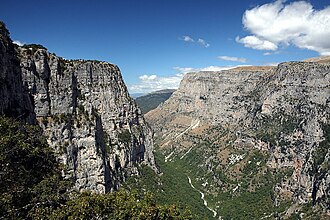
The main mountains in Boeotia are Mount Parnassus in the west, Mount Helicon in the southwest, Cithaeron in the south, and Parnitha in the east. The longest river is the Cephissus, which runs through the center. Lake Copais was once a big lake but was drained in the 1800s. Lake Yliki is a large lake near Thebes.
Origins
The name "Boeotians" might come from a mountain called Boeon in Epirus.
The first people in Boeotia, linked to the city of Orchomenus, were called Minyans. Writers like Pausanias said that Minyans helped build a seaside city named Teos and lived on islands such as Lemnos and Thera. Sometimes, heroes called the Argonauts were also called Minyans. Stories say the people of Thebes paid tribute each year to their king, Erginus. Many think the Minyans spoke an early form of Greek. Scholars say that the Myceneans came from the Minyans during the Middle Helladic period, but also think the Minyan culture began with people already living there, called an indigenous people. The old wealth and strength of Boeotia can be seen in Mycenean ruins in cities like Orchomenus and Thebes.
Some place names and a special way of speaking called the Aeolic dialect show that the Boeotians were linked to the Thessalians. Tradition says the Boeotians first lived in Thessaly, a big fertile area in Greece, but were pushed out by other Thessalians about two generations after the Fall of Troy in 1200 BC. They moved south to another rich plain. Some settled on islands like Lesbos and in Aeolis in Asia Minor, while others stayed in Thessaly and moved to the hills. Boeotia was one of the first members of the very old Amphictyonic League, a group of tribes that worked together for religious reasons, even though it was far from where the League began in Anthela.
Even though Boeotia had famous people like Pindar, Hesiod, Epaminondas, Pelopidas, and Plutarch, people from Athens often made fun of them.
Legends and literature
Many famous ancient Greek stories come from or are set in Boeotia. These stories began long ago during the Mycenean age (1600–1200 BC) when Mycenean Greeks lived in Boeotia and made the city of Thebes important. Some stories connect to Argos, and others show ties to Phoenicia, where Greeks set up trade places.
Important legends from Boeotia include stories about Eros, the Muses of Mount Helicon, Ogyges and a big flood, Cadmus who founded Thebes and brought the alphabet to Greece, Dionysus and Semele, Narcissus, Heracles who was born in Thebes, the Theban Cycle with Oedipus and the Sphinx and the Seven against Thebes, Antiope and her sons Amphion and Zethus, Niobe, and Orion who was born in Boeotia.
These legends inspired many plays by famous Greek poets like Aeschylus, Sophocles, and Euripides. Boeotia was also home to an important ancient shrine of Trophonius at Lebadea. The city of Graea in Boeotia may be the source of the word "Greece". Famous poets Hesiod and Pindar were from Boeotia.
History
Boeotia was very important in history because of its location on the north shore of the Gulf of Corinth. Its strong defenses and easy travel routes helped it play a big role. However, it did not have good harbors, which slowed its growth by sea.
The people of Boeotia, known as the Minyae, were important, as shown by ancient remains like the "Treasury of Minyas." The Boeotians came into the land from the north, possibly before other groups arrived. Except for the Minyae, the original people were absorbed by new arrivals, and the Boeotians became one group. They spoke Aeolic Greek.
In early history, the leading city in Boeotia was Thebes. Its central location and strong army made it a good capital. Other important towns were Orchomenus, Plataea, and Thespiae. The people of Thebes often wanted to combine all the towns into one state, like Athens did with its nearby areas. But the other towns resisted and only agreed to a loose group that was mostly for religious purposes.
Even though the Boeotians usually worked together against outside enemies, the fights between their own cities held back their progress. Boeotia did not appear much in history until the late 6th century BC.
Before that, the people of Boeotia were known for making a type of pottery with simple designs, similar to pottery from Athens. Around 519 BC, the people of Plataea resisted Thebes' attempts to control them, so Athens helped Plataea. The Athenians defeated the Boeotian army on this occasion and again in 507 BC.
The poem Works and Days by Hesiod, who lived in Boeotia, gives valuable information about the Boeotian economy and its changes during an early time in Greece. In the poem, Hesiod talks about the start of a newer economy, with workers doing special jobs like making plows and wagons, and the growing importance of trade by sea in Greece’s economy.
Emigration of the Boeotians
Stories tell us that the Boeotians (Ancient Greek: Βοιώτιοι, romanised: Boiotioi) originally lived in Thessaly, especially around Arne. Some may have gone to the Pagasitic Gulf before moving to the land called Boeotia. The place called Arne is not known, but it is sometimes thought to be Cierium in central Thessaly. Evidence from ancient times in Boeotia, like worship and place names from Thessaly, such as Itonia and Itonian Athena, Homole and Homoloian Zeus, Alalcomenae, Corseia and Pharae, supports the idea that the Boeotians came from Thessaly and brought parts of their old home with them.
The Boeotians were driven out of Thessaly after the Trojan war, though stories differ about how this happened. One story says the Boeotians were driven out by the Thessalians led by Thessalus, the son of Aiatus, who was the son of Pheidippus, and another Thessalus. Pheidippus is named in the Catalogue of ships as a leader from Cos and Carpathus. He was believed to have gone to Epirus after the war and settled in Ephyra in Thesprotid. So the Boeotians were driven out two generations after the Trojan War.
Another story places the Boeotians’ expulsion in the time of Aiatus, one generation after the war. This story also includes Plutarch’s tale about how Opheltas, king of the Boeotians, took Chaeronea “by force from the barbarians.” Opheltas was the son of Peneleus, one of the leaders from Boeotia in the Catalogue, and he lived one generation after the war. It was only during the rule of Damasichthon, Opheltas’ son, that the Boeotians took control of Thebes.
The Boeotians likely entered Boeotia through a common route. The second story says Chaeronea was the first place attacked, while the first says Orchomenus and Coronea were taken at almost the same time, after which the temple of Itonian Athena was built. It seems both stories imagined the Boeotians coming along a well-known route from Thessaly, through Thermopylae and Hyampolis to Chaeronea, where they could attack both Orchomenus and Coronea. After taking Chaeronea, Orchomenus and Coronea, along with their lands, the Boeotians seem to have paused to settle western Boeotia; the generation or two before Thebes was taken marks this pause in all the stories. The location near Coronea of the temple of Itonian Athena, the celebration of the Pamboeotia there, the renaming of rivers and other place names, and the importance of the nearby settlement of Alalcomenae all support the idea that this western area was where the first Boeotian settlers lived and where their institutions began in their new home. The move eastward continued both north and south of Copais lake. To the north, it eventually reached Anthedon, a town once thought to belong to the Thracians. To the south, it reached as far as Thebes and Thespiae.
The government of the league was also changed to match the democratic governments now common across the land. All power belonged to the popular assembly, which chose the Boeotarchs (between seven and twelve) and approved all laws.
Fifth century BC
During the Persian invasion of 480 BC, Thebes helped the Persian invaders. As a result, for a time, Thebes lost its leadership of the Boeotian League, but in 457 BC the Spartans restored Thebes as a strong point against attacks from Athens after the Battle of Tanagra. Athens responded by suddenly moving into Boeotia, and after winning at the Battle of Oenophyta took control of the whole land, tearing down the wall the Spartans had built. With this victory, the Athenians also took Phocis, the original cause of the conflict, and Opuntian Locris. For ten years the land was under Athenian control, governed through newly set-up democratic governments; but in 447 BC the people rose up, and after winning at the Battle of Coronea they won back their freedom.
In the Peloponnesian War the Boeotians fought hard against Athens. Though they became somewhat distant from Sparta after the peace of Nicias, they never stopped their dislike of their neighbor. They served well at Syracuse and at the Battle of Arginusae in the later years of the Peloponnesian War; but their greatest success was the big win at the Battle of Delium over the Athenian army in 424 BC, where both their foot soldiers and their horse soldiers showed unusual skill.
Boeotian League
According to the Hellenica Oxyrhynchia, in 395 BC the Boeotian League was made up of eleven groups of independent cities and smaller towns, each of which chose one Boeotarch or minister for war and foreign matters, sent sixty representatives to the federal council in Thebes, and provided a group of about 1000 foot soldiers and 100 horse soldiers to the federal army. A safety measure against too much control by the central government was included in the councils of the separate cities, where all important policy questions had to be approved. These local councils, where only property-owning people could vote, were divided into four parts, like the prytaneis of the Athenian council, which took turns voting on all new measures.
Two Boeotarchs came from Thebes, but by 395 BC Thebes provided four Boeotarchs, including two who represented places now taken by Thebes such as Plataea, Scolus, Erythrae, and Scaphae. Orchomenus, Hysiae, and Tanagra each provided one Boeotarch. Thespiae, Thisbe, and Eutresis provided two together. Haliartus, Lebadea and Coronea each provided one in turn, and so did Acraephia, Copae, and Chaeronea.
The total fighting force of the Boeotian League (11,000 foot soldiers and 1,100 horse soldiers) has been used as a starting point for several guesses about the population of the area in the early fourth century BC.
Fourth century BC
Boeotia played an important part in the Corinthian War against Sparta, especially in the battles of Haliartus and Coronea (395–394 BC). This change in policy was mostly because people were unhappy about outside control. However, dislike of Thebes was now growing, and Sparta encouraged this by insisting on the full independence of all the cities in the Peace of Antaclidas (387 BC). In 374 BC, Pelopidas restored Theban leadership. Boeotian forces fought in all the campaigns of Epaminondas against the Spartans, most notably at the Battle of Leuctra in 371 BC, and in the Third Sacred War against Phocis (356–346 BC); while in dealings with Philip of Macedon the cities simply followed Thebes.
The government of the league was also changed to match the democratic governments now common across the land. All power belonged to the popular assembly, which chose the Boeotarchs (between seven and twelve) and approved all laws. After the Battle of Chaeronea, where the Boeotian foot soldiers again showed their strength, the land never again reached great success.
Hellenistic period
The destruction of Thebes by Alexander the Great in 335 BC took away the energy of the Boeotians. They never again acted independently, but followed the lead of stronger powers. Though military training and organization continued, the people could not defend their borders, and the land became more and more a place of conflict. Though it joined the Aetolian League for a short time around 245 BC, Boeotia generally supported Macedon, and backed its later kings against Rome. Rome broke up the league in 171 BC, but it was brought back under Augustus, and joined with other central Greek groups in the Achaean union.
Middle Ages and later
Main article: Frankokratia
Except for a short time of growth under the Frankish rulers of Athens (1205–1310), who fixed the underground water systems (καταβόθρα katavóthra) of Lake Kopais and helped farming, Boeotia stayed in a weak condition, made worse by attacks from outside groups. The first step toward the country’s recovery was not until 1895, when the water systems of Kopais were put back to work.
Archaeological sites
In the late 1800s and early 1900s, scientists dug up important places in Orchomenus. They found a big round tomb called the "Tomb of Minyas." This tomb looked very similar to another famous tomb at Mycenae. Later, more digging found a temple, old graves, a palace, and an ancient theater.
Administration
The regional unit Boeotia is divided into 6 municipalities. These are:
Boeotia became a prefecture in 1836, then again in 1899 and 1943. It was formed from the Attica and Boeotia Prefecture. In 2011, the regional unit Boeotia was created from the old prefecture. The way towns were grouped together changed.
Provinces
The provinces were:
- Livadeia Province – Livadeia
- Thebes Province – Thebes
| New municipality | Old municipalities & communities | Seat |
|---|---|---|
| Aliartos | Aliartos | Aliartos |
| Thespies | ||
| Distomo-Arachova-Antikyra | Distomo | Distomo |
| Arachova | ||
| Antikyra | ||
| Livadeia | Livadeia | Livadeia |
| Davleia | ||
| Koroneia | ||
| Kyriaki | ||
| Chaironeia | ||
| Orchomenus | Orchomenus | Orchomenus |
| Akraifnia | ||
| Tanagra | Tanagra | Schimatari |
| Dervenochoria | ||
| Oinofyta | ||
| Schimatari | ||
| Thebes (Thiva) | Thebes | Thebes |
| Vagia | ||
| Thisvi | ||
| Plataies |
Economy
Boeotia helps make food and other products. It has one of the biggest pasta factories in Europe. This factory was built by MISKO, which is part of the Barilla Group. Large companies such as Nestlé and Viohalco also have factories in the town of Oinofyta in Boeotia.
Transport
Natives of Boeotia
Some famous people came from Boeotia, a region in Greece. These include writers, leaders, and important historical figures such as Bakis, Corinna, Hesiod, Pindar, and Plutarch. Others like Epaminondas and Pelopidas were known for their roles in history.
Images
Related articles



This article is a child-friendly adaptation of the Wikipedia article on Boeotia, available under CC BY-SA 4.0.
Images from Wikimedia Commons. Tap any image to view credits and license.