 Safekipedia
Bohr model
Adapted from Wikipedia · Adventurer experience
In atomic physics, the Bohr model is an old way of thinking about atoms. It was made between 1911 and 1918 by Niels Bohr. This model improved on older ideas about atoms, like the plum pudding model created by J. J. Thomson.
The Bohr model shows a tiny, heavy center called the atomic nucleus with electrons moving around it, like planets around the Sun. But instead of gravity holding the planets, it is an electrostatic force that keeps the electrons in place. The model also says that the electrons can only have certain fixed amounts of energy.
One big success of the Bohr model was that it helped explain why hydrogen, the simplest atom, gives off light in certain colors. Before this model, scientists knew these colors existed but did not know why. The Bohr model gave a clear reason for this pattern of colors. Even though we now use more advanced ideas to understand atoms, the Bohr model is still useful because it is simple and helps students learn the basics.
Background
Main article: History of atomic theory
Before the 1900s, people guessed a lot about what atoms look like. Even the idea that atoms exist was not fully accepted by all scientists.
Planetary models
In the late 1800s, some scientists thought atoms might look like tiny planets, with tiny particles called electrons moving around them. But this idea had a big problem. If electrons moved in circles, they would shake and send out energy. This would make them spiral into the center, and atoms could not stay stable.
Thomson's atom model
Main article: Plum pudding model
When Niels Bohr started working on his ideas about atoms in 1912, the best model was made by J. J. Thomson. Thomson thought atoms looked like plum pudding, with small electrons stuck inside a big positive sphere. But this model had problems. It could not explain why atoms looked the way they did in experiments, or why they gave off certain colors of light when heated.
Rutherford nuclear model
Main articles: Rutherford atom and Rutherford scattering experiments
In 1911, scientists Ernest Rutherford and his team found that atoms have a tiny, dense center called a nucleus. This nucleus holds most of the atom's mass and is surrounded by electrons. This idea replaced Thomson's model and helped Bohr develop his own model of the atom.
Atomic spectra
Scientists knew that when atoms are heated, they glow with certain colors. These colors are like fingerprints for each element. By the early 1900s, they had formulas to describe these colors, but they did not understand why these colors happened. Bohr would later explain that these colors come from electrons moving between different energy levels.
Haas atomic model
In 1910, Arthur Haas suggested another model for the hydrogen atom. He thought the electron moved around the edge of a sphere. Haas used a special number called the Planck constant to connect the electron's energy to its movement. This idea would later help Bohr in his own work.
Influence of the Solvay Conference
In 1911, some of the world's best scientists met at the Solvay Conference. They talked about how atoms work and why old ideas did not fully explain things. These talks encouraged Bohr to think differently about atoms and to use new ideas that went beyond old physics.
Nicholson atom theory
In 1911, John Nicholson made a model of the atom based on stars and their light. He used the Planck constant to explain how electrons moved. This work helped Bohr see how important certain numbers were in understanding atoms.
Bohr's previous work
Before Bohr made his famous atom model, he finished his PhD in 1911. His work looked at how electrons behave in metals. He found that old ideas did not fully explain things like heat or magnetism in metals. Later, he worked in labs and learned more about atoms, especially after Rutherford discovered the nucleus. This knowledge helped Bohr create his new model of the atom.
Development
Niels Bohr developed his model of the atom between 1911 and 1918. He noticed that light from hydrogen followed certain patterns, called the Balmer series. This helped him understand how electrons move around the nucleus.
Bohr suggested five important ideas about electrons. He said electrons move in fixed paths, or orbits, around the nucleus. These orbits are stable, so the electron won’t fall into the nucleus. When an electron jumps between orbits, it gives off or absorbs a particle of light, called a photon. Bohr’s ideas helped explain why atoms emit specific colors of light. Later scientists used his work to create better models of the atom.
Refinements
Main article: Bohr–Sommerfeld model
Some changes were made to the Bohr model. The Sommerfeld or Bohr–Sommerfeld models said that electrons move in oval paths around the nucleus instead of circular ones. This helped explain some things better, but it also had problems.
Later, scientists developed a new way to understand atoms using quantum mechanics. This new method was created by Wolfgang Pauli in 1925 and Erwin Schrödinger in 1926, and it replaced the older models. Even so, the older Bohr–Sommerfeld model could still explain some effects correctly.
Replacement
In 1925, scientists created a new way to understand tiny parts of atoms. This new idea improved an older model made by Niels Bohr. Werner Heisenberg wrote a paper to help start this theory. Later, Max Born and Pascual Jordan added more ideas. Erwin Schrödinger also found another way to describe these ideas using waves. He studied how electrons move around the center of a simple atom.
Electron energy levels
The Bohr model works best for simple systems with two charged particles, like a single electron orbiting a nucleus. This includes atoms such as hydrogen atom, singly ionized helium, and doubly ionized lithium. It also applies to positronium and Rydberg states where one electron is far from the nucleus.
To understand the model, we need two main ideas:
-
Classical mechanics: The electron moves in a circular orbit because of its attraction to the nucleus. The force pulling the electron in equals the force that keeps it moving in a circle.
-
A quantum rule: The electron’s angular momentum must be a whole number multiple of a very small constant called ħ (h-bar).
This model helped scientists learn more about how electrons act in simple atoms and led to important discoveries about atomic structure.
Rydberg formula
Main article: Rydberg formula
In the 1860s, scientists like Johann Balmer, Johannes Rydberg, and Walther Ritz found patterns in the colors of light from atoms.
Later, Niels Bohr used his ideas about atoms to explain why these patterns worked. He showed how the energy of light matched the energy levels of electrons in the atom. This helped confirm his model and showed how the Rydberg constant relates to basic parts of nature, like the charge and mass of an electron and the Planck constant.
Shell model (heavier atoms)
Main article: Electron shell
Niels Bohr’s early ideas about atoms helped us understand simpler elements. He thought of electrons arranged in circles or “rings” around the nucleus. Later, these rings were called “shells.” Each shell can hold a certain number of electrons before it fills up and a new shell starts.
Bohr’s ideas help explain why some elements behave differently. For example, small atoms get a bit smaller as you move across a row in the periodic table, and then suddenly get larger again. This happens because shells fill up one by one. When a shell is full, the next atom adds an electron to a new, outer shell, making the atom larger. This also helps explain why some elements, like helium and neon, don’t easily react with others—they have full outer shells.
Moseley's law and calculation (K-alpha X-ray emission lines)
In 1913, Henry Moseley discovered a link between the strongest X-ray line that atoms give off, called the K-alpha line, and their atomic number. Each element has its own atomic number.
Moseley learned that this X-ray line happens when an electron moves between two energy levels in the atom. His work showed that atoms have a small, dense center called a nucleus. It also helped show that elements are listed in order of their atomic number.
Shortcomings
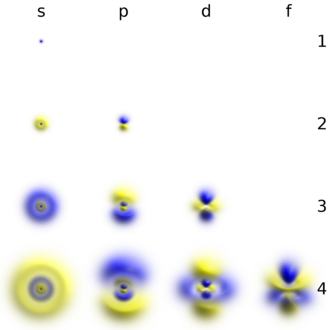
The Bohr model had some problems. It gave the wrong value for the spinning speed of electrons in their resting state. Today, we know electrons act more like a soft cloud around the nucleus, not like planets moving in circles.
The Bohr model couldn't explain many things we see in tests, like the exact patterns of light that atoms emit, or how atoms act in magnetic fields. It only worked for very simple atoms and missed key facts about how electrons really behave. Newer science ideas fixed the Bohr model to cover these gaps.
Main article: spherical cloud of probability
Further information: lithium, Rydberg formula, Stark effect, hyperfine structure, Zeeman effect, magnetic fields, Umdeutung paper
Model of the chemical bond
Niels Bohr had an idea about how atoms join to make molecules. In his idea, the electrons from two atoms that come together make a shape like a ring. This ring stands straight up from the line between the two atoms. The atoms stay balanced because the pull between the centers and the ring of electrons matches the push away that the centers feel. Bohr’s idea also thought about how electrons push each other away when they are far apart in this ring.
Symbolism of planetary atomic models
Even though scientists use better ideas about atoms now, many people still imagine atoms as tiny planetary systems. This idea of an atom with electrons moving around a center has become a popular symbol. You can see it in many places, such as:
- The logo of the United States Atomic Energy Commission, which helped develop nuclear fission technology.
- The flag of the International Atomic Energy Agency shows a spinning atom with olive branches around it.
- The US minor league baseball Albuquerque Isotopes logo has baseballs like electrons orbiting a big letter "A".
- The symbol called the atomic whirl stands for atheism.
- The Unicode Miscellaneous Symbols includes a symbol (⚛) that looks like a planetary atom model.
- The TV show The Big Bang Theory uses a similar image in its logo.
- The JavaScript library React also uses a planetary-like image for its logo.
- On maps, this symbol marks a nuclear power site.
Related articles




This article is a child-friendly adaptation of the Wikipedia article on Bohr model, available under CC BY-SA 4.0.
Images from Wikimedia Commons. Tap any image to view credits and license.