 Safekipedia
California
Adapted from Wikipedia · Adventurer experience
California is a large state in the Western United States that lies along the Pacific Coast. It shares borders with Oregon to the north, Nevada and Arizona to the east, and the Mexican state of Baja California to the south. California is the most populous U.S. state, with many people living in its many different landscapes.
Before European explorers arrived, California was home to many different Native American groups with their own languages and cultures. Later, it became part of the Spanish Empire, then Mexico, and finally the United States after the Mexican-American War. The discovery of gold brought many people to the state and changed its history.
Today, California is known for its important cities such as Los Angeles and Sacramento, its diverse geography—from coastal areas to mountain ranges—and its strong economy. The state leads the country in agriculture, technology, and entertainment.
Etymology
Main articles: Etymology of California and Island of California
The name "California" comes from early Spanish explorers. They called the area Las Californias. This name began with the peninsula of Baja California in Mexico. Later, it included lands further north, which became the U.S. state of California, known as Alta California.
The word "California" likely came from an old story about a fictional island. In this tale, the island was a faraway place full of gold and pearls. Strong women, much like the Amazons, lived there. The name appeared on maps by 1541, probably from a Spanish sailor.
Short ways to write the state's name include CA, Cal, Cali, Calif, and US-CA.
History
Further information: History of California before 1900
Indigenous tribes
Main article: Indigenous peoples of California
California had many different groups of people living there long before Europeans arrived. It was one of the most culturally rich places in pre-Columbian North America. Many thousands of people lived in California before new settlers came. The Indigenous peoples of California included over 70 distinct ethnic groups. They lived in many kinds of places, such as mountains, deserts, islands, and forests.
These groups took care of their land in smart ways. They used forest gardening to grow food and find medicinal plants. This was an early kind of sustainable agriculture. To keep forests safe, they used controlled burning. Some groups were led by leaders called chiefdoms, like the Chumash, Pomo, and Salinan.
Spanish period
Main articles: Province of Las Californias and Spanish missions in California
The first Europeans to see the coast of California were on a Spanish ship led by a sailor named Juan Rodríguez Cabrillo in 1542. He was looking for places to trade. Later, in 1769, another Spanish group, the Portolá expedition, came to California and built many places like missions, presidios, and pueblos.
Mexican period
Main articles: Alta California and Ranchos of California
In 1821, Mexico won its freedom from Spain. California became part of Mexico. In 1822, California had its first local government. By 1834, the California mission system was changed and became property of the Mexican government.
U.S. conquest and the California Republic
Main articles: Conquest of California and Bear Flag Revolt
In 1846, some American settlers in Sonoma decided to break away from Mexico. They raised a flag and called it the California Republic. Its leader was William B. Ide. Soon after, the Mexican–American War began.
The California Republic did not last long.
Early American period
See also: California gold rush and Interim government of California
In 1848, a treaty ended the war, and California became part of the United States. Just before this, gold was found in California. This brought many people to the area. Thousands of people from many countries came during the California gold rush.
1900–present
Main article: History of California (1900–present)
In the 1900s, many Japanese people moved to California. In 1913, a law was passed that stopped Asian immigrants from owning land. During World War II, Japanese Americans in California were interned. In 2020, California said it was sorry for this.
More people moved to California when roads were built, like Route 66. The population grew very fast.
Big projects were built to help, such as the Los Angeles Aqueducts, the Oroville and Shasta Dams, and the Golden Gate Bridge.
In the 1900s, California faced big problems like the 1906 San Francisco earthquake and the 1928 St. Francis Dam flood.
In recent years, California has had dry periods and wildfires, partly because of climate change. The COVID-19 disease came to the U.S. in California in early 2020. A state of emergency was called, and people were asked to stay home. This ended in early 2023.
Geography
Main article: Geography of California
Further information: Northern California and Southern California
California is the third-largest state in the U.S. It covers 163,696 square miles (423,970 km2). It is bordered by Oregon to the north, Nevada and Arizona to the east, the Pacific Ocean to the west, and shares a border with the Mexican state of Baja California to the south.
The state is split into Northern and Southern California, with the Central Valley between the Sierra Nevada and coastal mountains. The Sacramento and San Joaquin Valleys are important farming areas, and the Sacramento-San Joaquin River Delta helps supply water. Notable places include Mount Whitney, the highest peak in the contiguous U.S., and Death Valley, one of the hottest places on Earth. California has many different landscapes, including forests, deserts, and coastlines.
Climate
Main article: Climate of California
Further information: Climate change in California
Most of California has a Mediterranean climate, with cool, wet winters and dry, warm summers. The state's mountains create different climates, from cold conditions in the Sierra Nevada to desert climates in the east. Coastal areas are cooler because of the California Current, which brings fog. Northern parts of the state get more rain than the south. Climate change is causing more frequent and serious droughts, which affect water and farming.
Ecology
Main articles: Ecology of California and Environment of California
California is one of the richest places for plants and animals, with many species found only there. Its different landscapes support many kinds of plants and animals, from desert plants to coastal forests. Some threats to these places include building cities, cutting trees, overgrazing, and invasive species. Conservation work helps protect endangered species and habitats.
Flora and fauna
See also: List of California native plants
California's different climates and lands support many plant and animal species. The state is home to very large and old trees, like the giant sequoias. Native plants include the California poppy, the state flower, and the Joshua tree. Wildlife includes coastal sea lions and mountain animals. Many species face threats from losing their homes and climate change, so there are efforts to protect them.
Rivers
Main article: List of rivers of California
California's major rivers include the Sacramento and San Joaquin Rivers, which flow from the Sierra Nevada through the Central Valley to the Pacific Ocean. Other important rivers are the Klamath, Eel, Salinas, Mojave, and Santa Ana Rivers. These rivers are very important for farming and water, and many have dams as part of big water projects.
Regions
Main article: List of regions of California
See also: List of places in California
California is split into Northern and Southern California. Within these, there are many different regions, including the Shasta Cascade, North Coast, Bay Area, Central Valley, Sierra Nevada, Central Coast, Southern California, and California Deserts. Each region has its own unique geography, climate, and culture.
Cities and towns
See also: List of cities and towns in California and List of largest California cities by population
California has 483 cities and towns. Sacramento became the first incorporated city in 1850. The state's big cities include Los Angeles, the San Francisco Bay Area, Riverside-San Bernardino, San Diego, and Sacramento. These cities are important for the economy, culture, and where many people live.
| Location | August (°F) | August (°C) | January (°F) | January (°C) | Annual precipitation (mm/in) |
|---|---|---|---|---|---|
| Los Angeles | 83/64 | 29/18 | 66/48 | 20/8 | 377/15 |
| LAX/LA Beaches | 75/64 | 23/18 | 65/49 | 18/9 | 326/13 |
| San Diego | 76/67 | 24/19 | 65/49 | 18/9 | 262/10 |
| San Jose | 82/58 | 27/14 | 58/42 | 14/5 | 401/16 |
| San Francisco | 67/54 | 20/12 | 56/46 | 14/8 | 538/21 |
| Fresno | 97/66 | 34/19 | 55/38 | 12/3 | 292/11 |
| Sacramento | 91/58 | 33/14 | 54/39 | 12/3 | 469/18 |
| Oakland | 73/58 | 23/14 | 58/44 | 14/7 | 588/23 |
| Bakersfield | 96/69 | 36/21 | 56/39 | 13/3 | 165/7 |
| Riverside | 94/60 | 35/18 | 67/39 | 19/4 | 260/10 |
| Eureka | 62/53 | 16/11 | 54/41 | 12/5 | 960/38 |
| Death Valley | 115/86 | 46/30 | 67/40 | 19/4 | 60/2 |
| Mammoth Lakes | 77/45 | 25/7 | 40/15 | 4/ −9 | 583/23 |
Largest cities or towns in California Source: | |||||||||
|---|---|---|---|---|---|---|---|---|---|
| Rank | Name | County | Pop. | Rank | Name | County | Pop. | ||
| 1 | Los Angeles | Los Angeles | 3,898,747 | 11 | Stockton | San Joaquin | 320,804 | ||
| 2 | San Diego | San Diego | 1,386,932 | 12 | Riverside | Riverside | 314,998 | ||
| 3 | San Jose | Santa Clara | 1,013,240 | 13 | Santa Ana | Orange | 310,227 | ||
| 4 | San Francisco | San Francisco | 873,965 | 14 | Irvine | Orange | 307,670 | ||
| 5 | Fresno | Fresno | 542,107 | 15 | Chula Vista | San Diego | 275,487 | ||
| 6 | Sacramento | Sacramento | 524,943 | 16 | Fremont | Alameda | 230,504 | ||
| 7 | Long Beach | Los Angeles | 466,742 | 17 | Santa Clarita | Los Angeles | 228,673 | ||
| 8 | Oakland | Alameda | 440,646 | 18 | San Bernardino | San Bernardino | 222,101 | ||
| 9 | Bakersfield | Kern | 403,455 | 19 | Modesto | Stanislaus | 218,464 | ||
| 10 | Anaheim | Orange | 346,824 | 20 | Moreno Valley | Riverside | 208,634 | ||
| CA rank | U.S. rank | Metropolitan statistical area | 2020 census | 2010 census | Change | Counties |
|---|---|---|---|---|---|---|
| 1 | 2 | Los Angeles-Long Beach-Anaheim, CA MSA | 13,200,998 | 12,828,837 | +2.90% | Los Angeles, Orange |
| 2 | 12 | San Francisco-Oakland-Hayward, CA MSA | 4,749,008 | 4,335,391 | +9.54% | Alameda, Contra Costa, Marin, San Francisco, San Mateo |
| 3 | 13 | Riverside-San Bernardino-Ontario, CA MSA | 4,599,839 | 4,224,851 | +8.88% | Riverside, San Bernardino |
| 4 | 17 | San Diego-Carlsbad, CA MSA | 3,298,634 | 3,095,313 | +6.57% | San Diego |
| 5 | 26 | Sacramento–Roseville–Arden-Arcade, CA MSA | 2,397,382 | 2,149,127 | +11.55% | El Dorado, Placer, Sacramento, Yolo |
| 6 | 35 | San Jose-Sunnyvale-Santa Clara, CA MSA | 2,000,468 | 1,836,911 | +8.90% | San Benito, Santa Clara |
| 7 | 56 | Fresno, CA MSA | 1,008,654 | 930,450 | +8.40% | Fresno |
| 8 | 62 | Bakersfield, CA MSA | 909,235 | 839,631 | +8.29% | Kern |
| 9 | 70 | Oxnard-Thousand Oaks-Ventura, CA MSA | 843,843 | 823,318 | +2.49% | Ventura |
| 10 | 75 | Stockton-Lodi, CA MSA | 779,233 | 685,306 | +13.71% | San Joaquin |
| CA rank | U.S. rank | Combined statistical area | 2020 census | 2010 census | Change | Counties |
|---|---|---|---|---|---|---|
| 1 | 2 | Los Angeles-Long Beach, CA Combined Statistical Area | 18,644,680 | 17,877,006 | +4.29% | Los Angeles, Orange, Riverside, San Bernardino, Ventura |
| 2 | 4 | San Jose-San Francisco-Oakland, CA Combined Statistical Area | 9,714,023 | 8,923,942 | +8.85% | Alameda, Contra Costa, Marin, Merced, Napa, San Benito, San Francisco, San Joaquin, San Mateo, Santa Clara, Santa Cruz, Solano, Sonoma, Stanislaus |
| 3 | 23 | Sacramento-Roseville, CA Combined Statistical Area | 2,680,831 | 2,414,783 | +11.02% | El Dorado, Nevada, Placer, Sacramento, Sutter, Yolo, Yuba |
| 4 | 45 | Fresno-Madera, CA Combined Statistical Area | 1,317,395 | 1,234,297 | +6.73% | Fresno, Kings, Madera |
| 5 | 125 | Redding-Red Bluff, CA Combined Statistical Area | 247,984 | 240,686 | +3.03% | Shasta, Tehama |
Demographics
Main article: Demographics of California
California is the most populous state in the United States, with almost 40 million people. It is the largest state by population. The state has grown over the years, though growth has slowed recently because of high living costs and other factors.
The state includes major cities like Los Angeles, the second-largest city in the U.S., and San Francisco, known for its many people living close together. California’s population is very diverse, with many people from Latin American and Asian countries. The state has many languages spoken, with English as the official language, though many people speak Spanish and other languages at home.
| Census | Pop. | %± | |
|---|---|---|---|
| 1850 | 92,597 | — | |
| 1860 | 379,994 | 310.4% | |
| 1870 | 560,247 | 47.4% | |
| 1880 | 864,694 | 54.3% | |
| 1890 | 1,213,398 | 40.3% | |
| 1900 | 1,485,053 | 22.4% | |
| 1910 | 2,377,549 | 60.1% | |
| 1920 | 3,426,861 | 44.1% | |
| 1930 | 5,677,251 | 65.7% | |
| 1940 | 6,907,387 | 21.7% | |
| 1950 | 10,586,223 | 53.3% | |
| 1960 | 15,717,204 | 48.5% | |
| 1970 | 19,953,134 | 27.0% | |
| 1980 | 23,667,902 | 18.6% | |
| 1990 | 29,760,021 | 25.7% | |
| 2000 | 33,871,648 | 13.8% | |
| 2010 | 37,253,956 | 10.0% | |
| 2020 | 39,538,223 | 6.1% | |
| 2025 (est.) | 39,355,309 | −0.5% | |
| Sources: 1790–1990, 2000, 2010, 2020, 2024 Chart does not include indigenous population figures. Studies indicate that the Native American population in California in 1850 was close to 150,000 before declining to 15,000 by 1900. | |||
| Race and ethnicity | Alone | |
|---|---|---|
| Hispanic or Latino | — | 39.4% |
| White (non-Hispanic) | 34.7% | 38.3% |
| Asian (non-Hispanic) | 15.1% | 17.0% |
| African American (non-Hispanic) | 5.4% | 6.4% |
| Native American (non-Hispanic) | 0.4% | 1.3% |
| Pacific Islander (non-Hispanic) | 0.3% | 0.7% |
| Other (non-Hispanic) | 0.6% | 1.3% |
| Racial composition | 1950 | 1960 | 1970 | 1980 | 1990 | 2000 | 2010 | 2020 |
|---|---|---|---|---|---|---|---|---|
| White | 93.7% | 92% | 89% | 76.2% | 69% | 59.6% | 57.6% | 41.2% |
| Black | 4.4% | 5.6% | 7% | 7.7% | 7.4% | 6.7% | 6.2% | 5.6% |
| Asian | 1.7% | 2% | 2.8% | 5.3% | 9.6% | 10.9% | 13% | 15.4% |
| Native American | 0.2% | 0.2% | 0.5% | 0.9% | 0.8% | 1% | 1% | 1.6% |
| Pacific Islander | — | — | — | — | — | 0.4% | 0.4% | 0.4% |
| 'Some other race' | — | 0.1% | 0.7% | 10% | 13.2% | 16.8% | 17% | 21.2% |
| Two or more races | — | — | — | — | — | 4.8% | 4.9% | 14.6% |
| Hispanic or Latino (Any race) | 7.2% | 9.1% | 13.7% | 19.2% | 25.8% | 32.4% | 37.6% | 39.4% |
| Non-Hispanic White | 86.5% | 82.9% | 76.3% | 66.6% | 57.2% | 46.7% | 40.2% | 34.7% |
| Non-Hispanic Black | — | — | — | 7.5% | 7.0% | 6.4% | 5.8% | 5.4% |
| Non-Hispanic Asian | — | — | — | 5.3% | 9.1% | 10.8% | 12.8% | 15.1% |
| Non-Hispanic Native American | — | — | — | 0.9% | 0.6% | 0.5% | 0.4% | 0.4% |
| Non-Hispanic Pacific Islander | — | — | — | — | — | 0.3% | 0.3% | 0.3% |
| Non-Hispanic 'some other race' | — | — | — | 0.5% | 0.2% | 0.2% | 0.2% | 0.6% |
| Non-Hispanic two or more races | — | — | — | — | — | 2.7% | 2.4% | 4.1% |
| Language | Population (as of 2021) | % |
|---|---|---|
| English | 20,763,638 | 56.08% |
| Spanish | 10,434,308 | 28.18% |
| Chinese | 1,244,445 | 3.36% |
| Tagalog | 757,488 | 2.05% |
| Vietnamese | 544,046 | 1.47% |
| Korean | 356,901 | 0.96% |
| Arabic | 231,612 | 0.63% |
| Persian | 221,650 | 0.6% |
| Armenian | 211,614 | 0.57% |
| Hindi | 208,148 | 0.56% |
| Russian | 178,176 | 0.48% |
| Punjabi | 156,763 | 0.42% |
| Japanese | 135,992 | 0.37% |
| French | 126,371 | 0.34% |
Culture
Main article: Culture of California
See also: Cuisine of California
The culture of California mixes Western and U.S. traditions. It has strong influences from Hispanic, Californio, and Mexican heritage. Many people from Latin America and Asia live there, making California’s culture very diverse.
California is famous for its entertainment industry, especially in Los Angeles. Major film studios like Disney and Warner Bros. are there. The state also has a big technology scene, with Silicon Valley hosting companies like Apple and Google. California created many music styles, like Bakersfield sound and west coast hip hop. Popular foods such as McDonald's and Taco Bell also started here.
Media and entertainment
Further information: Media in Los Angeles, Media in the San Francisco Bay Area, and Music in California
See also: List of amusement parks in the Americas § California, List of newspapers in California, and List of radio stations in California
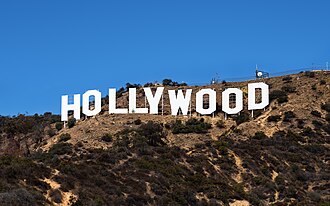
Hollywood and Los Angeles are very important to the world’s entertainment industry. Major film studios and TV networks are based there. Google, located in Mountain View, is one of the world’s biggest tech companies. California is also known for its music, with many famous styles and labels starting there. The state is home to many technology companies, including three of the “Big Five” firms.
Sports
Main article: Sports in California
See also: List of professional sports teams in California
California has many professional sports teams. There are five in the San Francisco Bay Area and ten in the Greater Los Angeles Area. The state has hosted the Summer and Winter Olympics. Los Angeles held the Summer Games in 1932, 1984, and will host again in 2028. California is where sports like surfing and skateboarding began. Popular sports in the state include golf, tennis, and motorsports.
Education
Main article: Education in California
See also: Spanish bilingual education in California
California has the most school students in the United States. Public high schools offer many courses in trades, languages, and arts. The state’s schools get more money as the economy and student numbers grow.
California is also home to many famous colleges and universities. The University of California, with its oldest campus at UC Berkeley, is the state’s main public university system. Other well-known schools include Stanford University, the California Institute of Technology, and the University of Southern California, along with many private and arts-focused colleges. The state’s higher education has three main systems: the University of California, the California State University, and the California Community Colleges.
Economy
Main article: Economy of California
California has a very big economy. In 2025, its total value was $4.250 trillion, making it the biggest economy of any U.S. state. It creates about one-seventh of the entire nation's wealth. California is home to many important companies, including 57 of the biggest 500 companies in the United States. The state has many ports, such as the Port of Los Angeles and the Port of Long Beach, which help move goods around the world.
The state’s largest jobs are in trading, transportation, and many service industries. California grows lots of food, like milk and cream, almonds, and grapes. Some areas, like Silicon Valley, are very wealthy, while others have less money. California works hard to use energy wisely and has many solar and wind power projects. The state also has many highways, airports, and public transportation systems to help people travel around.
Government and politics
Main article: Government of California
California's capital is Sacramento. The state has three main parts to its government: the executive, legislative, and judicial branches. The executive branch has the governor and other leaders chosen by voters. The legislative branch has two houses: the Assembly and the Senate. The judicial branch has the Supreme Court and smaller courts. California lets voters decide some laws by voting on propositions.
The executive branch has the governor and seven other leaders, each serving four years. The legislative branch has a Senate with 40 members and an Assembly with 80 members. Senators serve four years, and Assembly members serve two years. The judicial branch uses ideas from English common law and also has parts from Spanish civil law. It is the largest court system in the U.S., with many judges.
Images
Related articles



This article is a child-friendly adaptation of the Wikipedia article on California, available under CC BY-SA 4.0.
Images from Wikimedia Commons. Tap any image to view credits and license.