 Safekipedia
Dispersive prism
Adapted from Wikipedia · Adventurer experience
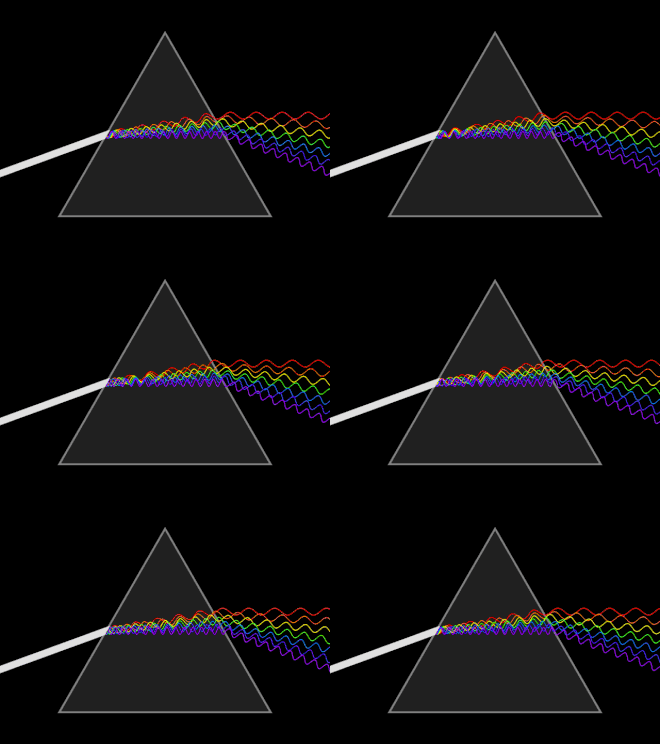
In optics, a dispersive prism is a special kind of optical prism that helps us see the many colors that make up light. When light passes through a dispersive prism, it spreads out into a rainbow of colors. This happens because different colors of light bend by different amounts when they go through the prism.
The material of the prism bends light more for some colors than for others. Usually, blue light bends more than red light. This spreading of light into its colors was studied by Sir Isaac Newton.
The most common shape for a dispersive prism is a triangle. But there are other shapes too, which can use both bending of light and a special effect called total internal reflection to spread out the colors even more.
Principle
Light changes its speed when it moves from one material to another, like from air into glass. This change in speed makes the light bend and turn at a new angle.
Because the material’s properties change with the color of the light, different colors bend by different amounts. This creates a spreading effect, like a rainbow. Prisms are good for looking at colors without mixing them up. Sometimes prisms can also reflect light, acting like a mirror in certain conditions.
Types
There are several kinds of prisms used to separate light into its colors. These include the triangular prism, Amici prism and other compound prisms, Littrow prism which has a mirror on its back, Pellin–Broca prism, Abbe prism, and Féry prism. Each type helps us see the different colors in light.
Deviation angle and dispersion
A dispersive prism separates light into its different colors. This happens because different colors of light bend by different amounts when they pass through the prism. Scientists can figure this out by watching a beam of light go through the prism and using a rule called Snell’s law.
When prisms are very thin and the light hits at a shallow angle, there is a simpler way to calculate how much the light bends. In this case, the bending of light depends mostly on the prism’s material and its shape. Using many prisms together can either increase or decrease how much the colors spread apart, depending on how they are arranged.
Main article: Multiple-prism dispersion theory
Choice of optical material for optimum dispersion
Different materials bend light in different ways, especially when the light has many colors. Some materials, like flint glass, bend the colors more than others, which helps to separate them out. However, these materials can’t see certain colors, like very purple light.
To get the best separation of colors, the shape of the prism can be changed. Often, it’s made in a special shape so that the light enters and leaves in a way that makes the colors spread out well. The most common shape for these prisms has angles of 60 degrees.
History
The word "prism" comes from ancient Greek. The mathematician Euclid first described it.
Famous scientists like René Descartes saw that light could split into colors when it passed through glass or water. Later, Isaac Newton did an experiment in 1666 with a prism. He showed that the colors of the rainbow were already in the light, and the prism separated them out. Newton wrote about these experiments in his book Opticks.
Grisms (grating prisms)
Main article: Grism
A special tool called a "grism" combines a diffraction grating with a prism. Astronomers use these tools to study the light from stars and other objects in space. By placing a grism in a camera, it can change the camera into a device that splits light into its colors, called a spectrometer. The grism makes sure the light bends just right so the colors can be seen clearly.
Another tool, called an immersed grating, also uses a prism and a diffraction grating, but the light reflects inside the prism. This helps make the colors even clearer. In both tools, the main job is done by the grating, while the prism just helps a little bit.
In popular culture
The cover of the album The Dark Side of the Moon by Pink Floyd shows a picture of a dispersive prism. This album is very famous. The picture shows white light going through the prism and spreading out into different colors.
Images
Related articles



This article is a child-friendly adaptation of the Wikipedia article on Dispersive prism, available under CC BY-SA 4.0.
Images from Wikimedia Commons. Tap any image to view credits and license.