
Epirus (region)
Epirus is a region in northwestern Greece. It borders Western Macedonia and Thessaly to the east, West Greece to the south, the Ionian Sea and Ionian Islands to the west, and Albania to the north. The area covers about 9,200 km2 (3,600 sq mi).
Epirus is part of a larger historical area that includes parts of both modern Albania and Greece. Most of it is in Greece today. This area has been important for its culture, history, and natural beauty for many years.
Geography and ecology
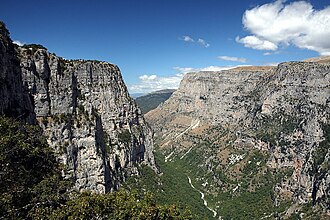
Greek Epirus is a rugged and mountainous area. It includes the lands of the ancient Molossians, Thesprotians, and Chaonians, with most of the Chaonian land lying in Southern Albania. The region has tall mountain ridges that are part of the Dinaric Alps. The highest point is Mount Smolikas, which is 2,637 metres (8,652 feet) tall. The Pindus Mountains run along the eastern edge, separating Epirus from Macedonia and Thessaly. Because of the winds from the Ionian Sea, Epirus gets more rain than any other part of Greece.
The Vikos-Aoos and Pindus National Parks are in the Ioannina Prefecture. These parks have many different plants and animals. The climate in Epirus is mostly alpine, with forests of coniferous trees. The wildlife here includes bears, wolves, foxes, deer, and lynxes.
Administration
The Epirus Region began in 1987 and was divided into smaller areas called prefectures. In 2011, Greece changed its local government. It now uses regional units and fewer municipalities instead of prefectures.
Today, Epirus has four regional units: Thesprotia, Ioannina, Arta, and Preveza. The leader of the region is Alexandros Kachrimanis. Voters chose him in 2010, 2014, and 2019.
| Regional Unit | Municipality | Population (2011) | Population (2021) | Seat |
|---|---|---|---|---|
| Ioannina | Ioannina | 112,486 | 113,094 | Ioannina |
| Ioannina | Konitsa | 6,362 | 5,325 | Konitsa |
| Ioannina | Pogoni | 8,960 | 6,859 | Kalpaki |
| Ioannina | Zagori | 3,724 | 3,384 | Asprangeloi |
| Ioannina | Metsovo | 6,196 | 5,429 | Metsovo |
| Ioannina | Zitsa | 14,766 | 13,630 | Eleousa |
| Ioannina | North Tzoumerka | 5,714 | 5,075 | Pramanta |
| Ioannina | Dodoni | 9,693 | 7,258 | Agia Kyriaki |
| Arta | Arta | 43,166 | 41,633 | Arta |
| Arta | Central Tzoumerka | 6,178 | 5,562 | Vourgareli |
| Arta | Nikolaos Skoufas | 12,753 | 11,411 | Peta |
| Arta | Georgios Karaiskakis | 5,780 | 5,321 | Ano Kalentini |
| Preveza | Preveza | 31,733 | 30,893 | Preveza |
| Preveza | Ziros | 13,892 | 13,071 | Filippiada |
| Preveza | Parga | 11,866 | 10,771 | Kanallaki |
| Thesprotia | Igoumenitsa | 25,814 | 25,709 | Igoumenitsa |
| Thesprotia | Souli | 10,063 | 8,767 | Paramythia |
| Thesprotia | Filiates | 7,710 | 6,351 | Filiates |
Communities
Municipalities
Municipal units
Economy
Epirus has rugged land, making farming difficult. Raising sheep and goats has been important, providing much of the meat in Greece, though it is now less common. Tobacco is grown near Ioannina, and there is some farming and fishing. Most food comes from other parts of Greece. The area is known for its famous dairy brands that make feta cheese and other products. Tourism, especially eco-tourism, is also important. People visit to enjoy the natural beauty, traditional villages, and local way of life.
The value of goods and services made in Epirus was €4.1 billion in 2018, which was 2.2% of all of Greece’s economy. The amount each person could buy with their money was €14,700, which is about half of the average in the European Union. This makes Epirus one of the poorer areas in Greece and the EU.
Demographics
About 320,000 people live in Epirus. It is the least populated of the 13 regions of Greece. This is because of past wars and people leaving for better jobs. The largest city is Ioannina, where many people live. Most people are Greeks, with some Aromanians and Arvanites.
The border between Greece and Albania set in 1913 moved some villages to different countries. This changed where people lived.
History
Main articles: Epirus (ancient state), Molossians, Thesprotians, Despotate of Epirus, and Epirus § History
Epirus has a long and interesting history. In ancient times, it was home to groups of people like the Molossians and Thesprotians. Later, the area was called the Despotate of Epirus, an important part of the region’s past. Today, Epirus is remembered for its rich culture and history.
Pictures
Keep exploring


This article is a child-friendly adaptation of the Wikipedia article on Epirus (region), available under CC BY-SA 4.0.
Images from Wikimedia Commons. Tap any image to view credits and license.