 Safekipedia
Etruscan civilization
Adapted from Wikipedia · Adventurer experience
The Etruscans created a civilization in Etruria in ancient Italy, forming a group of city-states with a shared language and culture. Their land covered areas that are now Tuscany, western Umbria, northern Lazio, the Po Valley, Emilia-Romagna, south-eastern Lombardy, southern Veneto, and western Campania.
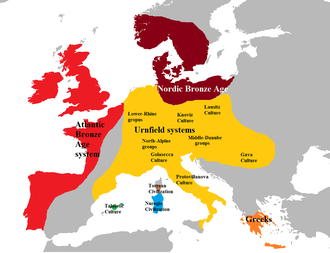
The Etruscans were likely local people of the region. Their civilization began around 900 BC during the Iron Age, developing from an earlier culture known as the Proto-Villanovan culture. By about 500 BC, they were very powerful, just before Rome grew stronger.
Etruscan cities were mostly independent. Rich families grew wealthy through trade with the Celts in the north and the Greeks in the south. They built large tombs for their families and filled them with beautiful items from other places.
The Etruscans wrote using a special alphabet that came from the Euboean alphabet, used in areas of Southern Italy called Magna Graecia. However, their language is still only partly understood today, so much of what we know about them comes from later Roman and Greek writers.
Legend and history
Main article: Etruscan history
Ethnonym and etymology
According to Dionysius of Halicarnassus, the Etruscans called themselves Rasenna, a word from the Etruscan Rasna meaning "the people". Inscriptions like Tular Rasnal and Mechlum Rasnal show this name was used to mean "boundary of the people" and "community of the people". In Attic Greek, they were known as Tyrrhenians. The Romans called them Tuscī or Etruscī. Their Roman name is where the terms Toscana and Etruria come from.
Origins
Main article: Etruscan origins
Ancient sources
We don't have any books or records written by the Etruscans, so we learn from later Roman and Greek writers. These writers had different ideas about where the Etruscans came from. Some thought they were Pelasgians who moved from Greece. Others thought they were native to central Italy.
The first Greek writer to mention the Etruscans was Hesiod in the 8th century BC. He said they lived in central Italy with the Latins. Later Greek writers started linking them to the Pelasgians.
In the 5th century BC, writers like Herodotus and Thucydides said the Etruscans came from Lydia by way of Lemnos. Strabo also supported this idea. Hellanicus of Lesbos said they came from Thessaly to Italy and were called Tyrrhenians.
There is some evidence linking Lemnos and the Etruscans. The Lemnos stele has writing that looks a lot like Etruscan.
Dionysius of Halicarnassus argued the Etruscans were native to Etruria and different from the Pelasgians and Lydians. Livy said the Rhaetians in the Alps were Etruscans pushed there by Gauls. Pliny the Elder also linked the Raeti to the Etruscans.
Archeological evidence and modern etruscology
Main articles: Proto-Villanovan culture and Villanovan culture
Modern scholars think the Etruscans were native to Italy. There's no proof of migrations from Lydia or the Pelasgians. Studies show early Etruscan culture came from the Proto-Villanovan culture. Contacts with Greece and the East happened later, during the Etruscan civilization's peak.
Archaeologists see a smooth change from the Bronze Age to the Iron Age in Etruria. This shows the Etruscans developed from people who had lived there for centuries.
Archeogenetics
Biological studies on Etruscan origins have only recently become possible with archaeogenetics. Studies show Etruscans were similar to their Latin neighbors and had a mix of ancient European ancestries. They were part of the European group, west of modern Italians. Most male Etruscans had a certain Y-DNA haplogroup.
These studies support the idea that Etruscans were native to central Italy.
Periodization of Etruscan civilization
Main article: Villanovan culture
The Etruscan civilization started with the early Iron Age Villanovan culture. The Etruscans themselves dated their origin to the 11th or 10th century BC. The Villanovan culture came from the late Bronze Age Proto-Villanovan culture. In the recent Villanovan phase (about 770–730 BC), the Etruscans began contacting Greeks in southern Italy, leading to the orientalizing period. This period saw big influences from the eastern Mediterranean and the Near East.
The later phases are called Archaic, Classical, and Hellenistic, matching the phases of ancient Greek civilization.
Chronology
Expansion
Main articles: Etruria Padana and Etruria Campana
The Etruscans expanded north beyond the Apennines and into Campania. Their metal trade, especially copper and iron, made them rich and influential. They clashed with Greeks who founded colonies in Sardinia, Spain, and Corsica.
Around 540 BC, the Battle of Alalia changed power in the western Mediterranean. Carthage gained more influence, and Etruria was limited to the northern Tyrrhenian Sea with control of Corsica. In the 5th century BC, Etruscan power began to decline after losing southern areas. By 480 BC, Carthage was defeated by cities in Magna Graecia. In 474 BC, Hiero of Syracuse defeated the Etruscans at the Battle of Cumae. Rome and the Samnites took over Etruscan areas.
In the 4th century BC, Gallic invasions ended Etruscan control of the Po Valley and the Adriatic coast. Rome began taking Etruscan cities, leading to the loss of northern areas. The Roman–Etruscan Wars ended with Rome conquering Etruria in the 3rd century BC.
Etruscan League
Main article: Etruscan cities
Legends say there was a league of 12 Etruscan cities between 600 BC and 500 BC, called the Etruscan League or Dodecapolis. It was said to be founded by Tarchon and Tyrrhenus. The cities may have included Arretium, Caisra, Clevsin, Curtun, Perusna, Pupluna, Veii, Tarchna, Vetluna, Volterra, Velzna, and Velch. Some think Rusellae was also part of it. The league was mostly for economics and religion. Later, under Roman rule, three more cities joined.
There were also leagues in Campania with Capua as the main city, and in the Po Valley with cities like Bologna, Spina, and Adria.
Possible founding of Rome
Main article: Founding of Rome
Some think Rome was first founded by Latins and then influenced by Etruscans. Others think Romans and Etruscans mixed early on. Rome was a small place until Etruscans built its first drains and walls.
Etruscan cities were often on hills with thick walls. Roman myths say Romulus and Remus founded Rome on the Palatine Hill using Etruscan rites. Etruscan influence is seen in Roman kings, customs, and symbols like the fasces. Some Roman families had Etruscan names.
Roman families of Etruscan origin
- Ancharia gens
- Arruntia gens
- Caecinia gens
- Caelia gens
- Caesennia gens
- Ceionia gens
- Cilnia gens
- Herminia gens – Patrician
- Erucia gens
- Lartia gens – Patrician
- Perpernia gens
- Persia gens
- Rasinia gens
- Sanquinia gens
- Spurinnia gens
- Tapsennia gens
- Tarquinia gens – Patrician (?)
- Tarquitia gens – Patrician
- Urgulania gens
- Verginia gens – Patrician
- Volumnia gens – Patrician
| Etruscan civilization (900–27 BC) | Villanovan period (900–720 BC) | Villanovan I | 900–800 BC |
| Villanovan II | 800–720 BC | ||
| Villanovan III (Bologna area) | 720–680 BC | ||
| Villanovan IV (Bologna area) | 680–540 BC | ||
| Orientalizing period (720–580 BC) | Early Orientalizing | 720–680 BC | |
| Middle Orientalizing | 680–625 BC | ||
| Late Orientalizing | 625–580 BC | ||
| Archaic period (580–480 BC) | Archaic | 580–480 BC | |
| Classical period (480–320 BC) | Classical | 480–320 BC | |
| Hellenistic period (320–27 BC) | Hellenistic | 320–27 BC | |
Society
Main articles: Etruscan society and Daily life of the Etruscans
Government
Main article: Etruscan governance
The Etruscans had a government that started as a kind of chiefdom but later became more like a state. Rome began as an Etruscan state before becoming an Italic one. The Etruscan government changed from a rule by one king to a group of leaders called an oligarchy, similar to what later happened in Rome.
The government was a central power over all tribes and clans. It had the power to make big decisions. A symbol of this power was the gorgon, which appeared in Etruscan art. The people were united by a common religion. The basic unit of political organization was the city-state, called a "methlum". Etruscan texts mention several leaders with different titles, such as camthi, parnich, and tamera, though their exact roles are not well understood.
Importance of Religion in the Government
Main article: Etruscan governance
Religion was very important in Etruscan government. The king, called a lucomo, was seen as the main leader and also a religious figure. Priests called haruspices looked at signs in the sky and animal parts to understand what the gods wanted. This mix of political and religious power was strong in Etruscan life. Even after the government changed from a kingdom to a republic, religion stayed important. Kings and leaders used religious rituals to keep peace with the gods.
While Etruscan city-states like Tarquinia and Veii were independent, scholars think that women could take part in public life. Etruscan art showed respect for female gods, and women were seen in public events.
The twelve main Etruscan city-states formed a group called the "duodecim populi Etruriae". Once a year, they met at a holy place called Fanun Voltumnae to choose a leader and discuss important matters. These meetings were also religious festivals. Decisions were believed to need approval from the gods.
Religion was also part of the layout of cities. Temples were not just for worship; they were places where leaders made decisions.
The Etruscan way of mixing religion and government influenced later Roman practices. When Rome took over Etruscan cities, they adopted many of these religious and government ideas.
Family
Main articles: Etruscan society: Rise of the family and Women in Etruscan society
Etruscan families were very important. Tombs were made for whole families over many years, showing how strong family ties were. Wealth from trade helped families grow in importance, especially in coastal cities.
The center of Etruscan society was the married couple. Etruscan society was monogamous, meaning one husband and one wife. Women had more freedom than in nearby Greek and early Roman societies. Some pictures show women and men together in social events. Inscriptions on tombs often listed both the father’s and mother’s names, showing that the mother’s family was also respected.
Military
Main article: Etruscan military history
See also: Padanian Etruria
The Etruscans had a strong tradition of warfare, like Ancient Greece and Rome. Fighting was common in the summer. Etruscan armies raided nearby areas to get land, goods, and people. Winning battles brought prestige and resources.
Some important events in Etruscan military history include:
- 550 BC: Etruscan and Punic forces fought against Greece near Corsica
- 540 BC: Naval victory at Alalia
- 524 BC: Defeat at Cyme against the Greeks
- 510 BC: End of Etruscan rule in Rome
- 508 BC: Lars Porsena besieged Rome
- 508 BC: War between Clusium and Aricia
- 482 BC: Start of conflict between Veii and Rome
- 474 BC: Defeat against Syracuse at the Battle of Cyme
- 430–406 BC: Defeat by the Samnites in Campania
- 406 BC: Rome besieged Veii
- 396 BC: Rome destroyed Veii
- From 396 BC: Celts moved into the Po Valley
- 384 BC: Pyrgi was attacked by Dionysius I of Syracuse
- 358 BC: Tarquinia and Cerveteri allied against Rome
- 310 BC: Defeat by Rome at Lake Vadimone
- 300 BC: Pyrgi became a Roman colony
- 280 BC: Vulci defeated by Rome
- 264–100 BC: Volsinii defeated by Rome
- 260 BC: Gauls took control of the Po Valley
- 205 BC: Etruscans helped Scipio against Hannibal
- 183 BC: Rome founded a colony in Saturnia
- 90 BC: Etruscans gained Roman citizenship
- 82 BC: Sulla suppressed Etruria
- 79 BC: Volterra surrendered
- From 40 BC: Etruria fully became part of Rome
Cities
Main article: Etruscan cities
Etruscan civilization is known for its cities. These cities were later taken over by Italic, Celtic, or Roman groups, but their names and ruins remain important for understanding history. Etruscan cities were spread across central Italy during the Roman Iron Age. Some were founded by the Etruscans and kept Etruscan names, while others were given Etruscan names by Etruscan settlers.
Culture
Agriculture
The Etruscans knew how to manage water from places like Egypt and Greece. They built canals and dams to help water their crops and used land that had been swamps. You can still see some of these old structures near the coast in Tuscany.
They had a special way of growing grapes called vite maritata, which means "married vines." This method involved planting vines close to trees like maples or willows. This technique came from the Maremma region.
Religion
The Etruscans believed that many gods and goddesses controlled everything around them. These gods could help or trouble people, and the Etruscans tried to understand what the gods wanted. Two important figures, Tages and Vegoia, were said to have been born from the earth and taught the Etruscans about the gods.
There were many gods and goddesses, like Catha and Usil (the sun), Turan (the goddess of love), and Laran (the god of war). The most important gods were Tinia (the sky), Uni (his wife), and Cel (the earth). Some of their gods were similar to Greek and Roman gods, like Menrva (similar to Minerva) and Pacha (similar to Dionysus).
Architecture
Not much is known about Etruscan buildings. They used styles from local Italian people but also got ideas from Greek buildings. Later, Roman buildings started with Etruscan styles and then added more Greek ideas. Etruscan temples looked different from Greek ones, but they also used stone like the Greeks did. Rich Etruscans lived in big, comfortable houses, but most of what we know comes from tombs. In some places, tombs were cut into rocks and covered by mounds.
Art and music
Etruscan artists made many things between the 9th and 2nd centuries BC. They were especially good at making sculptures from clay, painting walls, and working with metal, like bronze mirrors. They also made pottery, including black bucchero ware, and painted designs on vases.
Etruscan music used different kinds of pipes, like the plagiaulos, and percussion instruments such as the tintinnabulum and tympanum. Later, they also used string instruments like the lyre and kithara.
Language
Etruscans left behind about 13,000 writings, but most are very short. These writings date from 700 BC to AD 50. Scholars think the Etruscan language was not related to most other languages and may have been part of a group called the Tyrsenian languages.
Literature
Etruscan writing used a version of the Greek alphabet, which they got from Greek colonies nearby. Most of their writings that survive are short inscriptions, often on tombs, and a few short religious texts. They also had some longer texts, like the Liber Linteus, but these are rare. The Etruscans wrote from around 700 BC until the early 1st century AD.
The Etruscans shared their writing system with the Romans, who adapted it for Latin. The Roman alphabet used some Etruscan letters, like C, K, and Q, and later added new letters like G. The Etruscan alphabet also influenced other scripts in Italy.
| Euboean alphabet | ||||||||||||||||||||||||||
|---|---|---|---|---|---|---|---|---|---|---|---|---|---|---|---|---|---|---|---|---|---|---|---|---|---|---|
| Letter |  |  |  |  |  |  |  |  |  |  |  |  |  |  |  |  |  |  |  |  |  |  |  |  |  |  |
| Transcription | A | B | G | D | E | V | Z | H | TH | I | K | L | M | N | X | O | P | Ś | Q | R | S | T | U | X | PH | CH |
| Early Etruscan alphabet | ||||||||||||||||||||||||||
|---|---|---|---|---|---|---|---|---|---|---|---|---|---|---|---|---|---|---|---|---|---|---|---|---|---|---|
| Letter |  |  |  |  |  |  |  |  |  |  |  |  |  |  | | |  |  |  |  |  |  |  |  |  |  |
| Transcription | A | B | C | D | E | F | Z | H | TH | I | K | L | M | N | S | O | P | SH | Q | R | S | T | U | X | PH | KH |
Images
Related articles


This article is a child-friendly adaptation of the Wikipedia article on Etruscan civilization, available under CC BY-SA 4.0.
Images from Wikimedia Commons. Tap any image to view credits and license.