 Safekipedia
French Renaissance architecture
Adapted from Wikipedia · Adventurer experience
French Renaissance architecture was a special building style in the Kingdom of France from the late 1500s to the early 1600s. It came after a style called French Gothic architecture and was brought from Italy after a war called the Hundred Years' War. Kings like Charles VII, Louis XI, Charles VIII, Louis XII, and François I helped bring this new style to France.
Many beautiful houses called châteaux were built in this style, especially in the Loire Valley. Famous examples include the Château de Montsoreau, the Château de Langeais, the Château d'Amboise, the Château de Blois, the Château de Gaillon, the Château de Chambord, and near Paris, the Château de Fontainebleau.
French Renaissance architecture had two main periods. In the first period, from around 1491 to 1540, builders copied the Italian style closely. In the second period, from 1540 until 1589, French builders added their own touches. Important architects included Philibert Delorme, Pierre Lescot, Jean Bullant, and the Italian architect Sebastiano Serlio.
History – the Italian period
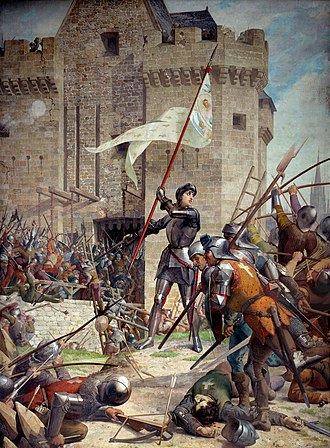
During the Hundred Years' War, Charles VII found the Loire Valley to be a safe place. He was crowned in Reims after battles led by Joan of Arc, which helped drive the English out of France. This time was very important for building in the Loire Valley. Kings and important people built homes there, updating old forts or building new ones. Charles VII lived in Chinon until 1450, and he and the future King Louis XI started many building projects. This marked the start of building many beautiful homes known as the Châteaux of the Loire Valley.
From 1443 to 1453, the main building of the Château de Montsoreau was built along the Loire River by Jean II de Chambes, an important advisor to the king. Between 1465 and 1469, Louis XI ordered the building of the Château de Langeais. In 1494, Charles VIII traveled to Italy and saw new styles of gardens and buildings that he loved. After facing some challenges, he brought back skilled workers from Italy to help redesign his home at the château in Amboise.
Château de Montsoreau (1450–1461)
In 1453, after the Hundred Years' War ended, Charles VII allowed Jean II de Chambes to build the Château de Montsoreau right on the banks of the Loire River. The design mixed older military styles with new comfortable living spaces. The main building went up in 1453, and between 1453 and 1461, two square sections were added.
Château d'Amboise (1491–1498)
In 1491, before his trip to Italy, Charles VIII started updating the Château d'Amboise to make it more comfortable. After returning from Italy in 1496, many workers were already busy changing the château. Some parts still looked medieval, but new additions like large windows and decorative pillars showed the new Renaissance style. Charles did not live to see it fully finished.
Château de Gaillon and Château de Bury
Not all new building styles were in the Loire Valley. Georges d'Amboise, an important church leader and advisor, updated his home along the Seine River, the Château de Gaillon, using ideas from Italy. He added beautiful decorations like fountains and carved designs. The Château de Bury, built starting in 1511, was designed just for living, with a balanced shape and elegant decorations inspired by buildings in Florence and Rome.
Château d'Azay-le-Rideau (1518–1527)
As kings and their advisors spent more time in the Loire Valley, many built grand homes nearby. The Château d'Azay-le-Rideau was built on an island in the Ile River by Gilles Berthelot, a wealthy advisor to the king. The château featured tall towers and decorative roof windows.
Château de Blois (1519–1536)
The Château de Blois started under Louis XII but became very important when François I took it over. François made it his main home and added new designs inspired by buildings in Rome, including fancy decorations.
Château de Chambord (1519–1538)
The Château de Chambord became a wonderful mix of French and Italian styles. François I wanted a comfortable hunting home, and building began in 1519. The design included both strong medieval towers and beautiful Renaissance decorations. Inside, there were symmetrical rooms.
The Château de Fontainebleau
After 1526, François I moved his court closer to Paris and built or updated several homes, the most important being the Château de Fontainebleau. The architect Gilles Le Breton helped change the old courtyard and add new decorations. Later artists from Italy added rich paintings and sculptures inside.
Other châteaux of François I period
François I also started building other homes near Paris. The largest was the Château de Madrid in Neuilly, though it was later torn down. Another was the Château of Saint-Germain-en-Laye, which got a new flat roof and fancy decorations. Other notable homes from this time include the Château d'Ancy-le-Franc in Burgundy.
Second period – Classical influence
The second period of French Renaissance architecture started around 1540, during the rule of François I, and lasted until 1559, when Henry II passed away. This time is often called the peak of this style. Both Italian and French architects worked on these buildings, including Giacomo Vignola, Sebastiano Serlio, Philibert Delorme, Jacques I Androuet du Cerceau, Pierre Lescot, Jean Bullant, and sculptor Jean Goujon.
Buildings from this period used ancient Classical orders like columns and pilasters in a special way. They started with the heaviest style, the Doric order, at the bottom, then used the Ionic style in the middle, and the lightest, the Corinthian style, at the top. Architect Philibert Delorme even created two new styles by adding decorative bands to regular columns.
These buildings had many decorative plaques and sculptures on their walls, inspired by ancient Greek and Roman art. These decorations included shapes like caryatides, fancy cartouches, statues of Fame, and figures such as satyrs and griffons, along with carved cloth and garlands. They also used the initials of the building’s owner in a stylish way.
The Château d'Anet was built by Philibert Delorme for Diane de Poitiers, a favorite of Henry II, between 1547 and 1552. Though only a few parts remain, the main entrance shows the three classical orders stacked together—a first in France. The chapel inside had a dome with a spiral design.
The Château d'Écouen, designed by Jean Bullant from 1538 to 1550, shows classical orders on its front and looks like the Pantheon in Rome. Inside, visitors can still see beautiful tiled floors and fancy fireplaces. Today, it serves as the French National Museum of the Renaissance.
The Lescot Wing of the Louvre Palace was rebuilt starting in 1546 under François I and finished by Henry II. Designed by Pierre Lescot, it mixes Italian and French styles. The outside has arches on the bottom and tall columns going up. The top floor has windows and sculptures. Inside, there are special supports called caryatides and a ceiling with hunting scenes, both made by Jean Goujon.
The hôtel d'Assézat in Toulouse was built between 1555 and 1562 by architect Nicolas Bachelier and later his son Dominique. This building shows a mix of Italian and French styles, with detailed decorations around its courtyard. The columns on its walls follow the Doric, Ionic, and Corinthian orders, just like famous ancient buildings. The use of different colored bricks and stones, along with carved designs, makes it stand out.
Religious architecture
The Renaissance did not change French religious buildings much; most cathedrals and churches were still built in the Gothic style. But a few churches added some new, classical touches. For example, Saint-Germain l'Auxerrois and Saint-Nicolas-des-Champs in Paris have classical-style doors. The church of Saint-Étienne-du-Mont mixes Gothic and classical styles, with a classic-style front and special columns inside.
The Church of Saint-Eustache in Paris is one of the largest churches there, started by François I. It mixes Gothic and Renaissance styles, with a Gothic outside but classical columns inside.
Last projects
After King Henry II passed away, France had hard times with the French Wars of Religion, which slowed down building. But some important Renaissance projects still began, mostly thanks to Catherine de Medici, Henry II's widow.
The biggest project was the new Tuileries Palace. It was designed by the king's main architect, Philibert Delorme, to be a modern palace with a big park near the city. The palace had a central part with lower wings with arches and rooms above, decorated with special windows. All the outside walls were beautifully decorated in an Italian style, with long carved figures inspired by the artist Michelangelo. After Delorme died in 1570, another architect, Jean Bullant, took over, but work stopped again after a sad event in 1572 and wasn’t finished for many years.
Catherine de Medici also brought Italian design to Fontainebleau by adding a new part called the Aile de la Belle Chiminée. The outside of this wing was designed by Francesco Primaticcio and mixed Italian and French styles, with columns, statues, a tall roof, and special designs at the top.
Another important building from this time was the Château de Verneuil, planned by the young architect Salomon de Brosse in 1576 for Henry IV of France. Its balanced design, corner towers, and hidden roof showed the French Renaissance style at the end of the 16th century.
Catherine de Medici also added to the Château de Chenonceau. The bridge over the Cher river was built by Philibert Delorme. After he died in 1570, she asked Jean Bullant to create a special walkway on top of the bridge in 1576. Bullant also planned to build more buildings around the bridge, but these were never built.
Images
Related articles


This article is a child-friendly adaptation of the Wikipedia article on French Renaissance architecture, available under CC BY-SA 4.0.
Images from Wikimedia Commons. Tap any image to view credits and license.