
German-occupied Europe
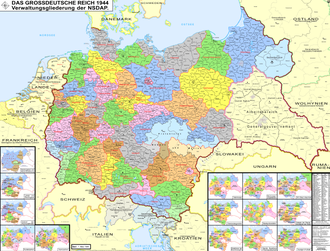
Between 1938 and 1945, Nazi Germany took control of large parts of Europe. At its peak in 1941 and 1942, Germany and the other Axis powers, including Italy, governed more than half of the continent's people. They ruled in different ways, including direct rule, civil occupation, military occupation, and puppet states. Germany's growth under the Nazi Party and Adolf Hitler led to the start of World War II in 1939. In some of the occupied countries, especially Poland, there were many Nazi camps. These camps were part of what later became known as the Holocaust, a time when many people were harmed.
The Wehrmacht, the German armed forces, controlled European land reaching as far north and east as Franz Josef Land in the Soviet Union, as far south as Gavdos in Greece, and as far west as Ushant in France.
German weather stations in Europe reached as far north as Schatzgräber on Franz Josef Land's Alexandra Land. The Kriegsmarine, Germany's navy, worked around the world during World War II. However, it focused mainly on gaining and keeping control of the North Atlantic, especially the North Sea.
History
See also: Areas annexed by Nazi Germany
Several countries that Germany occupied had first joined World War II as Allies of the United Kingdom or the Soviet Union. Some gave up before the war started, like Czechoslovakia. Others, like Poland, which was invaded on 1 September 1939, were defeated in battle and then occupied.
In some cases, the real governments had to leave their country. In other cases, governments-in-exile were set up by their citizens in other Allied countries. Some countries that were occupied by Nazi Germany had stayed officially neutral. Others had been members of the Axis powers, but German forces later occupied them too, such as Italy and Hungary.
Concentration camps
Main article: Nazi concentration camps
Germany ran many concentration camps in the parts of Europe it controlled. The first camps opened in March 1933, right after Adolf Hitler became Chancellor of Germany. In 1934, the Sturmabteilung (SA) was removed from power. After that, only the Schutzstaffel (SS) ran the camps. At first, most prisoners were members of the Communist Party of Germany. Later, other groups were also arrested, including "habitual criminals", "asocials", and Jews.
After World War II began, people from the occupied countries of Europe were also sent to the camps. Many people were held there, and many of them died. Most of these deaths happened in the second half of the war. In 1944 and 1945, the camps were gradually freed as the Allies won battles. Many prisoners died on the long marches that took place during this time. In Eastern Europe, many people were gathered up in large groups. In some camps, most of the prisoners were Poles. Some prisoners were sent to Auschwitz or to other camps nearby.
Occupied countries
The countries that were occupied included all, or most, of the following nations or territories:
Governments in exile
Allied governments in exile
Axis governments in exile
Neutral governments in exile


| Government in exile | Capital in exile | Timeline of exile | Occupier(s) |
|---|---|---|---|
 Kingdom of Bulgaria |  Vienna, Greater German Reich | Sep 16, 1944 – May 10, 1945 | Kingdom of Bulgaria Kingdom of Greece  Kingdom of Yugoslavia |
 French State | Sigmaringen, Greater German Reich | 1944 – Apr 22, 1945 |  Provisional Government of the French Republic |
 Kingdom of Hungary | Vienna, Greater German Reich | Mar 28/29, 1945 – May 7, 1945 |  Czechoslovak Republic Kingdom of Hungary  Kingdom of Romania Kingdom of Yugoslavia |
| Kingdom of Romania | Vienna, Greater German Reich | 1944–1945 | Kingdom of Romania |
 Montenegrin State Council |  Zagreb, Independent State of Croatia | Summer of 1944 – May 8, 1945 | Kingdom of Yugoslavia |
 Slovak Republic | Kremsmünster, Great-German Reich | Apr 4, 1945 – 8 May 1945 | Czechoslovak Republic |
 Government of National Salvation | Kitzbühel, Great-German Reich | Oct 7, 1944 – 8 May 1945 |  Soviet Union |
| Government in exile | Capital in exile | Timeline of exile | Occupier(s) |
|---|---|---|---|
 Belarusian Democratic Republic | Prague, Czechoslovak Republic (1923–1938) | 1919 – present | German Reich/Greater German Reich Realm Commissariat East Realm Commissariat Ukraine Republic of Poland  Soviet Union |
 Republic of Estonia |  Stockholm, Kingdom of Sweden (1944 – Aug 20, 1991) | Jun 17, 1940 – Aug 20, 1991 | Reichskommissariat Ostland Soviet Union |
 Ukrainian People's Republic | Warsaw, Republic of Poland (1920–1939) | 1920 – Aug 22, 1992 | German Reich/Greater German Reich Kingdom of Hungary Kingdom of Romania Reichskommissariat Ukraine Soviet Union |

Pictures
Keep exploring



This article is a child-friendly adaptation of the Wikipedia article on German-occupied Europe, available under CC BY-SA 4.0.
Images from Wikimedia Commons. Tap any image to view credits and license.