 Safekipedia
Jamaica
Adapted from Wikipedia · Adventurer experience
Jamaica is an island country in the Caribbean. It is the third-largest island in the Greater Antilles. Jamaica lies south of Cuba and west of Hispaniola, the island with Haiti and the Dominican Republic.
The Indigenous Ciboney people were there first. Later, Spain took control. Many Indigenous people died, and Spain brought Africans to work as slaves. In 1655, England took over and named the island Jamaica. Jamaica became independent from the United Kingdom on 6 August 1962.
Today, Jamaica is a parliamentary constitutional monarchy. Its capital is Kingston. Many Jamaicans live outside the country, especially in Canada, the United Kingdom, and the United States. Most Jamaicans have Sub-Saharan African ancestry, with some of European, East Asian (mainly Chinese), Indian, Lebanese, and mixed-race backgrounds.
Jamaica is famous for its music and culture. It gave the world the Rastafari religion and reggae music, as well as dub, ska, and dancehall. The country is also known for sports like cricket, sprinting, and athletics. Tourism is very important, with many visitors coming to enjoy its beaches and resorts each year.
Etymology
The Ciboney people, who lived on the island, called it Xaymaca in their language. This means "Land of Wood and Water" or "Land of Springs." Early explorers like Christopher Columbus may have called it Yamaye.
Today, Jamaicans often call their home "yaad," a word in Jamaican Patois meaning home. Other fun names include "Jamrock," "Jamdown" (or "Jamdung" in Jamaican Patois), and even just "Ja."
History
Main article: History of Jamaica
Prehistory
Main article: Pre-Columbian Jamaica
People did not live on Jamaica until about 500 CE. A group called the "Redware people" arrived around 600 CE. They were followed by the Taíno people around 800 CE, who most likely came from South America. They farmed and fished, and at their peak, they may have had around 60,000 people living in about 200 villages led by leaders known as caciques. The south coast of Jamaica, especially near Old Harbour, was the most crowded area.
Spanish rule (1509–1655)
Main article: Colony of Santiago
Christopher Columbus was the first European to see Jamaica, claiming it for Spain after landing there in 1494 on his second trip to the Americas. He likely landed at Discovery Bay, and named St. Ann's Bay “Saint Gloria.” He returned in 1503 but was shipwrecked and had to stay on the island for a year.
The first Spanish settlement was at Sevilla, built in 1509 by Juan de Esquivel but abandoned around 1524 because it was too unhealthy. The capital moved to Spanish Town, called St. Jago de la Vega, around 1534. Many Taíno people died from diseases brought by the Spanish. To replace them, the Spanish brought slaves from Africa to the island.
Some slaves escaped and formed communities in remote areas, mixing with the remaining Taíno people. These groups were known as Maroons. Many Jews also fled to Jamaica from Spain.
Early British period
Main article: Colony of Jamaica
The English invaded Jamaica in 1655, led by Admiral William Penn and General Robert Venables. Battles in 1657 and 1658 led to Spanish losses, and the English took control. The English government formed in 1661.
When the English took over, most Spanish colonists left, but some Spanish Jews stayed. The Spanish freed their slaves before leaving, and many slaves ran away to join the Maroon communities. Over time, these Maroons kept their freedom in the mountains.
The Spanish tried to take Jamaica back several times, so the British supported pirates who attacked Spanish ships. This made piracy common in places like Port Royal. Spain finally recognized British control in 1670.
In 1660, Jamaica had about 4,500 white people and 1,500 black people. As sugar plantations grew, the number of enslaved Africans increased, and they became the majority of the population. The Irish in Jamaica also became a big part of the population.
18th–19th centuries
Main article: Slavery in colonial British America
During the 1700s, Jamaica’s economy grew, especially from sugar, coffee, cotton, and indigo, all worked by enslaved people. Many slaves escaped and joined the Maroons, leading to conflicts known as The First Maroon War (1728 – 1739/40). The British made peace with the Maroons in treaties in 1739 and 1740.
A big slave rebellion called Tacky's War happened in 1760 but was stopped by the British and their Maroon allies. After another conflict in 1795–96, many Maroons were sent away to Nova Scotia and later Sierra Leone.
By the early 1800s, black people greatly outnumbered white people in Jamaica. Although the British banned the slave trade in 1807, slavery itself continued. In 1831, a large rebellion called the Baptist War broke out, led by a Baptist preacher named Samuel Sharpe.
Because of such rebellions and efforts by people who opposed slavery, Britain ended slavery in its empire in 1834, with full freedom declared in 1838. After slavery ended, Britain brought in workers from India and China to work on plantations. Jamaica’s population grew, but many people lived in poverty. In 1865, a rebellion led by Paul Bogle was harshly put down. New leaders worked to improve life for Jamaicans.
Early 20th century
In 1907, a big earthquake and fire caused damage in Kingston.
Unemployment and poverty were problems, leading to movements for change. Marcus Garvey started the Universal Negro Improvement Association and African Communities League in 1917, seeking better rights for people and inspiring the Rastafari religion in the 1930s.
The Great Depression of the 1930s hurt Jamaica badly, leading to strikes and riots. This led to reports suggesting reforms. A new House of Representatives was created in 1944, and Jamaica’s two-party system began, with the Jamaican Labour Party and the People's National Party forming.
Jamaica gained more independence from Britain. In 1958, it joined the Federation of the West Indies but left in 1962 to become fully independent on August 6, 1962. It stayed part of the Commonwealth of Nations and kept a system of government similar to Britain’s. Alexander Bustamante became the first prime minister.
Post-independence era
Main article: Independence of Jamaica
In the years after independence, Jamaica grew quickly, especially in mining, tourism, manufacturing, and farming. Jamaica joined the Non-Aligned Movement, keeping strong ties with Britain and the United States while also building relationships with other countries.
Different parties took power over the years. Social reforms were made, and ties with other nations were strengthened. Economic challenges came, especially in the 1970s and 1980s, but reforms were made to improve the country.
Elections continued, with changes in leadership between the two main parties. Economic reforms and infrastructure improvements were made, along with support for people in need.
In recent years, Jamaica has continued to hold elections, with changes in leadership between the two main parties. Economic challenges have persisted, and voter turnout has sometimes been low.
Government and politics
Main article: Politics of Jamaica
Further information: Foreign relations of Jamaica and Republicanism in Jamaica
Jamaica is a parliamentary democracy and constitutional monarchy. The head of state is the King of Jamaica (currently King Charles III). The king is represented by the Governor-General of Jamaica. The governor-general is chosen by the Prime Minister and the Cabinet and then appointed by the king. The monarch and governor-general mainly have ceremonial roles. Jamaica’s current constitution was created in 1962 when the country became independent.
Jamaica’s Parliament has two parts: the House of Representatives and the Senate. Members of the House are elected, and the governor-general chooses one to be Prime Minister. Senators are chosen by the Prime Minister and the Leader of the Opposition, then appointed by the governor-general.
The Jamaica Defence Force (JDF) is Jamaica’s small but professional military. It is organized similarly to the British military. Officer candidates go to training courses in Britain or Canada. Soldiers train at camps in St. Andrew. The JDF includes an infantry regiment, an Air Wing, a Coast Guard, and an Engineering Unit. It has sometimes helped the police with safety in areas with high crime.
Main article: Parishes of Jamaica
Jamaica is divided into 14 parishes. These parishes are called “Local Authorities.” Some are city municipalities, like Kingston & St. Andrew, and others are town municipalities. The newest city municipality is Portmore, created in 2003.
| Cornwall County | Capital | km2 | Middlesex County | Capital | km2 | Surrey County | Capital | km2 | |||
| 1 | Hanover | Lucea | 450 | 6 | Clarendon | May Pen | 1,196 | 11 | Kingston | Kingston | 25 |
| 2 | St. Elizabeth | Black River | 1,212 | 7 | Manchester | Mandeville | 830 | 12 | Portland | Port Antonio | 814 |
| 3 | St. James | Montego Bay | 595 | 8 | St. Ann | St. Ann's Bay | 1,213 | 13 | St. Andrew | Half Way Tree | 453 |
| 4 | Trelawny | Falmouth | 875 | 9 | St. Catherine | Spanish Town | 1,192 | 14 | St. Thomas | Morant Bay | 743 |
| 5 | Westmoreland | Savanna-la-Mar | 807 | 10 | St. Mary | Port Maria | 611 | ||||
Geography and environment
Main articles: Geography of Jamaica and Geology of Jamaica
Jamaica is the third-largest island in the Caribbean. It lies between 17° and 19°N and 76° and 79°W. The island has many mountains, like the Dry Harbour Mountains and the Blue Mountains. The tallest point is Blue Mountain Peak, which is 2,256 meters high. These mountains are surrounded by a narrow coastal plain.
Jamaica has two main cities. Kingston is the capital and is a busy place on the south coast. Montego Bay is a famous tourist spot on the north coast. Other towns include Portmore, Spanish Town, Savanna la Mar, Mandeville, and resort towns such as Ocho Ríos, Port Antonio, and Negril.
The weather in Jamaica is tropical and hot, but it can be cooler in the higher areas. Jamaica is sometimes affected by hurricanes. Some well-known storms include Charlie in 1951, Gilbert in 1988, and Hurricane Melissa in 2025.
Jamaica has many plants and animals. When Europeans first arrived, the island was full of forests. Today, it still has many native plants, including over 1,000 types found only there. The island is also home to unique animals such as bats, the Jamaican hutia, and many bird species, including the national symbol, the red-billed streamertail.
The waters around Jamaica are full of fish and marine life, but pollution and development make it hard to keep these resources safe. People are working to protect these important natural areas.
Demographics
Jamaica's population is mostly of African descent, with many tracing their roots to West African countries like Ghana and Nigeria. Other groups include people of European, South Asian, and East Asian backgrounds. Most Jamaicans see themselves as part of a shared national identity.
Jamaica uses two main languages: (Jamaican) English, which is used in schools, government, and official settings, and Jamaican Patois, a local creole language spoken in everyday life. Many Jamaicans can understand and speak both languages. Some also use Jamaican Sign Language or American Sign Language.
Many Jamaicans live outside of Jamaica, especially in the United Kingdom, the United States, and Canada. Large communities can be found in cities like New York City, London, and Toronto. These communities help keep Jamaican culture alive around the world.
Jamaica's diverse ethnic roots are reflected in the national motto "Out of Many One People".
Most of the population are of African or partially African descent, with many being able to trace their origins to the West African countries of present-day Ghana and Nigeria. Other major ancestral areas are Europe, South Asia, and East Asia. It is uncommon for Jamaicans to identify themselves by race, with most Jamaicans seeing Jamaican nationality as an identity in and of itself, identifying as simply being "Jamaican" regardless of ethnicity.
Asians form the third-largest group and include Indo-Jamaicans and Chinese Jamaicans. Most are descended from indentured workers brought by the British colonial government to fill labour shortages following the abolition of slavery in 1838.
The first wave of English immigrants arrived on the island in 1655 after conquering the Spanish. The first Irish immigrants came to Jamaica in the 1600s. In the 1650s, Oliver Cromwell exiled Scots prisoners of war to Jamaica, and as a result, Scots and Scottish Jamaicans have made a significant impact on the island.
There is also a significant Jamaican population of Portuguese descent.
Languages
Jamaica is regarded as a bilingual country, with two major languages used by the population. The official language is (Jamaican) English, which is used in all areas of public life. However, the primary spoken language is an English-based creole language called Jamaican Patois (or Patwa).
Additionally, some Jamaicans use one or more of Jamaican Sign Language (JSL), American Sign Language (ASL) or the declining indigenous Jamaican Country Sign Language (Konchri Sain).
Emigration
Many Jamaicans have emigrated to other countries, especially the United Kingdom, the United States, and Canada. In the case of the United States, about 20,000 Jamaicans per year are granted permanent residence. There has also been emigration of Jamaicans to other Caribbeans countries such as Cuba, Puerto Rico, Guyana, and The Bahamas.
About 800,000 Jamaicans live in the United Kingdom. Large-scale migration from Jamaica to the UK occurred primarily in the 1950s and 1960s when the country was still under British rule. There are Jamaican communities in most large UK cities. Concentrations of expatriate Jamaicans are quite considerable in numerous cities in the United States, including New York City, Buffalo, the Miami metro area, Atlanta, Chicago, Orlando, Tampa, Washington, D.C., Philadelphia, Hartford, Providence and Los Angeles. In Canada, the Jamaican population is centred in Toronto, with smaller communities in cities such as Hamilton, Montreal, Winnipeg, Vancouver and Ottawa.
Major cities
See also: List of cities and towns in Jamaica
| Ethnic origin | Percentage | Approx. Population |
|---|---|---|
| African descent | 76.3 | 2,047,668 |
| Afro-European | 15.1 | 405,240 |
| East Indian and Afro-East Indian | 3.4 | 91,246 |
| White | 3.2 | 85,878 |
| Chinese | 1.2 | 32,224 |
| Other | 0.8 | 21,470 |
| Total | 100.0% | 2,683,707 |
Largest cities or towns in Jamaica Demographic Statistics 2016, pp. 15–16 (2011 Census) | |||||||||
|---|---|---|---|---|---|---|---|---|---|
| Rank | Name | Parish | Pop. | ||||||
| 1 | Kingston | Kingston | 661,862 | ||||||
| 2 | Portmore | Saint Catherine | 182,153 | ||||||
| 3 | Spanish Town | Saint Catherine | 147,152 | ||||||
| 4 | Montego Bay | Saint James | 110,115 | ||||||
| 5 | May Pen | Clarendon | 61,548 | ||||||
| 6 | Mandeville | Manchester | 49,695 | ||||||
| 7 | Old Harbour | Saint Catherine | 28,912 | ||||||
| 8 | Savanna-la-Mar | Westmoreland | 22,633 | ||||||
| 9 | Ocho Rios | Saint Ann | 16,671 | ||||||
| 10 | Linstead | Saint Catherine | 15,231 | ||||||
Religion
Main article: Religion in Jamaica
Most people in Jamaica practice Christianity. Many belong to groups such as the Church of God, Seventh-day Adventist Church, and Baptist.
Another important faith in Jamaica is the Rastafari movement. It honors leaders like Marcus Garvey and Haile Selassie.
Other beliefs in Jamaica include Kumina, Jehovah's Witnesses, Bahá'í faith, Mormonism, Buddhism, and Hinduism. The Indo-Jamaican community celebrates Diwali each year.
There is also a small group of Jews in Jamaica, with a historic synagogue in Kingston.
Education
Main article: Education in Jamaica
After slaves were freed, Jamaica started building schools for everyone. Before that, most children went to school in England. New schools called All Age Schools were created, mostly by churches. This started Jamaica's school system.
Today, Jamaica has many types of schools. Young children go to early childhood schools from ages 2 to 5. Children aged 3 to 12 go to primary schools, which can be public or private. Secondary schools are for ages 10 to 19 and can be public or private. Some follow old school styles from England.
There are also colleges and universities, including the University of the West Indies, University of Technology, Jamaica, Northern Caribbean University, University of the Commonwealth Caribbean, and International University of the Caribbean. Education is free from early childhood through secondary school. There are also training programs and scholarships for those who want to study more.
Economy
Main article: Economy of Jamaica
Jamaica has a mixed economy with both government and private businesses. Important parts of the economy include agriculture, mining, manufacturing, tourism, petroleum refining, and services like financial and insurance work. Tourism and mining bring in the most money from other countries. About half of Jamaica's economy comes from services, especially tourism. Many visitors come to Jamaica each year. Jamaica is an upper-middle income country, but it can be affected by things like climate change, flooding, and hurricanes.
Since the early 1980s, Jamaica has made changes to help private businesses grow. This has included removing controls on money exchange, lowering taxes, and making it easier for foreign investment. The government has focused on keeping spending under control and opening up trade.
After gaining independence, Jamaica's economy grew quickly but slowed down in the 1980s. From 2001, banks that had problems were sold back once they were stable again.
Recently, Jamaica's economy has been improving. Farm production has grown, with increases in crops like corn, plantains, and bananas. Jamaica is also a big producer and exporter of bauxite, and it has large amounts of limestone. The tourism industry has grown a lot since 2017, with more visitors each year. Jamaica's top visitors come from North America, South America, and Europe. The country has won awards for its tourism.
Jamaica exports products like sugar, bananas, cocoa, and rum. The country has many industries, including aviation, engineering, light manufacturing, food processing, and more. Jamaica's science and technology sector is guided by government groups, and Jamaicans have made important discoveries in health and space technology.
Post–independence
Recent advancements
Tourism industry
Industries
Science and technology
Main articles: Science and technology in Jamaica and List of Jamaican inventions and discoveries
Infrastructure
Transport
Further information: Transport in Jamaica
Jamaica has roads, railways, and air travel. Roads are the main way people and goods move around the island.
Roadways
Main article: Roads in Jamaica
Jamaica has many roads, and most of them are paved. The government is improving roads, including building freeways to connect big towns.
Railways
Main article: Railways of Jamaica
Railways are not used as much as before. A small passenger service started again in 2011 between May Pen, Spanish Town, and Linstead.
Air transport
Jamaica has three big international airports: Norman Manley International Airport in Kingston; Ian Fleming International Airport in Boscobel, Saint Mary Parish; and the busiest one, Sir Donald Sangster International Airport in Montego Bay. There are also smaller airports for local flights at Tinson Pen (Kingston), Port Antonio, and Negril.
Ports, shipping and lighthouses
See also: Lighthouses in Jamaica
Many ships stop in Jamaica because it is close to major shipping routes. The Port of Kingston and Montego Freeport handle lots of cargo. There are ports all around the island, such as in St. Catherine, Clarendon, St. Elizabeth, Ocho Rios, and Port Antonio. Jamaica also has nine lighthouses to help ships navigate.
Energy
See also: Solar power in Jamaica
Jamaica gets most of its energy from imported oil. Power plants use diesel to make electricity. There are also smaller power stations and some wind farms. Jamaica has a small nuclear reactor and plans to add more modern nuclear power in the future.
Communication
Main article: Telecommunications in Jamaica
Jamaica has modern mobile phone networks, and almost everyone has a phone. The main companies are FLOW Jamaica and Digicel Jamaica. Both offer mobile internet, and Digicel also provides faster broadband services in some areas. A new company, Caricel, started in 2016 to offer mobile internet services.
Culture
Main article: Culture of Jamaica
Music
Main article: Music of Jamaica
Jamaican culture is famous for its music. The island is where many popular music styles began, such as reggae, ska, mento, rocksteady, dub, dancehall, and ragga. These styles have inspired many other types of music around the globe, including punk rock, dub poetry, new wave, two-tone, lovers rock, reggaeton, jungle, drum and bass, dubstep, grime, and American rap.
One of the most famous Jamaican musicians is Bob Marley, who with his band the Wailers helped make reggae popular all over the world. Many other well-known musicians were born in Jamaica, including Toots Hibbert, Millie Small, Lee "Scratch" Perry, Gregory Isaacs, Half Pint, Protoje, Peter Tosh, Bunny Wailer, Big Youth, Jimmy Cliff, Dennis Brown, Desmond Dekker, Beres Hammond, Beenie Man, Shaggy, Grace Jones, Shabba Ranks, Super Cat, Buju Banton, Sean Paul, I Wayne, Bounty Killer, and many more. Jamaican bands include Black Uhuru, Third World Band, Inner Circle, Chalice Reggae Band, Culture, Fab Five, and Morgan Heritage.
Literature
Jamaican writers have created many interesting stories and books. H. G. de Lisser, a journalist and author, wrote many novels set in Jamaica. He worked for the Jamaica Times and later started a magazine called Planters' Punch. One of his famous books is The White Witch of Rosehall. Another writer, Roger Mais, wrote short stories, plays, and novels.
Ian Fleming, the author of the James Bond books, often used Jamaica as a setting in his stories. He owned a home there and spent a lot of time on the island. Marlon James, a modern Jamaican writer, has written novels like John Crow's Devil, The Book of Night Women, and A Brief History of Seven Killings, which won the Man Booker Prize in 2015.
Film
See also: List of Jamaican films
Jamaica has been part of the film industry since the early 1960s. One famous Jamaican film is The Harder They Come, a musical crime movie from the 1970s starring Jimmy Cliff. Other well-known Jamaican films include Countryman, Rockers, Dancehall Queen, One Love, Shottas, Out the Gate, Third World Cop, and Kingston Paradise. Jamaica has also been a popular place to film movies, such as the James Bond film Dr. No, Papillon starring Steve McQueen, Cocktail with Tom Cruise, and the Disney comedy Cool Runnings, which is based on Jamaica's first bobsled team trying to compete in the Winter Olympics.
Cuisine
Jamaican food is well-known for its tasty flavors. The island is famous for Jamaican jerk spice, curries, and rice and peas. Jamaica is also home to Red Stripe beer and Jamaican Blue Mountain Coffee.
Sport
Main article: Sport in Jamaica
Sports are very important in Jamaica. While cricket is the most popular sport locally, Jamaicans have become famous around the world for their success in track and field athletics.
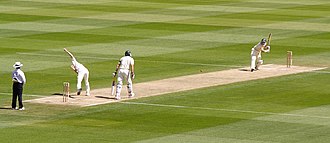
Jamaica hosted some matches during the 2007 Cricket World Cup, and the West Indies cricket team is one of the top teams in international Test cricket. The Jamaica national cricket team competes in regional matches and supplies players to the West Indies team. Sabina Park is the main cricket stadium on the island, though Greenfield Stadium is also used.
Since gaining independence, Jamaica has produced many world-class track and field athletes. The country has had dozens of top sprinters, including Olympic and world champion Usain Bolt, who holds world records in the 100-meter and 200-meter races. Other famous Jamaican sprinters include Arthur Wint, Donald Quarrie, Elaine Thompson, Roy Anthony Bridge, Merlene Ottey, Delloreen Ennis-London, Shelly-Ann Fraser-Pryce, Kerron Stewart, Aleen Bailey, Juliet Cuthbert, Veronica Campbell-Brown, Sherone Simpson, Brigitte Foster-Hylton, Yohan Blake, Herb McKenley, George Rhoden, Deon Hemmings, and Asafa Powell.
Football (soccer) and horse racing are also popular in Jamaica. The national football team has qualified for the FIFA World Cup. Horse racing has been an important sport in Jamaica for a long time, providing jobs for many people. Race car driving is enjoyed by many Jamaicans, with several racing tracks and clubs across the island.
The Jamaica national bobsled team was once a strong competitor in the Winter Olympics. Chess and basketball are also widely played in Jamaica. Netball is very popular on the island, with the Jamaica national netball team, called The Sunshine Girls, consistently ranking among the top teams in the world.
Rugby league has been played in Jamaica since 2006. The Jamaica national rugby league team is made up of players from both Jamaica and the UK. In November 2018, the team qualified for the Rugby League World Cup for the first time ever. Jamaica will play in the 2021 Rugby League World Cup in England.
Images
Related articles




This article is a child-friendly adaptation of the Wikipedia article on Jamaica, available under CC BY-SA 4.0.
Images from Wikimedia Commons. Tap any image to view credits and license.