 Safekipedia
Kennedy Space Center
Adapted from Wikipedia · Adventurer experience
The John F. Kennedy Space Center (KSC) in Florida is one of NASA’s ten main centers. Since 1968, it has been the main place for launching American spacecraft, doing research, and developing new technology. It has launched many famous missions, including the Apollo moon missions, Skylab, and the Space Shuttle flights. The center is located on Merritt Island, Florida, right next to Cape Canaveral Space Force Station. The two work closely together, sharing resources and facilities.
Although early Apollo, Mercury, and Gemini missions launched from Cape Canaveral, KSC managed those launches. Starting with Gemini 4, control of the missions was passed to the Mission Control Center in Houston shortly after liftoff. Today, KSC also manages robotic missions and research on growing food and using resources for exploring places beyond Earth. Since 2010, KSC has become a place where many different companies can launch their rockets, and it added a new launch pad in 2015.
KSC has around 700 buildings spread over 144,000 acres. Some of its special buildings include the huge Vehicle Assembly Building, where NASA stacks its biggest rockets, the Launch Control Center for managing launches, and the Operations and Checkout Building where astronauts get ready. There is also a place where parts of the Space Station are made and a long runway for the Space Shuttle to land. Visitors can also go to the Visitor Complex to learn more about space exploration.
Formation
Since 1949, the military launched rockets from what would become Cape Canaveral Space Force Station. In 1961, President John F. Kennedy wanted to send a person to the Moon by 1970. This needed bigger launch operations than Cape Canaveral could provide.
So, in 1962, NASA made a new launch center called the Launch Operations Center (LOC). They chose a spot next to Cape Canaveral on Merritt Island to build facilities for the huge Saturn V rocket. NASA bought a lot of land there, much of it used for growing citrus fruits. They let farmers keep using their land for a little while before moving in.
Building began in late 1962. In 1963, President Lyndon B. Johnson named the new site the John F. Kennedy Space Center. This name applied only to NASA's part, while the nearby military site became known as Cape Kennedy Air Force Station.
Location
The Kennedy Space Center is located on Merritt Island, Florida. It is north-northwest of Cape Canaveral along the Atlantic Ocean, halfway between Miami and Jacksonville. The center covers a large area—34 miles long and about six miles wide—and is a popular place for visitors. People can take tours through the Kennedy Space Center Visitor Complex.
Before it became a space center, the area was mostly swampland, citrus farms, and beaches. Some small towns were moved to make space for the center. Today, the Kennedy Space Center works to protect the natural environment. It has helped plant mangroves and works with nearby wildlife areas to keep nature healthy. The center’s land includes many different kinds of habitats where plants and animals live.
Historical programs
Apollo program
Main article: Apollo program
For a more comprehensive list, see List of Apollo missions.
From 1967 through 1973, there were 13 big rocket launches, including ten Apollo missions after Apollo 7. The first launch from KSC happened on November 9, 1967, with the Apollo 4 mission. The first time people flew on a Saturn V rocket was on December 21, 1968, during the Apollo 8 mission around the Moon. Several more missions tested new parts of the rocket. The most famous was Apollo 11, launched on July 16, 1969, which landed the first humans on the Moon on July 20. The crew included Neil Armstrong, Michael Collins, and Buzz Aldrin. This launch had many viewers on television. Apollo 12 followed a few months later. The Apollo program finished at KSC with missions from 13 through 17, launched between 1970 and 1972.
Skylab
Main article: Skylab
On May 14, 1973, the last big Saturn V rocket launch sent the Skylab space station into orbit from Pad 39A. By this time, two older launch pads were no longer used, so Pad 39B was changed to support smaller rockets. This pad was used for three trips with people to Skylab that year, and also for the final Apollo mission in 1975 for the Apollo–Soyuz Test Project.
Space Shuttle
Main article: Space Shuttle program
For a more comprehensive list, see List of space shuttle missions.
When the Space Shuttle was being planned, NASA looked at other places to build and land the shuttles. KSC had many good features, like already having buildings and being in a good spot for launching. But there were some challenges. Even though another place in New Mexico was considered, NASA chose KSC in 1972 to be the main place for the Space Shuttle. The very first launch of a Space Shuttle, Columbia, happened on April 12, 1981, for the mission STS-1.
In 1976, a big building called the VAB had a U.S. flag painted on it. In the late 1970s, the area where shuttles were prepared was changed to get ready for the Space Shuttle. Two big buildings called Orbiter Processing Facilities were built near the VAB, with a third one added later.
KSC had a very long runway called the Shuttle Landing Facility, which was mainly used when the shuttle came back to Earth. The first time a shuttle landed at KSC was in 1984 during the STS-41-B mission with Challenger. Before that, most landings were at Edwards Air Force Base in California.
Constellation
On October 28, 2009, the Ares I-X launch from Pad 39B was the first time since 1973 that KSC launched a rocket without people on it.
Expendable launch vehicles (ELVs)
Beginning in 1958, NASA and the military worked together on launches of robots into space. In the early 1960s, NASA sometimes had two of these robot launches each month. This helped the scientists learn quickly and improve the rockets. In 1963, some of the work was moved to another NASA center, but KSC still helped with getting the rockets ready.
Most robot launches were from Cape Canaveral Space Force Station, but KSC helped get the rockets ready before they were taken there. In 1998, the Launch Services Program was created at KSC to manage these robot missions for NASA and NOAA. Most of these launches happen at Cape Canaveral Space Force Station and Vandenberg Space Force Base, but sometimes other places are used too. Missions like the Mars Science Laboratory were prepared at KSC before being taken to Cape Canaveral for launch.
Artemis program
On November 16, 2022, the Space Launch System (SLS) rocket was launched from Complex 39B as part of the Artemis I mission. On April 1, 2026, the SLS will launch again from the same place for the Artemis II mission.
Space station processing
When planning began for the International Space Station in the early 1990s, KSC started working with other NASA centers and partners to get the pieces ready for launch on the Space Shuttles. KSC used what it learned from earlier missions to design a special building called the Space Station Processing Facility, which started being built in 1991.
From 1997 to 2007, KSC helped test and check the station pieces before they were sent to space. In January 2025, KSC signed an agreement with three universities to create a group to help with research for future Moon and Mars missions. In 2025, a training program for engineers was started at KSC.
The second “SpaceU Symposium” happened in November 2025 at a university, where KSC scientists, students, and industry leaders shared ideas and opportunities. KSC still gets ready experiments and pieces for the space station today and is working on a new project called the Lunar Gateway, which will also be made and tested at the Space Station Processing Facility.
Current programs and initiatives
The Kennedy Space Center has many exciting programs and projects today. These include the Commercial Crew Program, the Exploration Ground Systems Program, and the Launch Services Program. Other important projects are the Educational Launch of Nanosatellites (ELaNa), research and technology development, the Artemis program, the Lunar Gateway, and payloads for the International Space Station. There is also Camp KSC, which offers educational camps for schoolchildren during spring and summer. These camps focus on space, aviation, and robotics.
Facilities
The KSC Industrial Area is 5 miles south of Launch Complex 39. It has many support buildings. These include the Headquarters Building, the Operations and Checkout Building, and the Central Instrumentation Facility. Astronauts stay in the O&C building. There was also a tracking station called MILA for important radio and spacecraft tracking.
Facilities at the Kennedy Space Center help get spacecraft and cargo ready for flights. The Headquarters Building has offices, a library, archives, and security. The library started in 1965 and has over four million items about science and technology. It is only for center employees.
A new Headquarters Building finished in 2019. The center once had its own railroad, but it stopped in 2015.
Payload manufacture and processing
- The Neil Armstrong Operations and Checkout Building is a historic site used for getting payloads ready for many missions. These include Gemini, Apollo, Skylab, and parts of the International Space Station. Astronauts would leave from here to reach the launch pads.
- The Space Station Processing Facility is a huge building opened in 1994. It is used for getting Space Station and Shuttle payloads ready.
- The Vertical Processing Facility has a large door for getting payloads ready while standing up.
- The Hypergolic Maintenance and Checkout Facility stores special fuel for the Space Shuttle's systems.
- The Multi-Payload Processing Facility gets the Orion spacecraft and other cargo ready.
- The Payload Hazardous Servicing Facility has a large area for safely getting payloads ready.
Launch Complex 39
Launch Complex 39 was built for the Saturn V rocket used in the Apollo Moon landings. Since 1968, all human space flights have launched from here. These include Skylab, the Apollo–Soyuz Test Project, and the Space Shuttle program.
The complex includes:
- the Vehicle Assembly Building, a huge hangar;
- a transporter for moving rockets;
- a mobile service structure;
- the Launch Control Center; and
- a news media facility.
Launch Complex 48
Launch Complex 48 is under construction for small rockets and spacecraft. It will be located between Launch Complex 39A and Space Launch Complex 41.
Commercial leasing
As a part of helping grow the commercial space industry, KSC leases some of its properties. Here are some major examples:
- Exploration Park to multiple users (partnership with Space Florida)
- Shuttle Landing Facility to Space Florida
- Orbiter Processing Facility (OPF)-3 to Boeing
- Launch Complex 39A, Launch Control Center Firing Room 4 and land for SpaceX's Roberts Road facility (Hangar X) to SpaceX
- O&C High Bay to Lockheed Martin
- Land for FPL's Space Coast Next Generation Solar Energy Center to Florida Power and Light
- Hypergolic Maintenance Facility (HMF) to United Paradyne Corporation
Visitor complex
The Kennedy Space Center Visitor Complex, run by Delaware North since 1995, offers many exhibits and attractions about spaceflight history and future. Bus tours of KSC start here. The complex includes the Apollo/Saturn V Center and the United States Astronaut Hall of Fame.
In 2015, it was announced that the Astronaut Hall of Fame exhibit would move to make room for a new attraction called "Heroes and Legends," which opened in 2016. In 2016, the visitor center moved the famous countdown clock to the entrance. In 2019, NASA celebrated the 50th anniversary of the Apollo program, and Lunar Module 9 was moved to the Apollo/Saturn V Center.
Historic locations
NASA lists several Historic Districts at KSC, each with multiple buildings:
- Launch Complex 39: Pad A Historic District
- Launch Complex 39: Pad B Historic District
- Shuttle Landing Facility Area Historic District
- Orbiter Processing Historic District
- Solid Rocket Booster Disassembly and Refurbishment Complex Historic District
- NASA KSC Railroad System Historic District
- NASA-owned Cape Canaveral Space Force Station Industrial Area Historic District
There are 24 historic buildings outside these districts, including the Space Shuttle Atlantis, Vehicle Assembly Building, Crawlerway, and Operations and Checkout Building. KSC has one National Historic Landmark, 78 sites listed or eligible for the National Register of Historic Places, and 100 Archaeological Sites.
Other facilities
- The Rotation, Processing and Surge Facility gets solid rocket booster segments ready for moving to the Vehicle Assembly Building. It was built in 1984 and used for the Space Shuttle program. It will be used again for future rockets like the Space Launch System and OmegA.
Weather
Because Florida sticks out into the ocean, it often has strong storms and lots of lightning. The Kennedy Space Center has special systems to keep everyone and everything safe from lightning strikes. Once, during a flight called Apollo 12, lightning hit the rocket just after it took off, but the mission was still safe.
Big storms, like hurricanes, can also cause damage. In 2004, a hurricane named Frances hit the space center hard and broke parts of a big building. Another hurricane in 2005 caused more problems too. Scientists think that rising sea levels might make some parts of the space center more likely to flood in the future.
KSC directors
Since the Kennedy Space Center began, eleven NASA officials have been directors. Three of them were astronauts: Crippen, Bridges, and Cabana.
| No. | Image | Director | Start | End |
|---|---|---|---|---|
| 1 | 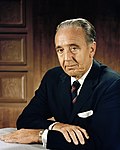 | Kurt H. Debus | July 1962 | November 1974 |
| acting | Miles Ross | November 1974 | January 18, 1975 | |
| 2 |  | Lee R. Scherer | January 19, 1975 | September 25, 1979 |
| 3 |  | Richard G. Smith | September 26, 1979 | August 2, 1986 |
| acting | Thomas E. Utsman | August 3, 1986 | September 30, 1986 | |
| 4 |  | Forrest S. McCartney | October 1, 1986 | August 31, 1987 |
| September 1, 1987 | December 31, 1991 | |||
| 5 | 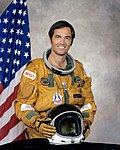 | Robert L. Crippen | January 1, 1992 | January 21, 1995 |
| 6 | 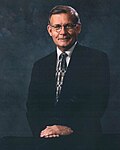 | Jay F. Honeycutt | January 22, 1995 | March 2, 1997 |
| 7 | 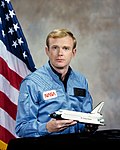 | Roy D. Bridges, Jr. | March 2, 1997 | June 13, 2003 |
| acting |  | James W. Kennedy | June 13, 2003 | August 10, 2003 |
| 8 | August 10, 2003 | January 4, 2007 | ||
| 9 |  | William W. Parsons | January 4, 2007 | October 26, 2008 |
| 10 |  | Robert D. Cabana | October 26, 2008 | May 17, 2021 |
| acting |  | Janet E. Petro | May 17, 2021 | June 29, 2021 |
| 11 | June 30, 2021 | May 1,2026 | ||
In popular culture
The Kennedy Space Center has been shown in many movies and shows. Some films were even made inside the space center, with workers helping as actors when they had free time. Movies that show the Kennedy Space Center include:
- Moonraker
- Stowaway to the Moon
- SpaceCamp
- Apollo 13
- Contact
- Armageddon
- Space Cowboys
- Swades
- Transformers: Dark of the Moon
- Tomorrowland
- Sharknado 3: Oh Hell No!
- First Man
- Geostorm
- Men in Black 3
- Fly Me to the Moon
- Simon
The space center is also an important place in the final part of the Stone Ocean story from the JoJo's Bizarre Adventure anime and manga series.
It was one of the main places in the 1960s TV show I Dream of Jeannie, even though the show was filmed in Los Angeles and not at the real space center.
Images
Related articles


This article is a child-friendly adaptation of the Wikipedia article on Kennedy Space Center, available under CC BY-SA 4.0.
Images from Wikimedia Commons. Tap any image to view credits and license.