Lightning
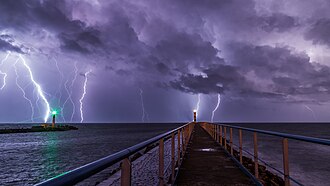
Lightning is a natural phenomenon made of electrostatic discharges that move through the atmosphere between two electrically charged regions. One or both of these regions are in the atmosphere, and the other can sometimes be on the ground. After a lightning flash, the regions become partly or fully neutral again.
A lightning flash releases a huge amount of energy in a very short time. The air around the flash gets extremely hot, very quickly. Some of the energy can be seen as a bright flash of light. Lightning also causes thunder. Thunder is a loud sound that comes from a shock wave. The shock wave forms when the air near the lightning suddenly expands.
Lightning most often happens during a thunderstorm, but it can also occur in other strong weather systems, such as volcanic eruptions. Lightning plays a role in the global atmospheric electrical circuit and in atmospheric chemistry. It is also a natural source of fire that can start wildfires. The World Meteorological Organization considers lightning an Essential Climate Variable, and the scientific study of lightning is called fulminology.
Forms
Lightning is grouped into three main forms based on where it happens. It can happen inside a single thundercloud (intra-cloud, or in-cloud), between two clouds (cloud-to-cloud, or inter-cloud), or between a cloud and the ground (cloud-to-ground). The last kind is called a lightning strike. Many other kinds are also known, including volcanic lightning, which can happen during volcanic eruptions, "heat lightning", which can be seen from far away but not heard, dry lightning, which can start forest fires, and ball lightning, which scientists rarely see. Cloud-to-ground lightning affects people most directly, even though intra-cloud and cloud-to-cloud lightning are more common. Those two affect people indirectly by changing atmospheric chemistry. Each type also has versions, such as "positive" and "negative" cloud-to-ground flashes, which have features that can be measured.
Cloud-to-ground lightning is the least common type, but it is the best understood. This is because it strikes a physical object, the ground, which makes it easier to measure with instruments. It is the most dangerous kind for people and property. The ground can affect how the lightning looks. It may be fresh water, salt water, or soil. Cloud-to-ground lightning is either positive or negative, depending on the direction of the conventional electric current. Most is negative, and positive lightning makes up less than 5% of strikes. Positive lightning is stronger, though. An average negative bolt carries about 30,000 amperes of current. It moves about 15 coulombs of electric charge and 1 gigajoule of energy. Large positive bolts can reach 120 kA. Because of this extra power, positive lightning is more likely to start fires. It is also linked to sprites, which appear far above the ground. It tends to occur in winter storms, such as thundersnow, in strong tornadoes, and as a thunderstorm fades. Intra-cloud lightning is the most frequent type. It usually happens between the anvil and the lower parts of a storm. At night it can appear as sheet lightning, which lights up the sky with no thunder heard. Lightning also gives off extremely low frequency and very low frequency radio waves. It can happen wherever there are differences in electric potential.
Formation
Main article: Thunderstorm
Lightning forms in several steps. It mostly happens when warm air mixes with colder air, which creates storms. A thunderstorm is a storm that also has lightning and thunder. Lightning can also happen during dust storms, forest fires, tornadoes, volcanic eruptions, and even in winter, when it is called thundersnow. Hurricanes usually produce some lightning, mostly in their outer bands, up to 160 km (99 mi) from the center. Very large fires, such as those in the 2019–20 Australian bushfire season, can create their own weather. This can include pyrocumulonimbus clouds, which can make dry lightning and fire tornadoes. The aerosol content of the air, such as dust or smoke, may affect how often lightning flashes in a storm.
Inside a thunderstorm, tiny ice crystals and soft hail called graupel bump into each other as air rushes upward. These bumps cause electric charges to separate. The top of the cloud becomes positive, and the lower part becomes negative. The air between these charged areas normally acts as a barrier. But when the electric field becomes strong enough, electricity jumps across. This creates a path of ionized air called a leader. When the leader reaches the ground, a bright return stroke travels back up the path. The air becomes very hot and expands quickly. This creates a shock wave, which we hear as thunder.
Distribution, frequency and properties
Main article: Distribution of lightning
Lightning on Earth happens about 44 times every second. That adds up to nearly 1.4 billion flashes a year. A typical lightning flash lasts about half a second. It is made up of many much shorter flashes, called strokes, that each last around 60 to 70 microseconds. About 70% of lightning happens over land in the tropics, where atmospheric convection is strongest. Many things affect lightning in a place, including latitude, prevailing wind currents, and relative humidity. Lightning is usually made by cumulonimbus clouds. Cloud-to-ground (CG) lightning makes up only 25% of all lightning in the world. Its share changes with the season and latitude. In the tropics, only 10% of flashes are CG. At the latitude of Norway, 50% are.
Lightning is most common over Lake Maracaibo. There, the Catatumbo lightning phenomenon makes about 250 bolts a day, on average, and this happens on 297 days a year. The second most lightning-filled place is near the village of Kifuka, in the mountains of the eastern Democratic Republic of the Congo. It sits at an elevation of around 975 m (3,200 ft). Other hotspots include Singapore and Lightning Alley in Central Florida. An unusually long lightning bolt is sometimes called a megaflash. The American Meteorological Society describes it as a continuous lightning flash that travels about 100 km (60 miles) or more in a straight line. Megaflashes come from wide, electrified clouds in mesoscale convective systems. So far, they have only been seen in the Great Plains of North America and the Río de la Plata Basin of South America. The World Meteorological Organization reported a bolt of 768 km (477.2 mi) in the southern U.S. in 2020.
Lightning has also been seen in the atmospheres of other planets. It has been seen on Jupiter and Saturn, and probably on Uranus and Neptune. On Saturn, lightning was discovered by the Voyager 1 mission. Scientists are still debating whether Venus has lightning. Signals from the Soviet Venera and U.S. Pioneer missions hinted at it. The Cassini–Huygens fly-by in 1999 found no sign of it. Radio pulses recorded by Venus Express may come from lightning. In 2025, researchers reported possible lightning on Mars. A microphone on the Mars 2020 rover Perseverance may have detected it.
Effects
Main article: Thunder
Further information: Radio atmospheric, Whistler, and Schumann resonances
Further information: Terrestrial gamma-ray flash
A lightning strike can cause effects that last only a moment, such as flashes of light, loud sounds, and electromagnetic radiation. It can also cause longer-lasting effects, including death, damage, and changes to the air and land. A lightning strike carries a huge amount of energy, which can harm trees, rocks, and buildings. A lightning rod can help protect a building by safely sending a strike into the ground. Aircraft are hit often, but they are usually safe because their Faraday cage design protects the people inside. Most people struck by lightning survive, but they may suffer severe injury.
Lightning heats the air so quickly that the air expands outward and creates a shock wave, which we hear as thunder. Light travels much faster than sound, so people can estimate how far away a strike is by counting the seconds between the flash and the thunder. Lightning also gives off light, radio waves, and even X-rays. Over time, lightning changes the air by creating ozone and adding nitrates to the soil, which help plants grow. It can also leave some rocks and soil permanently magnetized. Scientists have found that the magnetic fields near a severe storm may cause hallucinations in people within about 200 meters (660 feet) of the storm.
Detection and monitoring
The earliest detector made to warn of a coming thunderstorm was the lightning bell. Benjamin Franklin put one in his house. It was based on an electrostatic device called the 'electric chimes', which Andrew Gordon invented in 1742. Lightning sends out radio pulses that travel through the Earth-ionosphere waveguide. This waveguide carries VLF and ELF waves. Because the speed of these waves depends on their group velocity and frequency, scientists can find lightning strikes up to 10,000 km away. The Schumann resonances, at about 7.5 Hz, help track thunderstorms around the world. Many countries have built lightning detector networks, and several global networks exist too. Satellites have also watched lightning. The climatology of lightning was studied using OrbView-1 and TRMM. The ISS carried a lightning instrument for three years. Starting in 2016, the National Oceanic and Atmospheric Administration launched weather satellites with Geostationary Lightning Mapper instruments. The National Weather Service uses their data to make maps of lightning activity in real time.
Scientists have also tried to make lightning on purpose. This allows for more controlled research. Lightning can be triggered by launching specially designed rockets that trail wire into thunderstorms. The wire gives the lightning a path to follow. Since the 1970s, researchers have also tried using lasers to create a channel of ionized gas for lightning to travel through. In New Mexico, scientists tested a terawatt laser. It formed channels of ionized molecules called filaments, which acted like lightning rods. The filaments did not last long enough to cause a real strike. However, the laser pulses did increase electrical activity in the cloud. This made small discharges at the position of the plasma channels.
Impact of climate change and air pollution
It is hard to predict exactly how climate change will affect lightning. Cloud physics models have trouble copying the cloud processes that create lightning. Most of the world's lightning happens over Africa. One study predicts a small overall increase there as the region warms. Lightning is rare near the North and South Poles, but it is increasing in the Arctic, and models suggest this will continue. Lightning is also linked to air pollution. Tiny particles called particulates make lightning more likely, but only up to a point (aerosol optical depth = 0.3). Past that point, more particulates reduce lightning.
When lightning strikes, it heats the air so quickly that nitrogen and oxygen molecules break apart. This forms nitrogen oxides (NOx). These can lead to ozone, which is a greenhouse gas when it is found in the troposphere. Lightning nitrogen oxides also increase hydroxyl (OH) and hydroperoxyl (HO2) molecules. These break down greenhouse gases like methane and help clean the atmosphere. Because climate change affects lightning, lightning's effect on climate can change too. This can create a climate change feedback. Lightning produces tropospheric ozone and destroys methane, so its overall effect on climate depends on the balance between warming and cooling.
Lightning is the main natural cause of wildfire. It is estimated to cause 10% of forest fires worldwide. Wildfires release greenhouse gases and change plant cover, so a lightning-wildfire feedback is possible. Studies suggest there could be more lightning-started fires in Boreal and Arctic regions. These fires may also affect permafrost cover. Its impact on fires in the tropics is still uncertain.
In culture
The first known photograph of lightning was taken in 1847 by Thomas Martin Easterly. The first surviving photograph was taken in 1882 by William Nicholson Jennings.
Many cultures have seen lightning as a sign of a god, or as a god itself. These include the Greek god Zeus, the Aztec god Tlaloc, the Mayan God K, Slavic mythology's Perun, the Baltic Pērkons/Perkūnas, Thor in Norse mythology, Ukko in Finnish mythology, the Hindu god Indra, the Yoruba god Sango, Illapa in Inca mythology, and the Shinto god Raijin. The ancient Etruscans made guides for predicting the future from the omens that thunder or lightning seemed to show. This practice is called ceraunoscopy, a kind of aeromancy. In the traditional religion of the African Bantu tribes, lightning is a sign of the anger of the gods. Holy books in Judaism, Islam, and Christianity also give lightning special meaning. People sometimes use the idea that lightning never strikes the same place twice as a saying, but it is a common myth. Lightning can, and often does, strike the same place more than once. For example, lightning strikes the Empire State Building in New York City about 23 times a year on average.
Lightning appears in popular culture too. The superheroes the Flash and Shazam have a lightning bolt in their official logos. In French and Italian, the phrases for "love at first sight" are coup de foudre and colpo di fulmine, which word for word mean "lightning strike." The bolt of lightning in heraldry is called a thunderbolt and usually stands for power and speed. Some political groups have used lightning flashes as a symbol, including the People's Action Party in Singapore, the British Union of Fascists in the 1930s, and the National States' Rights Party in the United States in the 1950s. The Schutzstaffel, the paramilitary wing of the Nazi Party, used the Sig rune in its logo, which stands for lightning. The German word Blitzkrieg, meaning "lightning war," was a major attack strategy of the German army during World War II. A lightning bolt is also a common badge for military communications units and is the NATO symbol for a signal asset.

Quiz time!
4 questions about Lightning
What is lightning made of?
Pictures
Keep exploring




This article is a child-friendly adaptation of the Wikipedia article on Lightning, available under CC BY-SA 4.0.
Images from Wikimedia Commons. Tap any image to view credits and license.