
La Géométrie
Main article: René Descartes
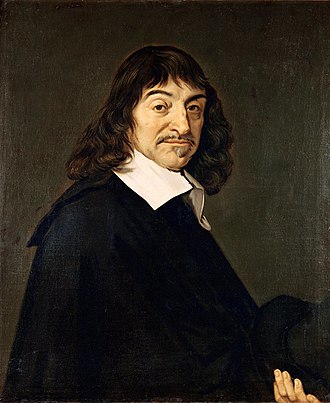
La Géométrie was published in 1637 as an appendix to Discours de la méthode (Discourse on the Method), written by René Descartes. In the Discourse, Descartes describes his method for finding clear answers to any question. La Géométrie and two other appendices were included to show examples of what could be achieved using his method.
This important work was the first to suggest joining algebra and geometry into one subject. It introduced an idea called analytic geometry, which means using algebra to solve geometry problems. This was a new idea at the time. The work helped shape the ideas of later mathematicians like Leibniz and Newton.
The text
This appendix has three parts.
In the first part, called Problems Which Can Be Constructed by Means of Circles and Straight Lines Only, Descartes showed new ways to write math problems. He used letters like x, y, z for unknown numbers and a, b, c for known numbers. He also used modern signs for squares and cubes. This helped him connect numbers to lengths that can be drawn with a ruler and compass. Most of this part explains how to solve special geometry problems from Pappus.
The second part, On the Nature of Curved Lines, describes different types of curves. Descartes talked about curves that can be described with equations using two variables and called them "geometrical." He also mentioned other curves, like the quadratrix and spiral, which he called "mechanical" and thought were not good for close study. He showed a way to find key points on these curves using algebra.
The third part, On the Construction of Solid and Supersolid Problems, looks more at solving equations. Descartes gave a way to rearrange equations to make them simpler and discussed answers to equations, including negative and imaginary ones. He also shared a rule to guess how many positive answers an equation might have.
Aftermath
Descartes wrote La Géométrie in French, not Latin, which was used for scholarly works at the time. His writing was not very clear and the material was not well organized. He often only gave hints of proofs, leaving many details for readers to figure out.
Although Descartes is often credited with creating the coordinate plane, the modern rectangular coordinate system does not appear in La Géométrie. Later mathematicians worked to clarify Descartes' ideas. This work was mainly done by Frans van Schooten, a mathematics professor, and his students. Van Schooten published a Latin version of La Géométrie in 1649, followed by several more editions. These editions included extra explanations and examples, helping to establish analytic geometry in the seventeenth century. One of van Schooten's students, Johannes Hudde, introduced a simpler method for finding double roots of polynomials, known as Hudde's rule.
Pictures
Keep exploring


This article is a child-friendly adaptation of the Wikipedia article on La Géométrie, available under CC BY-SA 4.0.
Images from Wikimedia Commons. Tap any image to view credits and license.