 Safekipedia
Lightning strike
Adapted from Wikipedia · Adventurer experience
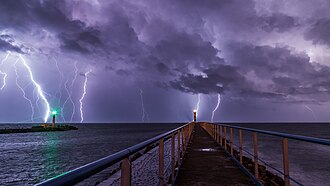
A lightning strike or lightning bolt is a big spark of electricity that jumps between the sky and the ground. This happens because of something called lightning, which is a powerful electric discharge. Most of these strikes start in tall, heavy clouds and end up hitting the ground. This type is called cloud-to-ground lightning.
There is also a less common kind of lightning that goes from the ground up into the clouds. This happens when something tall, like a tower or a tree, sends a spark up to the clouds. This is called ground-to-cloud lightning.
Lightning happens a lot in nature. Many lightning flashes happen high in the sky between clouds. Even airplanes can get struck by lightning, but this is usually not a big problem for them. Flying through clouds can sometimes create lightning strikes.
Epidemiology
See also: Lightning injury
Lightning can hurt humans in different ways. Sometimes, lightning strikes a person directly, which can cause serious harm inside the body. Other times, lightning can make something a person is touching become electrified. Lightning can also jump to a person from nearby objects.
Lightning can also affect people in other ways. When lightning strikes, the ground can become electrically charged, and this charge can travel through a person's body. Lightning can also create strong pulses that might affect medical devices like pacemakers.
There are many lightning strikes every day. Most people are safe, but some can be seriously hurt. It’s important to stay safe during thunderstorms by finding enclosed spaces and avoiding open areas or tall objects.
Effect on animals
Lightning strikes can be dangerous for animals, especially farm animals like cattle, sheep, and horses. Lightning can create electricity between two points on the ground. Because an animal’s legs are far apart, the electricity can flow through its body and cause injury.
Farmers can help protect their animals by using special grounding rods along fences and by keeping animals away from trees during storms. Trees can attract lightning and put animals near them at risk.
Effect on nature
Impact on vegetation
In places with few people, like the Russian Far East and Siberia, lightning strikes often start forest fires. The smoke and fog from big forest fires can create more lightning, starting new fires far away.
Shattering of rocks
Main article: Electromechanical disintegration
When lightning hits water inside cracks in rocks, the water heats up quickly and turns to steam. This can break the rocks apart and move big boulders. This process might help wear down mountains in warm areas. Signs of lightning strikes can be found in unusual magnetic fields.
Electrical and structural damage
Telephones, modems, computers, and other electronic devices can be harmed by lightning. Strong electric surges can travel through phone lines, internet cables, or power outlets.
Lightning creates fast electric currents. Even though lightning is a steady flow of electricity, it acts like changing currents in wires, causing the electricity to travel along the outer parts of conductors.
Prevention and mitigations
Protection systems
Main articles: Lightning rod, Lightning arrester, and Surge protector
Many tools, such as lightning rods, help protect buildings from lightning. A lightning rod is a metal rod connected to the ground. It gives lightning a safe path to the earth if it hits the building.
Monitoring and warning systems
We cannot predict exactly when and where lightning will strike. But we have tools that can tell us when the chance of lightning is high. These tools watch for lightning from the ground and from satellites.
Personal safety
See also: Lightning injury § Prevention
It is important to have a plan for safety when thunderstorms happen. Start your plan as soon as you see lightning or hear thunder. Lightning can strike even if it looks like there is no storm nearby.
One way to guess how far lightning is from you is to count the seconds between the flash and the thunder. Then divide that number by three to get the distance in kilometers, or by five for miles. If the time is 25 seconds or less, the lightning is very close, and you should take cover right away.
The safest place to be is inside a building or a car. Avoid tall objects and metal things. If you are inside, stay away from electrical things and pipes. It is still unsafe for up to 30 minutes after the last lightning or thunder.
If you are outside and cannot get inside, try to find the lowest ground, like a valley. Do not stand near water. If your hair stands up, lightning may be about to strike — get inside as fast as you can. If you cannot, kneel and lean forward.
Notable incidents
Earth-bound
In 1769, lightning struck a church in Brescia, Italy, and caused a big explosion. In 1902, lightning damaged the top of the Eiffel Tower in France. In 2005, lightning struck a tree where some cows were standing, and many cows were hurt. In 2016, a big lightning strike hurt many people at a music festival in Germany. In 2026, lightning struck a group of people at a rally in Brazil, hurting several of them.
In-flight
Airplanes often get hit by lightning, but they are usually built to handle it. In 1963, a plane crashed during a storm. In 1971, a plane’s fuel tank caught fire after being struck by lightning, but one person survived. In 2019, a plane was struck by lightning right after taking off, which caused problems on the ground.
Most-stricken human
Roy Sullivan, a park ranger, survived being struck by lightning seven times before he passed away in 1983.
Longest lightning bolt
In 2017, a lightning bolt was detected that stretched 515 miles from Dallas, Texas, to Kansas City, Missouri. This was the longest lightning bolt ever recorded.
Images
Related articles


This article is a child-friendly adaptation of the Wikipedia article on Lightning strike, available under CC BY-SA 4.0.
Images from Wikimedia Commons. Tap any image to view credits and license.