 Safekipedia
Maser
Adapted from Wikipedia · Adventurer experience
A maser is a special device that makes very clear and steady electromagnetic waves, especially microwaves. It uses a process called stimulated emission. The word “maser” comes from “microwave amplification by stimulated emission of radiation.” Important scientists like Nikolay Basov, Alexander Prokhorov, and Joseph Weber thought of the idea of a maser in 1952. Then, Charles H. Townes, James P. Gordon, and Herbert J. Zeiger built the first maser at Columbia University in 1953. For this work, Townes, Basov, and Prokhorov won the 1964 Nobel Prize in Physics.
Masers help keep very accurate time in atomic clocks. They are also used in radio telescopes to make clear signals. They help spacecraft communication work better with spacecraft far from Earth.
The maser inspired another famous device called the laser. Lasers work in a similar way but make waves we can see, like flashlight light. The idea for the laser came from the maser, and it was built in 1960. At first, it was called the “optical maser,” but later it was changed to laser, short for “light amplification by stimulated emission of radiation.”
History
The idea for a maser was first shared by Joseph Weber from the University of Maryland, College Park in June 1952. Around the same time, Nikolay Basov and Alexander Prokhorov from the Lebedev Institute of Physics also had the same idea.
In 1953, Charles Hard Townes, James P. Gordon, and H. J. Zeiger built the first maser at Columbia University. They used special molecules to make strong microwave signals. Their work helped create lasers a few years later. In 1964, Townes, Basov, and Prokhorov won the Nobel Prize in Physics for their important work.
Technology
The maser is a tool that uses special energy to make strong, clear waves, just like a laser. The idea started with Albert Einstein in 1917. When tiny parts called atoms get extra energy, they can make waves that match the material they are made from.
By placing these materials inside a special space, it helps create waves that stay the same for a long time.
Some common types
- Atomic beam masers
- Ammonia maser
- Free electron maser
- Hydrogen maser
- Gas masers
- Rubidium maser
- Liquid-dye and chemical laser
- Solid state masers
- Ruby maser
- Whispering-gallery modes iron-sapphire maser
- Dual noble gas maser (The dual noble gas of a masing medium which is nonpolar.)
21st-century developments
In 2012, scientists from the National Physical Laboratory and Imperial College London made a maser that works at normal room temperature. They used special materials to help it work.
In 2018, a group from Imperial College London and University College London showed how to make the maser work without stopping, using tiny changes in special diamonds.
In 2025, a team from Northumbria University built a maser that doesn’t need much power and works at room temperature, using a simple light source to start it.
Uses
Masers are important tools for keeping very exact time. They work like special clocks and are used where very accurate timing is needed.
In the past, masers were also used to make weak microwave signals stronger, especially in telescopes that look at space. One famous use was to help receive pictures from the Mariner IV space probe as it flew by Mars. The maser used very cold helium to work better and could make clear pictures even though the signal from the probe was weak.
The hydrogen maser is a special kind of maser that helps set the official international time standard. It works by using the natural vibrations of hydrogen atoms to create a stable and precise frequency signal.
Astrophysical masers
Main article: Astrophysical maser
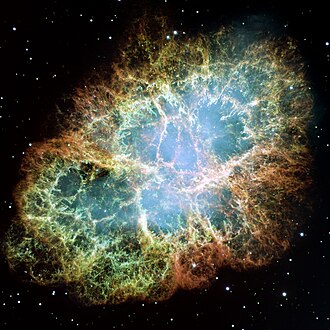
Natural maser-like emissions are found in space, often called "superradiant emission." These come from molecules such as water (H2O), hydroxyl radicals (•OH), methanol (CH3OH), formaldehyde (HCHO), silicon monoxide (SiO), and carbodiimide (HNCNH). Water molecules in areas where stars are forming can emit radiation at about 22.0 GHz, creating one of the brightest lines in radio waves. Some water masers also emit radiation at a frequency of 96 GHz.
Very strong masers linked to active centers of galaxies are called megamasers and can be up to a million times stronger than masers found around stars.
Terminology
The word maser originally meant "microwave amplification by stimulated emission of radiation". It described devices that sent out waves in the microwave part of the electromagnetic spectrum.
Later, scientists used the idea behind masers for other types of waves. When the laser was created, some people used the term optical maser, but this changed to laser. Today, we usually call devices that send out X-ray through infrared waves lasers, and those that send out microwave waves and lower are called masers.
Related articles



This article is a child-friendly adaptation of the Wikipedia article on Maser, available under CC BY-SA 4.0.
Images from Wikimedia Commons. Tap any image to view credits and license.