 Safekipedia
Roman Syria
Adapted from Wikipedia · Adventurer experience
Roman Syria was an early Roman province. It was taken over by the Roman Republic in 64 BCE. This happened when a Roman general named Pompey defeated Tigranes the Great, the King of Armenia.
Later, after the Herodian kingdom was split up in 4 BCE, parts of it were added to Roman Syria. This included places like Iturea and Trachonitis. By the late 2nd century, the area was separated into two parts: Coele Syria and Syria Phoenice.
Provincia Syria
Syria became part of the Roman Republic in 64 BC when the leader Pompey the Great changed the area. He chose a man named Marcus Aemilius Scaurus to lead Syria.
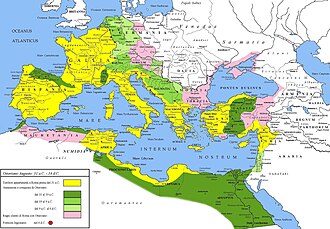
Later, when the Roman Republic became the Roman Empire, Syria was an important place ruled by a leader called a legate. The Roman army there had three groups of soldiers to guard the border with Parthia.
In the year 6 AD, the Roman leader Augustus changed nearby places like Judea, Samaria, and Idumea, putting them under Syria’s leader. After some kings died, more places such as Ituraea and Trachonitis also came under Syria’s control.
During the First Jewish–Roman War from 66 to 70 AD, leaders from Syria tried to keep things calm but had a hard time. Later, a man named Vespasian helped bring peace to the area and even became a Roman emperor.
Aftermath
Division into Coele Syria and Syria Phoenice
Main articles: Coele Syria (Roman province) and Syria Phoenice
The Roman leader Septimius Severus split Syria into two parts: Syria Coele and Syria Phoenice. Antioch became the main city of Syria Coele, and Tyre became the main city of Syria Phoenice.
During a difficult time for Rome called the Crisis of the Third Century, a ruler from Syria named Philip the Arab became the emperor of Rome. Later, nearby powers attacked the area, which damaged many cities.
Dominate reform
After changes made by Diocletian, Syria Coele became part of a larger group called the Diocese of the East. Later, a new area named Euphratensis was created from part of Syria Coele.
Syria in the Byzantine Empire
Main article: Diocese of the East
In later years, the area known as Roman Syria was governed by the Byzantine Empire as part of the Diocese of the East. This area was very important for trade, farming, and religion. It was also important because of its location near powerful neighbors.
Over time, Syria Coele was divided again into smaller areas. One part kept Antioch as its main city, and another had its main city at Apamea on the Orontes.
| The 'Orient' in the time of Septimius Severus c. 200 AD | ||
|---|---|---|
| Coele Syria | Provincia Syria Coele | |
| Phoenicia | Provincia Syria Phoenice | |
| Palaestina | Provincia Syria Palaestina | |
| Arabia | Provincia Arabia Petraea | |
Demographics
Syria had many different groups of people. In the countryside, most people spoke Aramaic and came from ancient West Semitic families. In places like Hauran, Trachonitis, and Emesa, Arabs lived and led the way. Palmyra was a mix of Aramaeans, Arabs, and Amorites.
Along the coast, especially in cities like Tyre, Sidon, and Berytus, people mainly spoke Phoenician.
In big cities such as Antioch, Apamea, Cyrrhus, and those in the Decapolis, most people were Greeks, brought there long ago by the Seleucid rulers.
The whole area known as the Levant had many people in the 1st century. Cities like Antioch and Palmyra had large populations, and Apamea had many free citizens. The hilly areas along the Syrian Coastal Mountain Range had fewer people.
Identity
The people in Syria began to use ideas from the Greeks but still kept some of their own traditions. Different places had different mixes of old cultures, like Aramean, Phoenician, and neo-Hittite influences. Some areas only used Greek ways.
Unlike the Jews, who shared common memories, the people of Syria did not all share one culture or identity. What linked them was mostly the Greek-style cities and stories that Roman rulers shared. So, the word 'Syrian' mainly meant people who lived in that area.
Episcopal sees
Ancient important cities in the Roman areas of Syria Prima (I) and Syria Secunda (II) are listed below. These cities were once important centers for church leaders, known as episcopal sees.
Ancient episcopal sees of the late Roman province of Syria Prima (I) listed in the Annuario Pontificio as titular sees:
- Anasartha (Khanasir)
- Barcusus (Baquza or Banqusa)
- Beroea (Aleppo)
- Chalcis in Syria (Qinnasrin)
- Gabala (Jableh)
- Gabula (at the marsh of Al-Jabbul)
- Gindarus (Jandairis)
- Laodicea in Syria (Latakia)
- Salamias (Salamiyah)
- Seleucia Pieria
Ancient episcopal sees of the late Roman province of Syria Secunda (II) listed in the Annuario Pontificio as titular sees:
- Apamea in Syria, the Metropolitan Archdiocese
- Arethusa (Al-Rastan)
- Balanea (Baniyas)
- Epiphania in Syria (Hama)
- Larissa in Syria (Shaizar)
- Mariamme (Maryamin)
- Raphanea
- Seleucobelus (Seleucopolis)
Images
Related articles


This article is a child-friendly adaptation of the Wikipedia article on Roman Syria, available under CC BY-SA 4.0.
Images from Wikimedia Commons. Tap any image to view credits and license.