
Salisbury
Salisbury is a cathedral city and civil parish in Wiltshire, England. It has many people living there and is where the rivers Avon, Nadder, and Bourne meet. The city is not too far from Southampton and Bath.
An old cathedral once stood north of the city at Old Sarum. Later, a new cathedral was built near the rivers, and a village grew around it. In 1227, this place got a city charter and was called New Sarum. It kept this name until the Salisbury City Council was made. Salisbury railway station links the West of England Line and the Wessex Main Line.
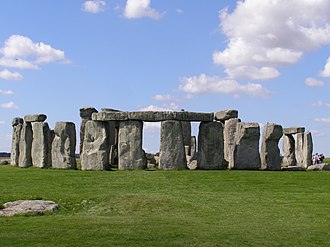
Not far from Salisbury, about 8 miles northwest, is Stonehenge, a special place that is a UNESCO World Heritage Site.
Toponymy
Old names for Salisbury include Cair-Caratauc, which was one of the cities of the Ancient Britons mentioned in the History of the Britons. Other old Welsh names were Caer-Caradog, Caer-Gradawc, and Caer-Wallawg.
When the Romans came, the city was called Sorbiodūnum. The part "_dūnon" came from the Brittonic language and meant "fortress". Later, in the Anglo-Saxon period, it was known as Searoburg, a name that came from the Roman one. The word "_burg" means "fort" in Old English. In Middle English, the name changed to Sarisberie, which was sometimes shortened to Sar.
History
Old Sarum
Main articles: Old Sarum, Old Sarum Cathedral, and Old Sarum Castle
The hilltop at Old Sarum is close to the Neolithic sites of Stonehenge and Avebury and shows signs of very early people living there. It was in a good spot between the River Bourne and the Hampshire Avon, near old trade routes. During the Iron Age, between 600 and 300 BC, people built a hillfort there. The Romans might have used the site or left it to friends. Later, in 552, it became part of the kingdom of Cynric of Wessex. The Saxons did not use the place much, but after Viking attacks, King Alfred fixed up its walls again. After this, the place was sacked and burned by a Dano-Norwegian king. After the Norman invasion in 1066, a castle was built there by 1070. The castle was important and held by the kings of England.
In 1075, a leader named Herman became the first bishop of Salisbury. Later, Saint Osmund helped build the first Salisbury cathedral, finished in 1092. The cathedral was damaged in a big storm soon after it was finished. A leader named Bishop Roger helped the king and built more at Old Sarum, but after he was arrested, the castle fell apart.
New Sarum
A bishop named Hubert Walter helped make peace with a leader named Saladin. Two brothers, Herbert and Richard Poore, planned to move the cathedral to a new place in the valley. King Richard I agreed, but it took many years. Finally, Richard Poore moved the cathedral to a new town called “New Sarum” in 1220. The new place was at the meeting point of the River Nadder and the Hampshire Avon.
Building the new cathedral, now called Salisbury Cathedral, started in 1221. The tall tower was built later. Many stones came from the old cathedral, and others from a place called Chilmark. The cathedral is famous for its beautiful style and contains a well-kept copy of the Magna Carta.
New Sarum became a city in 1227 by order of King Henry III and grew to be the largest town in Wiltshire by the 14th century. A wall was built around the town, and several gates were made. The old place at Old Sarum was used less and less.
In 1450, there were riots in Salisbury. In 1483, there was a big upset against Richard III.
In 1940, during World War II, Salisbury became an important place for building airplanes called Spitfires. Many young women helped build these airplanes in secret. In 2021, a large model airplane was put up to remember them.
20th and 21st centuries
In 2018, two people were hurt in Salisbury when a very bad chemical was used.
Governance
Salisbury is in the county of Wiltshire. It is managed by the Wiltshire Council, which takes care of local government for the area. Salisbury also has its own parish council called the Salisbury City Council.
Since 2020, the city centre is covered by two electoral wards named St Edmund and Harnham East, inside the A36 ring road. Other parts of the city are covered by six more wards. Nearby areas like Laverstock and Ford have their own parish council.
Before 2009, Salisbury was part of the old county of Wiltshire and had a different local government setup. The city has held city status for a very long time. The current Member of Parliament for Salisbury and nearby areas is John Glen from the Conservative party, who has been in office since 2010.
Geography
Salisbury is halfway between Exeter and London. It is 80 miles from Exeter, 78 miles from London, and 34 miles from Swindon. It is also 20 miles from Southampton and 32 miles from Bath.
The land around Salisbury is mostly chalk. Rivers through the city have been moved to make gardens. These gardens are popular in summer because the water is shallow and slow, which makes it safe to enter. But because the land is low, the rivers can flood in winter.
There are airfields near Salisbury, including one at Old Sarum and another at Thruxton near Andover.
Salisbury has many areas and suburbs, most of which were once villages. These areas do not have fixed boundaries. Some of these areas are Bemerton, Lower Bemerton, Bemerton Heath, Hampton Park, Laverstock and Ford, City Centre, Churchfields, East Harnham, West Harnham, Harnham Hill, Stratford-sub-Castle, St Paul's, St Francis, Fisherton, St Mark's, Bishopdown, Milford, St Edmund, Petersfinger, Netherhampton, Paul's Dene, Friary Estate (formerly Bugmore), and St Martin's.
Many nearby parishes, villages, and towns rely on Salisbury for services. Some of these places include Britford, Odstock, Quidhampton, Nunton, Homington, Old Sarum, Little Durnford, Fugglestone St Peter, Alderbury, Bodenham, Downton, Wilton, Charlton All Saints, Ditchampton, Bulbridge, Coombe Bissett, Ugford, South Newton, Winterbourne Earls, Winterbourne Gunner, and Winterbourne Dauntsey.
Demography
The civil parish of Salisbury has a population of 40,302 people, based on the 2011 census. This area does not include some of the city's suburbs like Laverstock, Ford, Britford, and Netherhampton.
The urban zone around Salisbury, which includes nearby wards, had a population of 62,216 in 2011. These wards include places like Laverstock, Britford, Downton, Alderbury, Odstock, and the town of Wilton. Towns like Amesbury and Romsey are not part of this urban zone.
Most people in Salisbury identify as white, with 95.73% of the population in this group. The largest minority group is "other white," making up 3.6% of the population. Many people were born in England, with 86.43% of the population born there. Some were born in other parts of the UK, the EU, or outside the EU.
Most people in Salisbury say their main language is English, with 95.89% reporting this. A small number speak other languages like Polish, Bengali, or Tagalog. Almost everyone, 99.43%, says they can speak English well or very well.
| Salisbury CP | Salisbury UA | Wiltshire | |
|---|---|---|---|
| White British | 91.0% | 91.3% | 93.4% |
| Asian | 2.5% | 2.4% | 1.3% |
| Black | 0.5% | 0.4% | 0.7% |
Economy
Salisbury has a long history of markets, holding a charter market on Tuesdays and Saturdays since 1227. In the past, the Market Place had four crosses for different kinds of trading, but today only the Poultry Cross remains. A funfair is held in the Market Place for three days each October.
From 1833 to the mid-1980s, the Salisbury Gas Light and Coke Company was a major employer, making gas and selling by-products like coke and fertiliser. Salisbury power station supplied electricity from 1898 to 1970. The city was also known for its cutlery industry and once made early motor cars. Today, shopping centres like The Old George Mall and The Maltings are popular, and Salisbury District Hospital is a major employer.
Culture
Salisbury was an important place for music in the 1700s. A friend of the famous composer Handel led concerts there for almost 50 years. Many famous musicians and singers performed in the city.
Salisbury has a special event each year on St George's Day. The city has many artists and galleries, including the Young Gallery, which has a museum inside. Famous painter John Constable painted the cathedral and the countryside around it. Salisbury also holds an arts festival with theatre, music, dance, and art shows. The city has a theatre for new plays and visiting performances.
The Salisbury Museum
The Salisbury Museum is in King's House, a very old building from the 1200s. It has an exhibit about Stonehenge with hands-on displays. Visitors can see the skeleton of the Amesbury Archer and look at old items from General Augustus Pitt Rivers. There is also a costume gallery where children can try on clothes and pretend to be characters from Salisbury’s history.
Twin towns and sister cities
Salisbury has friendly connections with towns in other countries. It has been linked with Saintes in France since 1990 and with Xanten in Germany since 2005. It is also a sister city to Salisbury, North Carolina and Salisbury, Maryland in the United States.
Education
Long ago, in the 1300s, Salisbury was a place where people studied. Students learned about important ideas and religion at a school called the College of the Valley Scholars, started by Bishop Giles of Bridport in 1262.
Today, Salisbury has many schools. It has special schools for older students, South Wilts Grammar School for girls and Bishop Wordsworth's School for boys. There are also other schools nearby, like Salisbury Cathedral School and Sarum Academy. Students can keep studying at Salisbury Sixth Form College or Wiltshire College, which works with Bournemouth University.
Transport
Road
Salisbury is where important roads meet, including the A30, the A36, and the A338. Other roads like the A343, A345, A354, and A360 also end here. You can park outside the city and take a bus to the center using a park-and-ride system. The A36 almost makes a circle around the city, and the A3094 helps connect the southwest part.
Bus
Buses go from Salisbury to places like Southampton, Bournemouth, Andover, Devizes, and Swindon, but there are fewer buses on Sundays. Salisbury Reds, part of Go South Coast, is the main bus company here. Another company, Wheelers Travel, goes to Shaftesbury and Andover. Other bus companies include Stagecoach and Beeline. Salisbury has a park-and-ride bus system with five spots around the city.
The old Salisbury bus station, which opened in 1939, closed in January 2014 because it cost too much to run and not many people used it. The space where it was, on the northeast side of the city center, is now homes for older people, which opened in February 2018.
Railways
Salisbury station is where two main train lines cross. One line goes from London Waterloo to Exeter St Davids, and the other goes from Bristol Temple Meads to Southampton Central. The station is run by South Western Railway. Trains from Great Western Railway also stop here, going to places like Cardiff Central, Bristol Temple Meads, Bath Spa, Southampton Central, and Portsmouth Harbour.
Churches
Salisbury has many churches in addition to its main cathedral. Important ones include St Martin, St Thomas, and St Lawrence. St Martin's Church is one of the oldest, with parts dating back to the 1200s. St Thomas' Church has a large, old painting above its altar.
Other churches were built later to serve growing communities. St Paul's Church was built in 1853, and St Mark's in 1894. The city also has churches for different religious groups, including Baptist and Methodist congregations that have been around for a long time.
Sport and leisure
Salisbury has a football team called Salisbury F.C. that plays in the National League South at the Raymond McEnhill Stadium. There are also other football clubs like Bemerton Heath Harlequins F.C. and Laverstock & Ford F.C..
The city has a rugby club, Salisbury Rugby Club, and a cricket club, South Wilts Cricket Club, both based at the Salisbury and South Wiltshire Sports Club. There is also a hockey club, Salisbury Hockey Club, at the same sports club.
People can enjoy activities at the Five Rivers Leisure Centre and Swimming Pool, opened in 2002, and at Salisbury Racecourse for horse racing. There are also places to play bowls and snooker.
Old Sarum Airfield offers aviation activities, including flying schools. The city has a theatre called the Salisbury Playhouse, and the City Hall hosts comedy and musical performances. The Salisbury Arts Centre features exhibitions and workshops.
Salisbury has many pubs, including the Haunch of Venison and the Rai d'Or, which have historical buildings and stories.
Notable people
Born before 1900
Some famous people were born in Salisbury before the year 1900. These include John of Salisbury, an important writer and church leader, and John Bevis, a doctor who discovered a famous star cluster called the Crab Nebula. Others include James Harris, a politician, and Herbert Ponting, a well-known photographer who travelled with explorers.
Since 1900
Many notable people have been born in Salisbury since 1900. William Golding, who wrote famous books, taught at a local school. John Rhys-Davies and Anthony Daniels are actors known for playing famous characters in movies. Other well-known faces from Salisbury include Michael Crawford, who performed in musicals, and David Mitchell, a comedian and television presenter.
Media
BBC Radio Wiltshire is a public service radio station for the area. It sometimes talks about news from the city. Salisbury once had its own radio station called Spire FM. It is now part of Greatest Hits Radio Salisbury. This station plays music and gives local news.
Television in the area is brought to you by BBC South and ITV Meridian. There is also a local channel called "That's Salisbury" from That's TV. The city has a weekly newspaper called the Salisbury Journal. It is available every Thursday. There is also a free paper called the Avon Advertiser.
In popular culture
The name Salisbury has been used in poems and stories. An old poem from 1928 used the city’s name in a playful way. Writers have used Salisbury as a setting in books and songs. For example, the writer Thomas Hardy used a version of Salisbury called “Melchester” in his novels. Charles Dickens wrote about Salisbury markets in one of his books, and a TV series by Ken Follett shows a cathedral much like Salisbury’s.
Famous musicians have also mentioned Salisbury in their work. A television drama called The Salisbury Poisonings told the story of an important event in 2018.
Climate
Salisbury has an oceanic climate, like most of the United Kingdom. It is one of the sunniest places in the country, with lots of sunshine each year. The temperature changes, with cold days and warm days.
Freedom of the City
The following people and military units have received the Freedom of the City of Salisbury.
Individuals
Military units
- The Royal Wiltshire Yeomanry: 1944.
- Royal Gloucestershire, Berkshire and Wiltshire Regiment: October 2004.
- The Rifles: 20 November 2010.
- 32nd Regiment, Royal Artillery: 7 July 2016.
- The Royal Military Police: 13 June 2018.
Pictures
Keep exploring




This article is a child-friendly adaptation of the Wikipedia article on Salisbury, available under CC BY-SA 4.0.
Images from Wikimedia Commons. Tap any image to view credits and license.