 Safekipedia
Old English
Adapted from Wikipedia · Adventurer experience
Old English, also called Anglo-Saxon, is the earliest form of the English language. It was spoken in England and parts of Scotland during the Early Middle Ages. This language came from the tongues brought to Great Britain by Anglo-Saxon settlers in the mid-5th century. The first pieces of Old English writing date to the mid-7th century.
After the Norman Conquest in 1066, English was replaced for a time by Anglo-Norman, a kind of French. This event ended the Old English period, and the language began changing into what we now call Middle English.
Old English came from dialects spoken by Germanic tribes like the Angles, Saxons, and Jutes. As these groups settled in England, their language replaced the older Celtic language and Latin spoken there. Old English had four main dialects: Kentish, Mercian, Northumbrian, and West Saxon. West Saxon became the basis for much of Old English literature.
Unlike today’s English, Old English had many ending changes in words and more flexible word order. At first, people used a runic system to write it, but later switched to a version of the Latin alphabet. Though hard for us to understand now, Old English is a vital part of our language’s history.
Etymology
The word "English" comes from Englisċ, which means "pertaining to the Angles". The Angles were one of the Germanic tribes that settled in Britain during the 5th century. By the 9th century, people speaking Old English were called Englisċ.
The name Englisċ might have come from an old Proto-Germanic word. Another idea is that it came from a word meaning curve or hook, perhaps because the Angles lived on curved land shaped like a fishhook.
History
Further information: History of English
Old English was the first form of the English language. People spoke it from the 5th century until the late 11th century. It came from the languages that Anglo-Saxon settlers brought to Britain. Many Old English words are not used today, but some are still part of our language.
Old English was a West Germanic language, like dialects spoken near the North Sea. People used it in most of what is now England and parts of southeastern Scotland. After the Norman Conquest in 1066, Anglo-Norman French became the language of the upper classes for many years. The oldest surviving work of Old English literature is Cædmon's Hymn, written in the late 7th century.
Dialects
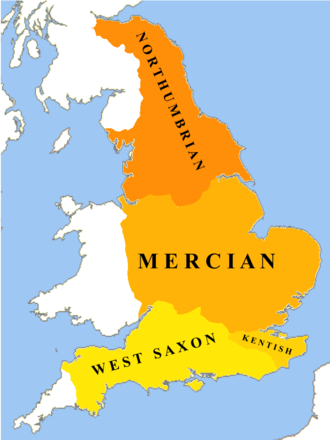
Old English, like Modern English, had different forms depending on where you lived. The main dialects were Mercian, Northumbrian, Kentish, and West Saxon. Each was linked to a different kingdom in England.
Northumbrian was spoken north of the Humber River, Mercian between the Humber and the Thames, West Saxon south and southwest of the Thames, and Kentish in a small area southeast of the Thames. Over time, Viking invasions changed these areas, and West Saxon became the standard language for government and literature. The other dialects influenced later forms of English, including Scots.
Influence of other languages
Further information: Celtic influence in English, Latin influence in English, and Scandinavian influence in English
Old English was influenced by many languages. The native British Celtic languages did not change Old English much, but a few words from Celtic remain, mostly in western areas. Latin added many words, especially after Christian missionaries brought the Latin alphabet for writing Old English.
Old Norse, the language of Scandinavian rulers and settlers, also had a big influence on Old English. Many common English words come from Old Norse. This influence helped make English grammar simpler.
Phonology
Old English had many sounds, some of which are similar to sounds in modern English but with important differences. For example, some sounds we no longer use, like certain soft consonants, disappeared as English changed over time. The way vowels and consonants changed helped shape the English we speak today.
Key changes included shifts in vowel sounds, the merging of diphthongs (combinations of vowel sounds), and the influence of nearby letters on pronunciation. These changes make Old English interesting to study, showing how language slowly evolves.
The sounds in Old English were influenced by the position of letters in a word and the letters around them, leading to many different pronunciations. These have since simplified in modern English.
| First element | Short (monomoraic) | Long (bimoraic) |
|---|---|---|
| Close | iy̯ | iːy̯ |
| Mid | eo̯ | eːo̯ |
| Open | æɑ̯ | æːɑ̯ |
Grammar
Old English used special word endings to show how words were related in a sentence. Nouns changed endings to show ownership or who was acting. Verbs changed endings to show if an action happened in the past or present and who was doing it.
The word order in Old English was more flexible than today because of these endings. Sentences often put the verb as the second important word. Questions were formed by switching word order, not using "do" like we do now.
Orthography
Old English was first written using runes, called the futhorc. These came from a German set of symbols. By the 8th century, writers started using a form of the Latin alphabet brought by Irish Christian teachers. This changed to a special cursive style called Insular script and later to Carolingian minuscule.
The Old English alphabet did not have the letters ⟨j⟩, ⟨w⟩, or ⟨v⟩. It added special symbols like ⟨æ⟩ and ⟨ð⟩, taken from old runes. Writers also used pairs of letters for single sounds and special signs for short words. Today, when we print old books, we use modern letters but keep some old symbols like ⟨æ⟩, ⟨ð⟩, and ⟨þ⟩. Old English spelling followed sound rules closely, without silent letters like in modern English.
| OE | Variants in modern editions | IPA transcription |
|---|---|---|
| a | a | /ɑ/ |
| ā | /ɑː/ | |
| æ | æ | /æ/ |
| ǣ | /æː/ | |
| ę | /æ/, /æː/ | |
| b | /b/ | |
| [v] (an allophone of /f/) | ||
| c | c | /k/ |
| ċ | /tʃ/ | |
| cg | cg | [ɡɡ] (between vowels; rare), [ɡ] (after /n/) |
| ċġ | [ddʒ] (between vowels), [dʒ] (after /n/) | |
| d | /d/ | |
| ð | ð, þ | /θ/, including its allophone [ð] |
| e | e | /e/ |
| ē | /eː/ | |
| ea | ea | /æɑ̯/ |
| ēa | /æːɑ̯/ | |
| eo | eo | /eo̯/ |
| ēo | /eːo̯/ | |
| f | /f/, including its allophone [v] | |
| g | g | /ɣ/, including its allophone [ɡ] |
| ġ | /j/, including its allophone [dʒ], which occurs after ⟨n⟩ | |
| h | /x/, including its allophones [h, ç] | |
| i | i | /i/, rarely [j] |
| ī | /iː/ | |
| ie | ie | /iy̯/ |
| īe | /iːy̯/ | |
| io | io | /io̯/ |
| īo | /iːo̯/ | |
| k | /k/ | |
| l | /l/ | |
| m | /m/ | |
| n | /n/, including its allophone [ŋ] | |
| o | o | /o/ |
| ō | /oː/ | |
| oe | oe, œ | /ø/ |
| ōe, œ̄ | /øː/ | |
| p | /p/ | |
| qu | /kw/ | |
| r | /r/ | |
| s | /s/, including its allophone [z] | |
| sc | sc | /sk/ (rare) |
| sċ | /ʃː/ (between vowels), /ʃ/ (elsewhere) | |
| t | /t/ | |
| th | /θ/ | |
| þ | /θ/, including its allophone [ð] | |
| u | u | /u/, also sometimes /w/. See ⟨ƿ⟩. |
| ū | /uː/ | |
| uu | w | /w/ |
| ƿ | ||
| x | /ks/ | |
| y | y | /y/ |
| ȳ | /yː/ | |
| z | /ts/ | |
Literature
Old English literature has about 400 surviving manuscripts. It mixes ideas from old pagan beliefs and Christianity, making it a rich collection from early Germanic peoples. Key works include Beowulf, an epic poem about a hero; the Anglo-Saxon Chronicle, a record of history; the Franks Casket, a decorated whalebone box; and Cædmon's Hymn, a religious poem. Most Old English writers are unknown, except for a few like Bede and Cædmon.
Beowulf begins with the story of Hrothgar's ancestor, Scyld, who was found as a baby and raised by a noble family. Old English poetry uses stress and alliteration, where words start with the same consonant sound. The Lord's Prayer and a charter from King Cnut in 1019 are also important examples of Old English writing.
| No. | Original | Representation with constructed cognates |
|---|---|---|
| 1 | Hƿæt! ƿē Gār-Dena in ġeār-dagum, | What! We of Gare-Danes (lit. Spear-Danes) in yore-days, |
| þēod-cyninga, þrym ġefrūnon, | of thede (nation/people)-kings, did thrum (glory) frain (learn about by asking), | |
| hū ðā æþelingas ellen fremedon. | how those athelings (noblemen) did ellen (fortitude/courage/zeal) freme (promote). | |
| Oft Scyld Scēfing sceaþena þrēatum, | Oft did Scyld Scefing of scather threats (troops), | |
| 5 | monegum mǣġþum, meodosetla oftēah, | of many maegths (clans; cf. Irish cognate Mac-), of meadsettees atee (deprive), |
| egsode eorlas. Syððan ǣrest ƿearð | [and] ugg (induce loathing in, terrify; related to "ugly") earls. Sith (since, as of when) erst (first) [he] worthed (became) | |
| fēasceaft funden, hē þæs frōfre ġebād, | [in] fewship (destitute) found, he of this frover (comfort) abode, | |
| ƿēox under ƿolcnum, ƿeorðmyndum þāh, | [and] waxed under welkin (firmament/clouds), [and amid] worthmint (honour/worship) theed (throve/prospered) | |
| oðþæt him ǣġhƿylc þāra ymbsittendra | oth that (until that) him each of those umsitters (those "sitting" or dwelling roundabout) | |
| 10 | ofer hronrāde hȳran scolde, | over whaleroad (kenning for "sea") hear should, |
| gomban gyldan. Þæt ƿæs gōd cyning! | [and] yeme (heed/obedience; related to "gormless") yield. That was [a] good king! |
| Line | Original | IPA | Word-for-word translation into Modern English | Translation |
|---|---|---|---|---|
| 1 | Fæder ūre þū þe eart on heofonum, | [ˈfæ.der ˈuː.re | ˈθuː ðe ˌæɑ̯rt on ˈheo̯.vo.num] | Father Ours, thou which art in heavens, | Our Father, who art in heaven, |
| 2 | Sīe þīn nama ġehālgod. | [ˈsiːy̯ ðiːn ˈnɒ.mɑ jeˈhɑːɫ.ɣod] | Be thine name hallowed. | Hallowed be thy name. |
| 3 | Tōbecume þīn rīċe, | [ˌtoː.beˈku.me ˌθiːn ˈriː.t͡ʃe] | To be come [is] thine kingdom, | Thy kingdom come, |
| 4 | Ġeweorðe þīn willa, on eorðan swā swā on heofonum. | [jeˈweo̯rˠ.ðe ˌθiːn ˈwil.lɑ | on ˈeo̯rˠ.ðan ˈswɑː ˌswɑː on ˈheo̯.vo.num] | Let there be thine will, on earth so so in heavens. | Thy will be done on earth as in heaven. |
| 5 | Ūrne dæġhwamlīċan hlāf sele ūs tōdæġ, | [ˌuːrˠ.ne ˈdæj.ʍɑmˌliː.t͡ʃɑn ˈhl̥ɑːf | ˈse.le ˌuːs toːˈdæj] | Our daily loaf sell us today, | Give us this day our daily bread, |
| 6 | And forġief ūs ūre gyltas, swā swā wē forġiefaþ ūrum gyltendum. | [ˌɒnd forˠˈjiy̯v uːs ˌuː.re ˈɣyɫ.tɑs | ˈswɑː ˌswɑː weː forˠˈjiy̯.vɑθ ˌuː.rum ˈɣyɫ.ten.dum] | And forgive us our guilts, so so we forgiveth our guilters. | And forgive us our debts, as we forgive our debtors. |
| 7 | And ne ġelǣd þū ūs on costnunge, ac ālīes ūs of yfele. | [ˌɒnd ne jeˈlæːd ðuː ˌuːz oŋ ˈkost.nuŋ.ɡe | ɑk ɑːˈliːy̯z uːs of ˈy.ve.le] | And not lead thou us in costening, but alease us of evil. | And lead us not into temptation, but deliver us from evil. |
| 8 | Sōðlīċe. | [ˈsoːðˌliː.t͡ʃe] | Soothly. | Amen. |
| Original | Representation with constructed cognates |
|---|---|
| ¶ Cnut cyning gret his arcebiscopas and his leod-biscopas and Þurcyl eorl and ealle his eorlas and ealne his þeodscype, tƿelfhynde and tƿyhynde, gehadode and læƿede, on Englalande freondlice. | ¶ Cnut, king, greets his archbishops and his lede'(people's)'-bishops and Thorkell, earl, and all his earls and all his peopleship, greater (having a 1200 shilling weregild) and lesser (200 shilling weregild), hooded(ordained to priesthood) and lewd(lay), in England friendly. |
| And ic cyðe eoƿ, þæt ic ƿylle beon hold hlaford and unsƿicende to godes gerihtum and to rihtre ƿoroldlage. | And I kithe(make known/couth to) you, that I will be [a] hold(civilised) lord and unswiking(uncheating) to God's rights(laws) and to [the] rights(laws) worldly. |
| ¶ Ic nam me to gemynde þa geƿritu and þa ƿord, þe se arcebiscop Lyfing me fram þam papan brohte of Rome, þæt ic scolde æghƿær godes lof upp aræran and unriht alecgan and full frið ƿyrcean be ðære mihte, þe me god syllan ƿolde. | ¶ I nam(took) me to mind the writs and the word that the Archbishop Lyfing me from the Pope brought of Rome, that I should ayewhere(everywhere) God's love(praise) uprear(promote), and unright(outlaw) lies, and full frith(peace) work(bring about) by the might that me God would(wished) [to] sell'(give). |
| ¶ Nu ne ƿandode ic na minum sceattum, þa hƿile þe eoƿ unfrið on handa stod: nu ic mid-godes fultume þæt totƿæmde mid-minum scattum. | ¶ Now, ne went(withdrew/changed) I not my shot(financial contribution, cf. Norse cognate in scot-free) the while that you stood(endured) unfrith(turmoil) on-hand: now I, mid(with) God's support, that [unfrith] totwemed(separated/dispelled) mid(with) my shot(financial contribution). |
| Þa cydde man me, þæt us mara hearm to fundode, þonne us ƿel licode: and þa for ic me sylf mid-þam mannum þe me mid-foron into Denmearcon, þe eoƿ mæst hearm of com: and þæt hæbbe mid-godes fultume forene forfangen, þæt eoƿ næfre heonon forð þanon nan unfrið to ne cymð, þa hƿile þe ge me rihtlice healdað and min lif byð. | Tho(then) [a] man kithed(made known/couth to) me that us more harm had found(come upon) than us well liked(equalled): and tho(then) fore(travelled) I, meself, mid(with) those men that mid(with) me fore(travelled), into Denmark that [to] you most harm came of(from): and that[harm] have [I], mid(with) God's support, afore(previously) forefangen(forestalled) that to you never henceforth thence none unfrith(breach of peace) ne come the while that ye me rightly hold(behold as king) and my life beeth. |
Dictionaries
Old English lexicography started in the Anglo-Saxon period. Scholars made English glosses to explain Latin words. At first, these glosses were written in the edges or between the lines of Latin books. Later, they were collected into word-lists like the Épinal-Erfurt, Leiden, and Corpus Glossaries. These lists grew and were organized into bigger glossaries, such as the Cleopatra, Harley, and Brussels Glossaries.
In later times, Old English lexicography became popular again in the early modern period. Important books include William Somner's Dictionarium Saxonico-Latino-Anglicum and Joseph Bosworth's Anglo-Saxon Dictionary from 1838. Today, important dictionaries are the Dictionary of Old English, An Anglo-Saxon Dictionary by Bosworth and Toller, and A Concise Anglo-Saxon Dictionary by Clark Hall. These books help scholars learn about Old English words and what they mean.
Main articles: Dictionary of Old English, An Anglo-Saxon Dictionary, A Concise Anglo-Saxon Dictionary, Roget's Thesaurus
Modern legacy
Old English still inspires writers and people who love languages today. Famous authors like J. R. R. Tolkien used Old English in their books. Some websites about Modern Paganism and historical reenactment encourage people to learn and use Old English. There is even an Old English version of Wikipedia.
But many online texts that try to look like Old English have mistakes and do not show the real language. Some people look back to Old English for new words or to bring back old ones.
Images
Related articles


This article is a child-friendly adaptation of the Wikipedia article on Old English, available under CC BY-SA 4.0.
Images from Wikimedia Commons. Tap any image to view credits and license.