 Safekipedia
Shrimp
Adapted from Wikipedia · Adventurer experience
A shrimp (pl.: shrimp (US) or shrimps (UK)) is a common name for small, swimming creatures with long bodies. They belong mainly to groups called Caridea or Dendrobranchiata, though some other creatures are also called shrimp. Shrimp have long, narrow tails, long whiskers called antennae, and thin legs. They swim by moving the parts under their tails called swimmerets, and when scared, they flip quickly to escape.
Shrimp are found everywhere, in both fresh water like rivers and lakes, and in the ocean. They live near the seafloor on most coasts and estuaries, and they are an important food source for larger animals, from fish to whales.
Many people enjoy eating shrimp, which are a popular type of shellfish. The industry for catching or farming shrimp is very big. However, catching too many shrimp and pollution from shrimp farms can harm the environment.
Classification
The words "shrimp" and "prawn" are common names, not scientific ones. They describe small sea creatures with long bodies, often eaten as food. Sometimes, "shrimp" is used for smaller ones, and "prawn" for larger ones, but there is no clear rule. Both words have been used for a long time, and their meanings can change depending on where you are.
Shrimp are sea creatures with long, narrow bodies and legs made for swimming. Unlike crabs and lobsters, shrimp are built for moving through the water. Some small swimming sea creatures are also called shrimp, even if they look a little different.
| Differences between shrimp, lobsters and crabs | ||
|---|---|---|
shrimp | lobsters | crabs |
| Shrimp are slender with long muscular abdomens. They look somewhat like small lobsters, but not like crabs. The abdomens of crabs are small and short, whereas the abdomens of lobsters and shrimp are large and long. The lower abdomens of shrimp support pleopods which are well-adapted for swimming. The carapaces of crabs are wide and flat, whereas the carapaces of lobsters and shrimp are more cylindrical. The antennae of crabs are short, whereas the antennae of lobsters and shrimp are usually long, reaching more than twice the body length in some shrimp species. | Clawed lobsters (pictured left) and spiny lobsters (pictured right) are an intermediate evolutionary development between shrimp and crabs. They look somewhat like large versions of shrimp. Clawed lobsters have large claws while spiny lobsters do not, having instead spiny antennae and carapace. Some of the biggest decapods are lobsters. Like crabs, lobsters have robust legs and are highly adapted for walking on the seafloor, though they do not walk sideways. Some species have rudimentary pleopods, which give them some ability to swim, and like shrimp they can lobster with their tail to escape predators, but their primary mode of locomotion is walking, not swimming. | Crabs evolved from early shrimp, though they do not look like shrimp. Unlike shrimp, their abdomens are small, and they have short antennae and short carapaces that are wide and flat. They have prominent grasping claws as their front pair of limbs. Crabs are adapted for walking on the seafloor. They have robust legs and usually move about the seafloor by walking sideways. They have pleopods, but they use them as intromittent organs or to hold egg broods, not for swimming. Whereas shrimp and lobsters escape predators by lobstering, crabs cling to the seafloor and burrow into sediment. Compared to shrimp and lobsters, the carapaces of crabs are particularly heavy, hard and mineralized. |
Description
A shrimp's body has two main parts: the head and thorax joined together, and a long, narrow abdomen. The shell on the head and thorax is hard and thick, called the carapace. It protects the gills. The rostrum at the front looks like a small beak and helps with defense and swimming backward. Shrimp have two eyes on stalks for wide vision and two pairs of whiskers. The long whiskers help them know where they are, and the short ones help check if food is safe to eat.
Shrimp have several pairs of legs from the head and thorax. The first legs near the mouth are for eating. The next ones have claws for grabbing food or defending themselves. The other legs are for walking. The abdomen has six segments with thinner shells. Each segment, except the last, has paddle-like parts for swimming forward. The last segment helps the shrimp swim backward and steer while moving forward. If scared, a shrimp can quickly flip backward to escape danger.
Habitat
Shrimp live in water almost everywhere, from close to the shore to deep ocean waters. They can be found near the seafloor, in rivers, and even in lakes. Some shrimp stay in shallow water, while others live in dark, deep waters. A few special kinds of shrimp can even be near mangroves on land.
Some shrimp help keep fish clean by removing tiny harmful creatures from their skin. Shrimp live in many places, from warm tropical waters to cold polar regions, showing how well they can adapt.
Behaviour
Shrimp come in many shapes and sizes, and they act in many different ways. For example, the tiny Pederson's shrimp looks very different and acts differently from the larger pink shrimp. Some shrimp, called pistol shrimp, have big claws that make loud snapping sounds. These sounds can be so loud that they are heard underwater.
Some small shrimp, like the emperor shrimp, live together with other sea animals, such as sea slugs and sea cucumbers. Shrimp also eat different kinds of food. Some catch small creatures, while others sweep up bits of material from the water using their bristly legs.
Mating
Some female shrimp can hold onto sperm from more than one partner. Scientists think the mother shrimp might choose the best sperm to use, which helps make stronger baby shrimp.
Species
Decapods
Scientists do not all agree on how to group creatures called shrimp. Some say shrimp belong to a group called Caridea, while others put them in a group called Dendrobranchiata. There are over 3,000 types of caridean shrimp. They are often called "true shrimp".
Scientists used to think of shrimp as part of a group called Natantia, which means "swimmers", because their bodies and legs are made for swimming. Now, scientists use different groups to organize shrimp and other sea creatures.
All the shrimp that people catch and eat belong to the Natantia group. The FAO helps decide how to name and group these shrimp for fishing reports.
Other sea creatures sometimes called shrimp include ghost or mud shrimp, which in Australia are called yabbies. Scientists are still learning how to best group these creatures.
Non-decapods
Many small sea creatures that are not like the shrimp we eat are also called shrimp. These include brine shrimp, clam shrimp, fairy shrimp, and tadpole shrimp. They look very different from the shrimp we eat — some have long, thin bodies, while others have tiny shells they can open and close.
Some creatures called shrimp, like mantis shrimp, can be as big as a foot and have very strong claws they use to hit their food.
| Major shrimp groups of the Natantia | |||||
|---|---|---|---|---|---|
| Order | Suborder | Infraorder | Image | Extant species | Description |
| Decapoda | Dendrobranchiata | 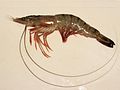 | 533 | Penaeid shrimp A particularly significant family in this suborder is the Penaeidae, often referred to as penaeid shrimp or penaeid prawn. Most commercially important species are in this family. See below. | |
| Pleocyemata | Caridea | 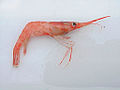 | 3438 | The numerous species in this infraorder are known as caridean shrimp, though only a few are commercially important. They are usually small, nocturnal, difficult to find (they burrow in the sediment), and of interest mainly to marine biologists. Caridean shrimp, such as the pink shrimp pictured, typically have two pairs of claws. Female carideans attach eggs to their pleopods and brood them there. The second abdominal segment overlaps both the first and the third segment, and the abdomen shows a pronounced caridean bend. | |
| Procarididea |  | 6 | A minor sister group to the Caridea (immediately above) | ||
| Stenopodidea | 71 | Known as boxer shrimp, the members of this infraorder are often cleaner shrimp. Their third pair of walking legs (pereiopods) are greatly enlarged. The banded coral shrimp (pictured) is popular in aquariums. The Stenopodidea are a much smaller group than the Dendrobranchia and Caridea, and have no commercial importance. | |||
| Other species groups commonly known as shrimp | |||||
|---|---|---|---|---|---|
| Class | Image | Group | Extant species | Description | |
| Branchiopoda | Branchiopoda comes from the Greek branchia meaning gills, and pous meaning feet. They have gills on their feet or mouthparts. | ||||
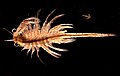 | brine shrimp | 8 | Brine shrimp belong to the genus Artemia. They live in inland saltwater lakes in unusually high salinities, which protects them from most predators. They produce eggs, called cysts, which can be stored in a dormant state for long periods and then hatched on demand. This has led to the extensive use of brine shrimp as fish feed in aquaculture. Brine shrimp are sold as novelty gifts under the marketing name Sea-Monkeys. | ||
 | clam shrimp | 150 | Clam shrimp belong to the group Conchostraca. These freshwater shrimp have a hinged bivalved carapace which can open and close. | ||
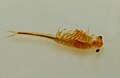 | fairy shrimp | 300 | Fairy shrimp belong to the class Anostraca. These 1–10 cm long freshwater or brackish shrimp have no carapace. They swim upside down with their belly uppermost, with swimming appendages that look like leaves. Most fairy shrimp are herbivores, and eat only the algae in the plankton. Their eggs can survive drought and temperature extremes for years, reviving and hatching after the rain returns. | ||
 | tadpole shrimp | 20 | Tadpole shrimp belong to the family Notostraca. These living fossils have not much changed since the Triassic. They are drought-resistant and can be found preying on fairy shrimp and small fish at the bottom of shallow lakes and temporary pools. The longtail tadpole shrimp (pictured) has three eyes and up to 120 legs with gills on them. It lives for 20–90 days. Different populations can be bisexual, unisexual or hermaphroditic. | ||
| Malacostraca | Malacostraca comes from the Greek malakós meaning soft and óstrakon meaning shell. The name is misleading, since normally the shell is hard, and is soft only briefly after moulting. | ||||
 | Lophogastrida | 56 | These marine pelagic shrimp make up the order Lophogastrida. They mostly inhabit relatively deep pelagic waters throughout the world. Like the related opossum shrimp, females lophogastrida carry a brood pouch. | ||
 | mantis shrimp | 400 | Mantis shrimp, so called because they resemble a praying mantis and a shrimp, make up the order Stomatopoda. They grow up to 38 cm (15 in) long, and can be vividly coloured. Some have powerful spiked claws which they punch into their prey, stunning, spearing and dismembering them. They have been called "thumb splitters" because of the severe gashes they can inflict if handled carelessly. | ||
 | opossum shrimp | 1,000 | Opossum shrimp belong to the order Mysida. They are called opossum shrimp because the females carry a brood pouch. Usually less than 3 cm long, they are not closely related to caridean or penaeid shrimp. They are widespread in marine waters, and are also found in some brackish and freshwater habitats in the Northern hemisphere. Marine mysids can form large swarms and are an important source of food for many fish. Some freshwater mysids are found in groundwater and anchialine caves. | ||
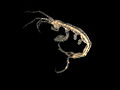 | skeleton shrimp | Skeleton shrimp, sometimes known as ghost shrimp, are amphipods. Their threadlike slender bodies allow them to virtually disappear among fine filaments in seaweed. Males are usually much larger than females. For a good account of a specific species, see Caprella mutica. | |||
| Ostracoda | Ostracod comes from the Greek óstrakon meaning shell. In this case, the shells are in two parts, like those of bivalves or clams. | ||||
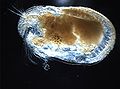 | seed shrimp | 13,000 | Seed shrimp make up the class Ostracoda. This is a class of numerous small crustacean species which look like seeds, typically about one millimetre (0.04 in) in size. Their carapace looks like a clam shell, with two parts held together by a hinge to allow the shell to open and close. Some marine seed shrimp drift as pelagic plankton, but most live on the sea floor and burrow in the upper sediment layer. There are also freshwater and terrestrial species. The class includes carnivores, herbivores, filter feeders and scavengers. | ||
Human uses
History
The painting "The Shrimp Girl" by William Hogarth, made around 1740–1745, shows a girl in London selling shrimp and mussels balanced on her head.
Archaeologists suggested that ancient raised areas near the coast in Chiapas, Mexico, might have been used to dry shrimp in the sun. Nearby clay hearths may have been used when there was no sun. In 1985, scientists found evidence of shrimping off the southeastern coast of North America dating back to 600 AD by identifying shrimp from the remains of their mandibles (jaws). Clay vessels with shrimp designs have been found in the ruins of Pompeii. In the 3rd century AD, the Greek writer Athenaeus wrote in his work, Deipnosophistae; "... of all fish the daintiest is a young shrimp in fig leaves."
In North America, indigenous peoples of the Americas caught shrimp and other sea creatures using fishing weirs and traps made from branches and Spanish moss, or nets woven from plant fibers. Early European settlers did not know about the "protein-rich coasts" around them and went hungry. In 1735, beach seines were brought from France, and Cajun fishermen in Louisiana began catching white shrimp and drying them in the sun, a practice that continues today. In the mid-1800s, Chinese immigrants arriving for the California Gold Rush started catching shrimp near San Francisco Bay, especially a small type called Crangon franciscorum.
The catch was dried and sent to China or sold to Chinese communities in the United States. This was the start of the American shrimping industry. Overfishing and pollution from gold mines caused the fishery to decline. It was replaced by a penaeid white shrimp fishery on the South Atlantic and Gulf coasts. These shrimp were so plentiful that beaches were covered with piles of their moults. Modern industrial shrimping began in this area.
Shrimp trawling catches shrimp in large amounts by dragging a net along the seafloor. Trawling was first recorded in England in 1376, when King Edward III was asked to ban this new and harmful fishing method. In 1583, the Dutch banned shrimp trawling in estuaries.
Diesel engines were adapted for shrimp boats in the 1920s. Power winches connected to these engines allowed small crews to quickly lift heavy nets onto the boat. Shrimp boats became larger, faster, and more capable. New fishing areas could be explored, trawls could be used in deeper waters, and shrimp could be caught year-round, not just seasonally. Larger boats fished farther out to sea, while smaller boats worked in bays and estuaries. By the 1960s, stronger hulls made from steel and fiberglass allowed boats to tow heavier nets, and advances in electronics, radar, sonar, and GPS made shrimp fleets more advanced and capable.
As shrimp fishing became industrialized, changes also happened in how shrimp were processed. In the 19th century, sun-dried shrimp were largely replaced by canneries. In the 20th century, canneries were replaced with freezers."
In the 1970s, significant shrimp farming began, especially in China. Farming grew quickly in the 1980s because the demand for shrimp exceeded the supply from wild catches, and because trawling for wild shrimp caused bycatch and threatened endangered sea turtles. In 2007, farmed shrimp production exceeded the catch of wild shrimp.
Commercial species
Although there are thousands of shrimp species worldwide, only about 20 are important for commercial use. The table below lists the main commercial shrimp, the seven most harvested species. All of them are decapods; most belong to the Dendrobranchiata and four are penaeid shrimp.
Fishing
Double-rigged shrimp trawler with one net up and the other being brought aboard
Traditional shrimper with a shrimp net
Commercial ways to catch wild shrimp include otter trawls, seines and shrimp baiting. A system of nets is used when trawling. Baited traps are common in parts of the Pacific Northwest.
Shrimp trawling can catch many non-target species accidentally. In 1997, the FAO found that up to 20 pounds of unwanted fish and other sea life were caught for every pound of shrimp. The world average was 5.7 pounds for every pound of shrimp. Trawl nets, especially shrimp trawls, have been linked to the death of finfish and cetaceans. Bycatch is often dead or dying when it is thrown back into the sea, and it can change the balance of nature in the areas where it happens. Worldwide, shrimp trawl fisheries make up about 2% of the total weight of fish caught, but they account for more than one third of all unintended catch.
The most commonly fished species are the akiami paste shrimp, the northern prawn, the southern rough shrimp, and the giant tiger prawn. Together, these four species make up almost half of the total wild catch. In recent years, the global catch of wild shrimp has been overtaken by the harvest from farmed shrimp.
Farming
Tanks in a shrimp hatchery
The whiteleg shrimp (juvenile shown) has become the preferred species for shrimp farming.
A shrimp farm is an aquaculture business that grows marine shrimp or prawns for people to eat. Commercial shrimp farming started in the 1970s and grew quickly, especially to meet the demands of the United States, Japan and Western Europe. The total global production of farmed shrimp reached more than 1.6 million tonnes in 2003, worth nearly 9 billion U.S. dollars. About 75% of farmed shrimp are produced in Asia, especially in China, Thailand, Indonesia, India and Vietnam. The other 25% are produced mainly in Latin America, where Brazil is the largest producer. By 2016, India was the biggest exporter, followed by Ecuador, Thailand, Indonesia and China.
Global aquaculture production started slowly in the 1970s and then grew fast during the 1980s. After a slowdown in the 1990s due to diseases, production increased again and by 2007 exceeded the catch from wild fisheries. By 2010, the aquaculture harvest was 3.9 million tonnes, compared to 3.1 million tonnes for wild shrimp.
In the early years of shrimp farming, the large giant tiger prawn was the preferred species. It was kept in circular tanks where it thought it was in the open ocean and swam in "never-ending migration" around the tank. In 2000, global production of giant tiger prawn was 630,984 tonnes, compared to 146,362 tonnes for whiteleg shrimp. Since then, these positions have switched, and by 2010, giant tiger prawn production increased modestly to 781,581 tonnes while whiteleg shrimp production increased nearly twenty-fold to 2,720,929 tonnes. The whiteleg shrimp is now the main species in shrimp farming. It is a medium-sized shrimp that grows to 230 mm (9"), and it is good for farming because it "breeds well in captivity, can be stocked at small sizes, grows fast and at uniform rates, has comparatively low protein requirements... and adapts well to variable environmental conditions." In China, prawns are farmed together with sea cucumbers and some fish species, in integrated multi-trophic systems.
China is the biggest producer of farmed shrimp. Other important producers are Thailand, Indonesia, India, Vietnam, Brazil, Ecuador and Bangladesh. Most farmed shrimp is exported to the United States, the European Union and Japan, as well as other Asian markets including South Korea, Hong Kong, Taiwan and Singapore.
Some reports have found concerns about the impact of farming these species on the environment, including the loss of mangroves and the over-catching of young shrimp from the wild to feed farms. Some groups have questioned the sustainability of tropical shrimp farming.
There is also evidence that shrimps, like other sea creatures, can feel pain.
As food
Shrimp are sold and used in many ways. Most shrimp are sold frozen and are grouped based on how they look, their color, and how uniform they are. Shrimp have high levels of omega-3 fatty acids and low levels of mercury. Shrimp are usually sold whole, but sometimes only the meat of shrimp is sold.
Like other seafood, shrimp contains a lot of calcium, iodine and protein but not many food energy calories. A shrimp meal is also a good source of cholesterol, ranging from 122 mg to 251 mg per 100 g of shrimp, depending on how it is prepared. However, eating shrimp is considered good for the heart because shrimp do not have much saturated fat, so the cholesterol in shrimp helps improve the balance of good and bad cholesterol and lowers triglycerides.
Ebiko - shrimp roe, sometimes called "shrimp flakes" - is used as an ingredient in sushi.
Shrimp and other shellfish are among the most common foods that people can be allergic to. They are not kosher and are not allowed in Jewish cuisine.
Since the early 2020s, plant-based and cultured alternatives to shrimp have been developed and are improving quickly.
Aquaria
Several types of shrimp are kept in home aquaria. Some are just for looks, while others help control algae and clean up debris. Freshwater shrimp commonly kept include the Bamboo shrimp, Japanese marsh shrimp (Caridina multidentata, also called "Amano shrimp," because Takashi Amano first used them in aquaria), cherry shrimp (Neocaridina heteropoda), and ghost or glass shrimp (Palaemonetes spp.). Popular saltwater shrimp include the cleaner shrimp Lysmata amboinensis, the fire shrimp (Lysmata debelius) and the harlequin shrimp (Hymenocera picta).
| Principal commercial shrimp species | ||||||||||||
|---|---|---|---|---|---|---|---|---|---|---|---|---|
| Group | Common name | Scientific name | Description | Max length (mm) | Depth (m) | Habitat | FAO | WoRMS | 2010 production (thousand tonnes) | |||
| wild | farmed | total | ||||||||||
| Dendrobranchiata | Whiteleg shrimp | Litopenaeus vannamei (Boone, 1931) | The most extensively farmed species of shrimp. | 230 | 0–72 | marine, estuarine | 1 | 2721 | 2722 | |||
| Giant tiger prawn | Penaeus monodon Fabricius, 1798 | 336 | 0–110 | marine, estuarine | 210 | 782 | 992 | |||||
| Akiami paste shrimp | Acetes japonicus Kishinouye, 1905 | Most intensively fished species. They are small with black eyes and red spots on the uropods. Only a small amount is sold fresh, most is dried, salted or fermented. | 30 | shallow | marine | 574 | 574 | |||||
| Southern rough shrimp | Trachysalambria curvirostris (Stimpson, 1860) | Easier to catch at night, and fished only in waters less than 60 m (200 ft) deep. Most of the harvest is landed in China. | 98 | 13–150 | marine | 294 | 294 | |||||
| Fleshy prawn | Fenneropenaeus chinensis (Osbeck, 1765) | Trawled in Asia where it is sold frozen. Exported to Western Europe. Cultured by Japan and South Korea in ponds. | 183 | 90–180 | marine | 108 | 45 | 153 | ||||
| Banana prawn | Fenneropenaeus merguiensis (De Man, 1888) | Typically trawled in the wild and frozen, with most catches made by Indonesia. Commercially important in Australia, Pakistan and the Persian Gulf. Cultured in Indonesia and Thailand. In India it tends to be confused with Fenneropenaeus indicus, so its economic status is unclear. | 240 | 10–45 | marine, estuarine | 93 | 20 | 113 | ||||
| Caridea | Northern prawn | Pandalus borealis (Krøyer, 1838) | Widely fished since the early 1900s in Norway, and later in other countries following Johan Hjort's practical discoveries of how to locate them. They have a short life which contributes to a variable stock on a yearly basis. They are not considered overfished. | 165 | 20–1380 | marine | 361 | 361 | ||||
| All other species | 1490 | 220 | 1710 | |||||||||
| Combined total | 3129 | 3788 | 6917 | |||||||||
| Freshwater aquaria variant shrimp come in many colours |
|---|
The Caridina cantonensis snow white shrimp is a white freshwater shrimp. The "Neocaridina heteropoda var. red" cherry shrimp is particularly easy to keep and breed. The "Neocaridina zhanghjiajiensis var. blue" pearl shrimp is closely related to the cherry shrimp. The Caridina cantonensis tiger shrimp is transparent with black stripes. The Caridina cantonensis red tiger shrimp is transparent with red stripes and is found in southern China. The popular Caridina cantonensis crystal red bee shrimp has broad red and white stripes. |
Images
Related articles



This article is a child-friendly adaptation of the Wikipedia article on Shrimp, available under CC BY-SA 4.0.
Images from Wikimedia Commons. Tap any image to view credits and license.