 Safekipedia
United States dollar
Adapted from Wikipedia · Adventurer experience
The United States dollar (symbol: $; currency code: USD) is the official currency of the United States and several other countries. It was first introduced by the Coinage Act of 1792, which divided it into 100 cents and began the minting of coins.
Originally, the dollar was tied to both silver and gold, but later it was linked only to gold. In 1971, it became a free-floating currency without ties to metals. Today, it is widely used around the world in international transactions and is held by many countries as a reserve currency.
The monetary policy of the United States is managed by the Federal Reserve System, which acts as the nation's central bank.
Overview
In the Constitution
The U.S. Constitution gives Congress the power to create money. This power is written in Article I, Section 8. Today, these laws are found in Title 31 of the U.S. Code, particularly Section 5112. This section explains how U.S. dollars should be made, including coins that are considered legal tender for paying debts. For example, the Sacagawea dollar is a copper coin, while the American Silver Eagle is made of pure silver. Section 5112 also talks about making other coins worth from one cent to $100.
Article I, Section 9 of the Constitution says that a regular report of all government money coming in and going out should be published. These amounts are reported in U.S. dollars, so the dollar is the main unit of money in the United States. The word "dollar" appears in this section and refers to the Spanish milled dollar, a coin worth eight Spanish reales.
Coinage Act
In 1792, the U.S. Congress passed the Coinage Act. Section 9 of this Act allowed the making of various coins. Section 20 of the Act says that the United States dollar is the main unit of money for the country. This means all government accounts and court cases must use dollars.
Decimal units
The Coinage Act created a decimal system for U.S. money. This system includes the mill (one-thousandth of a dollar), the cent (one-hundredth of a dollar), the dime (one-tenth of a dollar), and the eagle (ten dollars). Today, only the cent is commonly used, except when pricing gasoline. The dime is just the name for the coin worth ten cents. The mill was used for sales taxes but is now mostly unknown, though it still appears in gasoline prices. The eagle is also not well known and was used for ten-dollar gold coins.
Etymology
The word "dollar" comes from the German word joachimstaler, named after the valley where silver was mined in Bohemia. This word was later shortened to taler and spread to many languages, eventually becoming "dollar" in English. The Spanish eight-real coin, called the "piece of eight," became known as the dollar in the 18th century.
Nicknames
The U.S. dollar has many nicknames. For example, it is often called a buck. Another nickname is greenback, which comes from the green color on the back of some old dollar bills. Other nicknames include greenmail, green, and dead presidents (because the bills feature pictures of past presidents). There are also special names for different amounts, like two bits for a quarter, buck for a $1 bill, and Benjamin for a $100 bill.
Dollar sign
Main article: Dollar sign
The dollar sign ($) is used for the U.S. dollar and many other currencies. It may have come from the abbreviation ps for the peso, which was a common coin in the New World. Over time, the letters p and s were written on top of each other, creating the $ sign. Another idea is that it comes from the Pillars of Hercules on Spanish coins, which look like two vertical lines (||) and an S. Some people think it comes from the letters U and S stacked together, but this symbol was used before the United States was even created.
History
See also: History of the United States dollar
Origins: the Spanish dollar
The U.S. dollar was made to be like the Spanish-American silver dollar, also called the Spanish peso or piece-of-eight. This coin came from rich silver mines in Spanish America and was made in places like Mexico City, Potosí, and Lima. It was used all over the Americas, Asia, and Europe from the 1500s to the 1800s. Machine-milled Spanish dollars, starting in 1732, became trusted for trade and inspired the U.S. dollar.
Even after the United States Mint began making coins in 1792, locally made dollars and cents were less common than Spanish American pesos and reales. So, Spanish, Mexican, and American dollars all stayed legal money in the U.S. until 1857. People were used to the Spanish two-real quarter peso, which is why the U.S. made a 25-cent quarter instead of a 20-cent coin.
Coinage Act of 1792
See also: Coinage Act of 1792
On July 6, 1785, the Continental Congress decided the U.S. dollar would contain 375.64 grains of fine silver. Later, on August 8, 1786, they said the dollar would be divided into smaller parts like cents and dimes.
The Coinage Act of 1792 officially defined the U.S. dollar. It was based on the Spanish milled dollar and contained 371 + 4⁄16 grains of fine silver. It also defined an "eagle" as containing 247 + 4⁄8 grains of fine gold. Alexander Hamilton helped set these amounts based on tests of worn Spanish dollars.
The same act set the value of an eagle at 10 dollars and the dollar at 1⁄10 eagle. It called for making silver coins in amounts like 1, 1⁄2, 1⁄4, 1⁄10, and 1⁄20 dollar, and gold coins in 1, 1⁄2, and 1⁄4 eagle. This helped keep the value of goods steady, except when gold and silver amounts changed in the economy.
Design
Early U.S. money didn’t show presidents’ faces, unlike today. The government didn’t want to put leaders’ portraits on money, comparing it to kings in Europe. The money we know today with portraits didn’t appear until after 1900. Before that, coins showed designs from Greek and Roman stories or Native American themes. The last coins to get portraits of real Americans were the dime in 1946, the half dollar in 1948, and the dollar in 1971.
Continental currency
See also: Continental currency
After the American Revolution, the Thirteen Colonies became free from British rules. They made their own paper money to pay for the war. The Continental Congress also made "Continental Currency" in Spanish dollars. This money lost value during the war because it wasn’t well managed. The currency was replaced by the silver dollar at a rate of 1 silver dollar to 1000 continental dollars. This led to the U.S. Constitution saying states couldn’t use anything but gold and silver for paying debts.
Silver and gold standards, 19th century
From 1792 to 1900, the dollar was linked to both silver and gold, called a bimetallic standard. It was defined as either 371.25 grains of fine silver or 24.75 grains of fine gold.
After the California Gold Rush, the Coinage Act of 1853 changed the silver standard for coins below $1 to 384 grains, 90% silver. It also limited people to only turning bullion into one type of silver coin, the silver dollar.
Summary and links to coins from the 1800s:
- In base metal: 1/2 cent, 1 cent, 5 cents.
- In silver: half dime, dime, quarter dollar, half dollar, silver dollar.
- In gold: gold $1, $2.50 quarter eagle, $5 half eagle, $10 eagle, $20 double eagle.
- Less common amounts: bronze 2 cents, nickel 3 cents, silver 3 cents, silver 20 cents, gold $3.
Note issues, 19th century
To pay for the War of 1812, Congress allowed Treasury Notes, which were like short-term loans but also used as money. They were printed again after economic problems in 1837 and 1857, and to help pay for wars like the Mexican–American War and the Civil War.
In 1862, paper money was made without gold or silver backing because of the Civil War. Besides Treasury Notes, Congress allowed the Treasury to borrow $50 million as Demand Notes in 1861. But by late 1861, there wasn’t enough gold and silver to exchange them for, so they stopped taking them for gold. In February 1862, Congress passed the Legal Tender Act of 1862, making United States Notes legal money that had to be accepted for payments, except for taxes and government interest. Silver and gold coins were still made, which made the new notes lose value. In 1869, the Supreme Court said Congress couldn’t force people to accept these notes, but changed its mind in 1870. In 1875, Congress said the Treasury would start taking these notes for gold again in 1879.
Gold standard, 20th century
Although the dollar officially used the gold standard after 1900, the link to silver ended in practice in 1873 when the Coinage Act of 1873 stopped making the standard silver dollar. This happened just as lots of silver was found in the Comstock Lode in the 1870s.
The Gold Standard Act of 1900 ended the dollar’s link to silver and set it to 23.22 grains (1.505 g) of fine gold. In 1933, President Franklin D. Roosevelt ordered people to give up gold coins. In 1934, the value changed to $35 per troy ounce of gold.
After 1968, the link to gold was changed several times, ending completely on August 15, 1971, in what’s called the Nixon Shock. Since then, the U.S. dollar has changed value freely based on world markets.
Federal Reserve Notes, 20th century to present
See also: Federal Reserve Note
Congress kept making paper money after the Civil War. The latest type is the Federal Reserve Note, started by the Federal Reserve Act of 1913. Now, all U.S. dollar notes are Federal Reserve Notes.
Emergence as reserve currency
Main article: International use of the U.S. dollar
The U.S. dollar became an important world money in the 1920s, after the First World War, because the U.S. wasn’t as affected by the war and received lots of gold. After the U.S. became a strong global power during the Second World War, the Bretton Woods Agreement of 1944 made the U.S. dollar the main world money and the only one linked to gold. Even after the link to gold ended in 1971, the dollar remains the main money used around the world for trade.
The Bretton Woods Agreement also set up rules and groups like the International Monetary Fund and the World Bank Group to help manage world money and trade using the U.S. dollar.
The monetary policy of the United States is handled by the Federal Reserve System, the nation’s central bank, which began in 1913 to provide flexible money and oversee banks after the Panic of 1907.
For most time after World War II, the U.S. government has borrowed money from world markets using dollars, which helps it borrow at low interest rates without big money problems. This special ability is called the United States's exorbitant privilege.
Coins
Main article: Coins of the United States dollar
The United States Mint has made coins every year since 1792. Today, the coins you’ll find are the penny, nickel, dime, quarter, half dollar, and dollar.
The United States Mint makes coins at the Philadelphia and Denver Mints, and special coins for collectors at the San Francisco and West Point Mints.
Collector coins are worth more because of their special designs or metal. These include:
- American Eagle bullion coins
- American Silver Eagle $1 Silver coin 1986–present
- American Gold Eagle $5, $10, $25, and $50 Gold coins 1986–present
- American Platinum Eagle $10, $25, $50, and $100 Platinum coins 1997–present
- American Palladium Eagle $25 Palladium coin 2017–present
- United States commemorative coins—special coins, such as:
- $50.00 (Half Union) made for the Panama-Pacific International Exposition (1915)
- Silver proof sets with dimes, quarters and half-dollars made of silver
- Presidential dollar coins proof sets
| Denomination | Common name | Obverse | Reverse | Obverse portrait and design date | Reverse motif and design date | Weight | Diameter | Material | Edge | Circulation |
|---|---|---|---|---|---|---|---|---|---|---|
| Cent 1¢ | penny |  |  | Abraham Lincoln (1909) | Union Shield (2010) | 2.5 g (0.088 oz) | 0.75 in (19.05 mm) | 97.5% Zn covered by 2.5% Cu | Plain | Wide |
| Five cents 5¢ | nickel |  |  | Thomas Jefferson (2006) | Monticello (1938) | 5.0 g (0.176 oz) | 0.835 in (21.21 mm) | 75% Cu 25% Ni | Plain | Wide |
| Ten cents 10¢ | dime |  |  | Franklin D. Roosevelt (1946) | Olive branch, torch, and oak branch (1946) | 2.268 g (0.08 oz) | 0.705 in (17.91 mm) | 91.67% Cu 8.33% Ni | 118 reeds | Wide |
| Quarter dollar 25¢ | quarter |  | 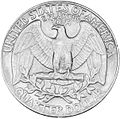 | George Washington (1932) | Various (5 designs per year) | 5.67 g (0.2 oz) | 0.955 in (24.26 mm) | 91.67% Cu 8.33% Ni | 119 reeds | Wide |
| Half dollar 50¢ | half dollar | 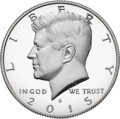 |  | John F. Kennedy (1964) | Presidential Seal (1964) | 11.34 g (0.4 oz) | 1.205 in (30.61 mm) | 91.67% Cu 8.33% Ni | 150 reeds | Limited |
| Dollar coin $1 | dollar coin, golden dollar | 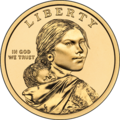 |  | Sacagawea (2000) | Various (4 designs per year) | 8.10 g (0.286 oz) | 1.043 in (26.50 mm) | 88.5% Cu 6% Zn 3.5% Mn 2% Ni | Plain 2000–2006 Lettered 2007–present | Limited |
| These images are to scale at 2.5 pixels per millimetre. For table standards, see the coin specification table. | ||||||||||
Banknotes
Main article: Federal Reserve Note
In the United States, special paper money called Federal Reserve Notes is used. These notes are made by the government and can be used to pay debts. They are often called “greenbacks” because they have a green color.
Today, you can find notes for $1, $2, $5, $10, $20, $50, and $100. Larger notes used to exist but are not printed for everyday use anymore. These notes are made from special cotton paper and come in different sizes. New colors have been added to help people tell the different amounts apart more easily.
| Denomination | Obverse | Reverse | Portrait | Reverse motif | First series | Latest series | Circulation |
|---|---|---|---|---|---|---|---|
| One dollar | George Washington | Great Seal of the United States | Series 1963 Series 1935 | Series 2021 | Wide | ||
| Two dollars | Thomas Jefferson | Declaration of Independence by John Trumbull | Series 1976 | Series 2017A | Limited | ||
| Five dollars | Abraham Lincoln | Lincoln Memorial | Series 2006 | Series 2021 | Wide | ||
| Ten dollars | Alexander Hamilton | Treasury Building | Series 2004A | Series 2021 | Wide | ||
| Twenty dollars | Andrew Jackson | White House | Series 2004 | Series 2017A | Wide | ||
| Fifty dollars | Ulysses S. Grant | United States Capitol | Series 2004 | Series 2021 | Wide | ||
| One hundred dollars | Benjamin Franklin | Independence Hall | Series 2009A | Series 2021 | Wide |
Countries that use US dollar
These countries and areas use the US dollar as their main money:
- The United States and its areas like American Samoa, Guam, Northern Mariana Islands, Puerto Rico, and U.S. Virgin Islands
- Places that agreed to use the US dollar like the Marshall Islands, Federated States of Micronesia, and Palau
- Other countries like Ecuador, El Salvador, Liberia, Panama, and Timor-Leste also use the US dollar, sometimes with their own smaller coins
- Some areas like the British Virgin Islands and Turks and Caicos Islands use the US dollar too
In a few other places, people also use the US dollar even though it is not their official money. Examples include Argentina, Cambodia, Honduras, Lebanon, Venezuela, and Zimbabwe. Some smaller areas like British Indian Ocean Territory and Sint Maarten also accept the US dollar.
Monetary policy
See also: Federal Reserve, Monetary policy, Monetary policy of the United States, and money supply
The Federal Reserve Act created the Federal Reserve System in 1913. It is the central bank of the United States. Its main job is to help the economy grow and stay stable. It does this by managing money and interest rates.
Monetary policy is how the country's money supply is controlled. This helps keep prices steady and jobs available. The Federal Reserve influences how much money is available by setting rules for banks and buying or selling government bonds. These actions affect interest rates, which influence spending and investment.
International use as reserve currency
See also: Reserve currency, International monetary system, Eurodollar, Exorbitant privilege, Strong dollar policy, and Dollarization
Main article: International use of the U.S. dollar
Ascendancy
For many years, the main money for trade around the world was the Spanish-American silver dollar. Later, the British pound became important, especially when gold became the standard for money.
After the First World War, the U.S. dollar grew in importance. The United States did not suffer as much damage in that war and received a lot of gold from other countries. After the Second World War, the U.S. became very strong. In 1944, an agreement called the Bretton Woods Agreement made the U.S. dollar the main money for trade around the world. It was linked to gold, at a price of $35 for each troy ounce.
As international reserve currency
Today, the U.S. dollar is one of the main currencies, along with the euro, the British pound, the Japanese yen, and the Chinese renminbi. Banks all over the world keep large amounts of U.S. dollars. Many people also keep U.S. dollars as $100 bills, and most of these bills are held outside the United States.
In the global markets
The U.S. dollar is the main money used to buy and sell goods around the world. It is also used to settle payments in many markets. The U.S. government can borrow large amounts of money in U.S. dollars with very low interest rates because it is considered very safe.
Currencies fixed to the U.S. dollar
Some countries use the U.S. dollar as their official money. These include Panama, Ecuador, El Salvador, British Virgin Islands, Turks and Caicos Islands, Caribbean Netherlands, Palau, Federated States of Micronesia, Marshall Islands, and Timor-Leste. Other countries, like Cambodia and Zimbabwe, use the U.S. dollar along with their own money.
Some countries tie their money to the U.S. dollar. This includes countries in the Caribbean and some oil-producing Arab countries. Other countries, such as Hong Kong and Jordan, also do this.
Value
The U.S. dollar is the money used in the United States. In 1792, a law called the Coinage Act introduced the U.S. dollar. It was worth the same as a Spanish silver dollar and was divided into 100 smaller parts called cents.
Over time, the value of the U.S. dollar has changed. This change is tied to something called inflation, which means prices for goods and services go up. Because of inflation, the dollar buys less today than it did in the past. Different events have affected the dollar’s value over the years.
| Year | Equivalent buying power |
|---|---|
| 1775 | $1.00 |
| 1780 | $0.59 |
| 1790 | $0.89 |
| 1800 | $0.64 |
| 1810 | $0.66 |
| 1820 | $0.69 |
| 1830 | $0.88 |
| 1840 | $0.94 |
| 1850 | $1.03 |
| 1860 | $0.97 |
| Year | Equivalent buying power |
|---|---|
| 1870 | $0.62 |
| 1880 | $0.79 |
| 1890 | $0.89 |
| 1900 | $0.96 |
| 1910 | $0.85 |
| 1920 | $0.39 |
| 1930 | $0.47 |
| 1940 | $0.56 |
| 1950 | $0.33 |
| 1960 | $0.26 |
| Year | Equivalent buying power |
|---|---|
| 1970 | $0.20 |
| 1980 | $0.10 |
| 1990 | $0.06 |
| 2000 | $0.05 |
| 2007 | $0.04 |
| 2008 | $0.04 |
| 2009 | $0.04 |
| 2010 | $0.035 |
| 2011 | $0.034 |
| 2012 | $0.03 |
Pegged currencies
Many countries link their money to the United States dollar. This helps with trading and travel.
Some of these countries include Aruban florin, Bahamian dollar, Bahraini dinar, Barbadian dollar, and Bermudian dollar, among others.
Currencies formerly with pegs
Some countries used to link their money to the United States dollar but stopped. Examples include Argentine peso, Chinese yuan, Indonesian rupiah, and South Korean won.
Obsolete currencies with USD peg
A few older currencies once linked their value to the United States dollar. These include Netherlands Antillean guilder and Cuban convertible peso.
Exchange rates
See also: U.S. Dollar Index
Historical exchange rates
The U.S. dollar has been shown on graphs compared to the Euro (starting in 1999), the Pound sterling, and the Japanese yen (both starting in 1990). These graphs show how many dollars are needed for one euro or pound.
Graphs also show the U.S. dollar compared to the Canadian dollar (starting in 1990), the Mexican peso (starting in 1994), and the Chinese Renminbi (starting in 1990). These graphs show how many Canadian dollars, pesos, and renminbi are needed for one U.S. dollar.
| Currency units | 1970 | 1980 | 1985 | 1990 | 1993 | 1999 | 2000 | 2005 | 2010 | 2015 | 2018 | 2024 |
|---|---|---|---|---|---|---|---|---|---|---|---|---|
| Euro | — | — | — | — | — | 0.9387 | 1.0832 | 0.8033 | 0.6739 | 0.9015 | 0.8504 | 0.9239 |
| Japanese yen | 357.6 | 240.45 | 250.35 | 146.25 | 111.08 | 113.73 | 107.80 | 110.11 | 87.78 | 121.05 | 111.130 | 151.4551 |
| Pound sterling | 8s 4d =0.4167 | 0.4484 | 0.8613 | 0.6207 | 0.6660 | 0.6184 | 0.6598 | 0.5493 | 0.4548 | 0.6544 | 0.7454 | 0.7827 |
| Swiss franc | 4.12 | 1.68 | 2.46 | 1.39 | 1.48 | 1.50 | 1.69 | 1.15 | 1.03 | 1.00 | 0.98 | 0.8808 |
| Canadian dollar | 1.081 | 1.168 | 1.321 | 1.1605 | 1.2902 | 1.4858 | 1.4855 | 1.2115 | 1.0298 | 1.2789 | 1.2842 | 1.3699 |
| Mexican peso | 0.0195 | 2.80 | 2.67 | 2.50 | 3.1237 | 9.553 | 9.459 | 10.894 | 12.623 | 15.837 | 19.911 | 18.3062 |
| Soviet / Russian ruble | 0.9000 | 0.6395 | 0.9200 | 0.6072 | 1.0037 | 24.6489 | 28.1287 | 28.1910 | 30.3679 | 61.3400 | 62.9502 | 92.6567 |
| Chinese Renminbi | 2.46 | 1.7050 | 2.9366 | 4.7832 | 5.7620 | 8.2783 | 8.2784 | 8.1936 | 6.7696 | 6.2840 | 6.383 | 7.1957 |
| Pakistani rupee | 4.761 | 9.9 | 15.9284 | 21.707 | 28.107 | 51.9 | 51.9 | 59.7 | 85.75 | 104.763 | 139.850 | 278.390 |
| Singapore dollar | — | — | 2.179 | 1.903 | 1.6158 | 1.6951 | 1.7361 | 1.6639 | 1.24586 | 1.3748 | 1.343 | 1.3363 |
| South Korean won | 310.556 | 607.717 | 870.020 | 707.766 | 802.538 | 1189.439 | 1130.362 | 1024.328 | 1156.460 | 1130.953 | 1100.163 | 1363.438 |
Images
Related articles


This article is a child-friendly adaptation of the Wikipedia article on United States dollar, available under CC BY-SA 4.0.
Images from Wikimedia Commons. Tap any image to view credits and license.