 Safekipedia
Socialist Federal Republic of Yugoslavia
Adapted from Wikipedia · Adventurer experience
The Socialist Federal Republic of Yugoslavia was a country in Central and Southeast Europe from 1945 to 1992. It was formed after World War II in Yugoslavia and included six republics: Bosnia and Herzegovina, Croatia, Macedonia, Montenegro, Serbia, and Slovenia. The capital was Belgrade in Serbia.
Led by Josip Broz Tito, Yugoslavia began as a communist state but later chose to stay neutral during the Cold War. It joined the Non-Aligned Movement and tried to balance its economy.
After Tito died in 1980, the country faced difficult times with rising prices, unemployment, and growing tensions among its people.
In the late 1980s and early 1990s, as communism fell in other parts of Eastern Europe, Yugoslavia began to break apart. In 1991, Croatia and Slovenia declared independence, and fighting followed. By 1992, the country had dissolved into several separate nations. Even though it no longer exists, Yugoslavia played an important role in history and was a founding member of the United Nations and the Organization for Security and Co-operation in Europe.
Name
The name "Yugoslavia" comes from two words. "Jug" means "south" and "slavija" means "land of the Slavs." So, Yugoslavia roughly means "Land of the South Slavs."
Yugoslavia had different names over time. It started in 1918 as the Kingdom of Serbs, Croats and Slovenes. In 1929, it became the Kingdom of Yugoslavia. After World War II, it was called the Federal People's Republic of Yugoslavia. In 1963, it became the Socialist Federal Republic of Yugoslavia. This last name is the one most people remember. People often just called it "Yugoslavia" or used the short form SFRY.
History
World War II
Yugoslavia was invaded by Axis powers led by Nazi Germany on April 6, 1941. Soon after, the country was fully occupied and divided. Two main resistance groups formed: the Royal Yugoslav Army in the Homeland and the Communist Yugoslav Partisans, led by Josip Broz Tito. The Partisans wanted to unite all Yugoslav nations and stood for left-wing and socialist ideas. They created the Anti-Fascist Council for the People's Liberation of Yugoslavia (AVNOJ), which acted as Yugoslavia’s parliament.
In 1943, the Partisans fought hard against Axis forces and grew stronger. After Italy surrendered in September 1943, Tito briefly freed the Dalmatian coast. The AVNOJ met again in November 1943 and decided to create a federation of six equal South Slavic republics. Tito became prime minister, and the Allies recognized the Partisans as their resistance group.
By 1945, the Partisans had removed Axis forces and freed Yugoslavia. Belgrade was freed with help from the Soviet Red Army in October 1944. The country was planned as a “Democratic Federation” with six federated states.
Postwar period
Elections were held on November 11, 1945, and the People’s Front, led by Tito, won. The monarchy ended, and Yugoslavia became a republic. The country faced big challenges after the war, with many people hurt, homeless, and industries broken. Yugoslavia received help to rebuild.
Tito made economic changes and focused on growing industry. The country became more industrialized, and life got better for many. Yugoslavia stayed neutral during the Cold War and joined the Non-Aligned Movement. The country built strong friendships with many nations.
Informbiro period
In 1948, a disagreement between Tito and Stalin caused Yugoslavia to be cut off from the Soviet Union. Yugoslav security stopped people who supported the Soviet Union. The West gave economic help and started sending weapons to Yugoslavia. Tito kept Yugoslavia neutral in the Cold War.
Reform
In the 1950s and 1960s, Yugoslavia made changes to share power more and give workers more say in their jobs. The country became more open and allowed more freedoms, though the government still kept control. Yugoslavia’s economy grew, and more people moved to cities. Schools got better, and more people learned to read and write.
Post-Tito period
Tito died on May 4, 1980, and many Yugoslavs mourned him. A group leadership was created, and the country faced economic troubles in the 1980s. Yugoslavia hosted the 1984 Winter Olympics in Sarajevo, showing unity among its different peoples.
Dissolution and war
In the 1980s and early 1990s, Yugoslavia had growing tensions between ethnic groups and economic troubles. The country split into several independent republics, leading to conflicts called the Yugoslav Wars. These conflicts caused much damage and suffering. The Socialist Federal Republic of Yugoslavia officially ended in 1992.
Post-1992 UN membership
After the breakup, the Federal Republic of Yugoslavia (Serbia and Montenegro) tried to be recognized as the continuation of the SFRY but was not accepted into the United Nations until after the removal of Slobodan Milošević in 2000.
Governance
Constitution
The first Yugoslav Constitution was adopted in 1946 and changed in 1953. A second constitution came in 1963, and a third in 1974. The League of Communists of Yugoslavia won the first elections and stayed in power until the country ended. It had Communist parties from each part of Yugoslavia. Leaders met to decide on changes. Josip Broz Tito was the main leader, but others were important too, especially after Tito passed away.
In 1974, Tito became President-for-life. After he died in 1980, Yugoslavia created a group of leaders from each part of the country to make decisions together. This group rotated leaders from each republic. In 1974, Yugoslavia changed its constitution again. One big change was dividing Serbia into two parts, Vojvodina and Kosovo, each with equal voting power like the other parts of Yugoslavia.
Women's rights policy
The 1946 Constitution wanted to make sure women had equal rights in all areas of life, like work, family, and society. By the 1970s, many women had more chances to learn and work, but full equality was still far off.
Federal units
Yugoslavia was made up of six parts, called republics. These parts were equal in rights and duties. Two special areas, Vojvodina and Kosovo, were also part of Serbia and had equal voting power.
Foreign policy
Yugoslavia chose not to side with any big powers during the Cold War. It worked closely with many countries, especially those just becoming independent. Yugoslavia helped groups fighting for freedom in other places. It also became a popular place for tourists to visit.
Military
Yugoslavia had its own army, called the Yugoslav People's Army. It made its own weapons and sold some to other countries. Each republic also had its own defense forces to help protect the country.
| Name | Capital | Flag | Coat of arms | Location |
|---|---|---|---|---|
| Socialist Republic of Bosnia and Herzegovina | Sarajevo |  |  | |
| Socialist Republic of Croatia | Zagreb |  |  | |
| Socialist Republic of Macedonia | Skopje |  |  | |
| Socialist Republic of Montenegro | Titograd (now Podgorica) |  |  | |
| Socialist Republic of Serbia | Belgrade | |  | |
| Socialist Republic of Slovenia | Ljubljana | 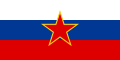 |  |
Economy
Main article: Economy of the Socialist Federal Republic of Yugoslavia
The economy of Yugoslavia was different from other nearby countries. After World War II, many buildings and factories were damaged, and lots of people lived in the countryside. Finding jobs was difficult, so many people went to work in places like West Germany to support their families.
Yugoslav companies sold goods to both Western and Eastern countries. In the 1970s, the government tried to let workers have more control over companies, but these changes caused problems. Things like high prices and shortages became common. By the 1980s, many people, especially young people, were unemployed, and money was scarce. The economy had more difficulties in the 1990s because of wars and bad management.
Transportation
Air transport
Further information: List of airlines of Yugoslavia and Air transport in Yugoslavia
After World War II, Yugoslavia worked to rebuild its air travel. The first plan was made in 1944 to connect big cities like Belgrade, Zagreb, and Ljubljana. Early flights used old planes, but new planes were added later. The national airline, JAT Airways, started in 1947 and grew to serve many places around the world.
Railways
Yugoslavia had a large railway network run by Yugoslav Railways. Many tracks were built or changed to use electricity. Important projects included connecting Zagreb to Belgrade and building the Belgrade–Bar railway. Trains traveled to many countries, including on the famous Orient Express.
Roads
The main road in Yugoslavia was the Brotherhood and Unity Highway. It went from the Austrian border to the Greek border, passing through Ljubljana, Zagreb, Belgrade, and Skopje. Building it took many years and lots of help from volunteers.
Maritime and river transportation
Yugoslavia had a long coast on the Adriatic Sea with ports like Split and Rijeka. Ferries crossed to Italy and Greece. Rivers like the Danube were used for travel, connecting cities such as Belgrade and Novi Sad.
Urban
Big cities in Yugoslavia had many buses, and some also had trams and trolleybuses. Belgrade planned a metro but never built it, so people used trams, buses, and trains called Beovoz instead. Other cities like Zagreb and Ljubljana also had their own tram systems.
Communications
Radio and television
Main article: Yugoslav Radio Television
Yugoslav Radio Television, called JRT, was the national public broadcasting system in Yugoslavia. It was one of the first members of the European Broadcasting Union. JRT had eight radio and television centers, each based in one of the six republics and two autonomous provinces of Yugoslavia. Each center made its own shows, and some had more than one channel. After Yugoslavia broke apart, these centers continued as public broadcasters in the new countries, but with new names. Zagreb Radio began broadcasting in 1926, the first public radio station in Southeast Europe. In 1956, Zagreb also started the first television program in Yugoslavia, which later switched to color broadcasting in 1972. RT Belgrade and RT Ljubljana began their television programs in 1958.
Geography
Yugoslavia was a country in Europe. It shared borders with several nations, including Italy, Austria, Hungary, Romania, Bulgaria, Greece, Albania, and the Adriatic Sea. Teachers used a special word, "BRIGAMA", to help students remember the neighboring countries.
In 1954, Yugoslavia gained some land from an area called the Free Territory of Trieste. Later, in the early 1990s, Yugoslavia broke apart into several new countries. These included Slovenia, Croatia, Macedonia, and Bosnia and Herzegovina. By 1992, only Serbia and Montenegro stayed together as the Federal Republic of Yugoslavia.
Demographics
Main article: Demographics of SFR Yugoslavia
Further information: Demographics of Yugoslavia and Demographics of the Balkans
See also: Ethnic groups in Yugoslavia
The Socialist Federal Republic of Yugoslavia had many different groups of people. Some groups were called "nations." These included Croats, Macedonians, Montenegrins, Muslims (from 1971), Serbs, and Slovenes. Other groups were called "nationalities." In total, about 26 different ethnic groups lived in Yugoslavia. Some people just called themselves "Yugoslav" if their families came from different backgrounds.
When Yugoslavia was ruled by communists, not many people said they were religious. By 1987, more than one-third of people said they had no religion. This was up from about one-eighth in 1951. The numbers of Orthodox and Catholic Christians went down, but the number of Muslims went up a little.
People in Yugoslavia mainly spoke three languages: Serbo-Croatian, Slovene, and Macedonian. Serbo-Croatian was spoken by most people in Serbia, Croatia, Bosnia and Herzegovina, and Montenegro. Slovene was spoken mostly in Slovenia, and Macedonian in Macedonia. Other languages were also spoken, such as Hungarian, Albanian, Turkish, Romanian, and Italian. The main languages were similar, so people from different areas could often understand each other.
Many people left Yugoslavia during the 1960s and 1970s to find work in other countries. Large numbers went to Switzerland, West Germany, Austria, Australia, Sweden, the United States, and Canada. The Yugoslav government tried to protect the rights of these workers abroad.
Education
During the time of the Socialist Federal Republic of Yugoslavia, education improved a lot. After World War II, many people learned to read and write, especially women. The number of people who could not read or write went down each year. In 1946, there were many elementary schools with millions of students. By 1958, all children could go to school for eight years.
More high schools and universities opened across the country. Famous schools like the University of Zagreb and University of Belgrade were already there, but new ones were added, such as the University of Sarajevo and University of Skopje.
Arts
Before breaking apart in the 1990s, Yugoslavia had a modern and multicultural society. The country valued unity and brotherhood, remembering the brave Yugoslav Partisans who fought during World War II. All kinds of art grew freely. The history of World War II was very important, showing a fight between good and bad within Yugoslavia itself.
Literature
Many Yugoslav writers supported the Partisans during World War II. Famous names included Vladimir Nazor, Oton Župančič, Matej Bor, and others. After the war, literature became more varied. Ivo Andrić won the Nobel Prize for Literature in 1961. Other well-known writers were Miroslav Krleža, Meša Selimović, and Mak Dizdar.
Graphic arts
Notable painters were Đorđe Andrejević Kun, Petar Lubarda, and Mersad Berber. A famous sculptor was Antun Augustinčić, who created a monument in front of the United Nations Headquarters in New York City.
Film
Yugoslav cinema had famous actors like Danilo Stojković, Mustafa Nadarević, and Bata Živojinović. Directors included Emir Kusturica and Dušan Makavejev. Many foreign actors appeared in Yugoslav films, such as Orson Welles and Richard Burton. Several foreign films were also made in Yugoslavia.
Music
Traditional music
Famous traditional music artists included the Tanec ensemble and Romani performer Esma Redžepova. Narodna muzika was very popular. In the 1980s and 1990s, novokomponovana muzika and turbo-folk became popular. Lepa Brena was a top singer in the 1980s.
Classical music
Ivo Pogorelić and Stefan Milenković were famous classical performers. Jakov Gotovac was a well-known composer and conductor.
Popular music
Yugoslavia had a lot of freedom for popular music, partly because of its split with Stalin. Popular music included many Western influences and was widely covered in media. Aspiring artists could travel to Western Europe for new instruments and ideas.
Yugoslavia joined the Eurovision Song Contest in 1961 and won in 1989 with the song "Rock Me" by the band Riva. They hosted the contest in 1990 in Zagreb.
Rock music
The Yugoslav rock scene began in the late 1950s and followed Western trends. In the 1960s, rock music grew popular, with bands like Bijele Strijele and Siluete. The 1970s saw progressive and jazz rock bands like Indexi and Korni Grupa. Bijelo Dugme became very popular with their folk-influenced rock sound.
The late 1970s and early 1980s brought punk rock and new wave scenes with bands like Paraf and Azra. By the mid-1980s, Yugoslavia had a rich and vibrant rock scene, with many different types of bands enjoying popularity.
Architectural heritage
Main article: Architecture of Yugoslavia
Yugoslav cities grew a lot and often used modernist or brutalist architecture. New neighborhoods like Novi Beograd and Novi Zagreb were built to house the growing middle class.
Sports
Yugoslavia had a strong sports community, especially in team sports like football, basketball, handball, water polo, and volleyball. The country was excited when Sarajevo was chosen to host the 1984 Winter Olympic Games.
Football
Main article: Football in Yugoslavia
Yugoslavia's biggest football success came when the club Red Star Belgrade won the 1990–91 European Cup, beating Olympique de Marseille in the final. Later that year, they became world club champions by beating Colo-Colo. The national team played in seven FIFA World Cups, with their best result being 4th place in Chile in 1962. They also played in four European Championships.
Basketball
Basketball grew quickly in Yugoslavia. The national team won three FIBA World Championships, a gold medal at the 1980 Olympics, and five European Championships. Yugoslav clubs also won the European Champion's Cup seven times.
Water polo
Yugoslavia's water polo team won three Olympic gold medals and two World Championship titles. The team also won one European Championship title.
Handball
Yugoslavia won two Olympic gold medals in handball and the World Championships title in 1986. The women's team also won Olympic gold and the World Championship.
Individual sports
Yugoslavia had success in individual sports like tennis, skiing, gymnastics, boxing, and chess. Monica Seles won five Grand Slam events under the Yugoslav flag in the early 1990s. Skiers, gymnasts, and boxers also achieved notable results, and Yugoslavia was considered one of the world's strongest chess nations.
National anthem
The national anthem of Yugoslavia was "Hej, Sloveni", meaning "Hey, Slavs". It was first sung during World War II and became the anthem in 1943. It stayed the anthem until 1988. After Yugoslavia broke up, the anthem was used by the union of Serbia and Montenegro.
Legacy
"Former Yugoslavia" redirects here. For a later former country that was also referred to as Yugoslavia, see Federal Republic of Yugoslavia. For a country that used to be called the Former Yugoslav Republic of Macedonia, see North Macedonia.
The countries that were once part of Yugoslavia are still sometimes called the former Yugoslavia. These countries are:
- Croatia (since 25 June 1991)
- Slovenia (since 25 June 1991)
- North Macedonia (since 25 September 1991; formerly Macedonia)
- Bosnia and Herzegovina (since 3 March 1992)
- Federal Republic of Yugoslavia (Serbia and Montenegro; 1992–2006)
- Montenegro (since 3 June 2006)
- Serbia (since 5 June 2006)
- Kosovo (since 17 February 2008; independence disputed)
In 2001, the countries reached an agreement about sharing money and other things from the old Yugoslavia, which started working in 2004.
Many of these countries want to join the European Union. Slovenia joined in 2004, and Croatia joined in 2013. Bosnia and Herzegovina, North Macedonia, Montenegro, and Serbia are waiting to join. Kosovo also wants to join.
People sometimes miss the old Yugoslavia because of its stability, good education, and travel freedom. This feeling is called Yugo-nostalgia. The ties between these countries are sometimes called the "Yugosphere".
| Country | 1991 | 2011 | Growth rate p.a. (CAGR) | Growth rate (2011 est.) |
|---|---|---|---|---|
| Bosnia and Herzegovina | 4,377,000 | 3,688,865 | –0.9% | N/A |
| Croatia | 4,784,000 | 4,288,000 | −0.6% | −0.08% |
| North Macedonia | 2,034,000 | 2,077,000 | +0.1% | +0.25% |
| Montenegro | 615,000 | 662,000 | +0.4% | −0.71% |
| Serbia | 9,778,991 | 7,310,000 | −1.5% | −0.47% |
| Slovenia | 1,913,000 | 2,000,000 | +0.2% | −0.16% |
| Total | 23,229,846 | 21,115,000 | −0.5% | N/A |
| Source: The CIA Factbook estimates for the successor states, as of July 2011 | ||||
Images
Related articles


This article is a child-friendly adaptation of the Wikipedia article on Socialist Federal Republic of Yugoslavia, available under CC BY-SA 4.0.
Images from Wikimedia Commons. Tap any image to view credits and license.