 Safekipedia
Bosnia and Herzegovina
Adapted from Wikipedia · Adventurer experience
Bosnia and Herzegovina, often called Bosnia, is a country in Southeast Europe. It is on the Balkan Peninsula and borders Serbia, Montenegro, and Croatia. The country has a small coastline along the Adriatic Sea. Bosnia has a mix of climates, with cooler winters and warmer summers, and its landscape is mostly mountainous.
People have lived in this area for thousands of years. Over time, many different groups, including Romans, Slavs, and Ottomans, have influenced the land. In the 1990s, Bosnia and Herzegovina became independent but had a difficult time.
Today, Bosnia and Herzegovina is home to many different people, including Bosniaks, Serbs, and Croats, who share the country. The country is made up of two main parts with their own local governments. Bosnia and Herzegovina is working to grow its economy and provide good services for its people, and it hopes to join important groups like the European Union in the future.
Etymology
The name "Bosnia" was first used in a book by a Byzantine emperor in the 10th century. It probably comes from the river Bosna that flows through the area.
The name "Herzegovina" means "a duke's land." It began with a Bosnian leader named Stjepan Vukčić Kosača in the 1400s. Later, the whole area became known as Bosnia and Herzegovina. The country adopted this name when it became independent in 1992.
History
Main articles: History of Bosnia and Herzegovina and Early history of Bosnia and Herzegovina
Bosnia has been home to people for a very long time, dating back to the Paleolithic era. One of the oldest known cave drawings was found in Badanj Cave near Stolac, showing an animal that looks like a horse from around 13,000 to 12,000 BC. During the Neolithic period, important cultures like the Butmir and Kakanj lived along the Bosna River. The Butmir culture, which thrived between 5100 and 4500 BC, is famous for its unique pottery and small statues of people.
From the 8th century BCE, Illyrian tribes grew into kingdoms. Two important Illyrian kings were Bardylis of the Dardani and Agron of the Ardiaei, who ruled large areas. Illyrian tribes later faced the Romans, starting in 229 BCE. The Romans finally took over the area in AD 9 after a tough four-year war called the Bellum Batonianum. During Roman times, Latin-speaking people settled among the Illyrians.
Middle Ages
The Early Slavs moved into the Western Balkans, including Bosnia, in the 6th and 7th centuries. By the 10th century, Bosnia was mentioned as its own land. Over time, Bosnia formed its own ruling group. In the High Middle Ages, Bosnia was sometimes controlled by the Kingdom of Hungary and the Byzantine Empire but later became independent as the Banate of Bosnia. The first known Bosnian leader was Ban Borić. Ban Kulin later ruled and faced issues with the Bosnian Church.
Bosnia faced struggles between different ruling families until Stephen II Kotromanić became Ban in 1322. He expanded Bosnia’s lands, and by 1377, under his nephew Tvrtko, Bosnia became a kingdom. After Tvrtko’s death in 1391, Bosnia began to decline. The Ottoman Empire started taking over the Balkans in the 15th century and finally conquered Bosnia in 1463.
Ottoman Empire
Main articles: Ottoman conquest of Bosnia and Herzegovina and Ottoman Bosnia and Herzegovina
The Ottoman conquest brought big changes to Bosnia. The Ottomans added Bosnia to their empire and changed how the land was governed. Many people left Bosnia, and some villages were empty. Over time, more people in Bosnia became part of the Ottoman culture. Cities like Sarajevo and Mostar grew and became important trade centers. Bosnian leaders also played important roles in the Ottoman Empire.
By the late 1600s, the Ottoman Empire began to struggle, and Bosnia felt the effects. There were uprisings and problems with leadership. In the 19th century, new nationalist ideas began to appear in Bosnia.
Austro-Hungarian occupation and condominium
Main articles: Austro-Hungarian campaign in Bosnia and Herzegovina in 1878 and Austro-Hungarian rule in Bosnia and Herzegovina
In 1878, Austria-Hungary began to control Bosnia and Herzegovina. Although there were some tensions, things settled down, and Austria-Hungary made improvements to laws and industries. In 1908, Austria-Hungary officially took over Bosnia completely. In 1914, a Bosnian named Gavrilo Princip was involved in an important event that helped start World War I.
Kingdom of Yugoslavia
Main article: History of Bosnia and Herzegovina § Kingdom of Yugoslavia (1918–41)
After World War I, Bosnia became part of the Kingdom of Serbs, Croats, and Slovenes, which was later called Yugoslavia. During this time, there were many political changes and struggles between different groups in Yugoslavia.
World War II (1941–1945)
Main article: History of Bosnia and Herzegovina (1941–1945)
During World War II, Bosnia was controlled by the Independent State of Croatia, which was allied with Germany and Italy. This time was very hard for many people. By the end of the war, Bosnia became one of the republics in the new Socialist Federal Republic of Yugoslavia.
Socialist Federal Republic of Yugoslavia (1945–1992)
Main article: Socialist Republic of Bosnia and Herzegovina
After the war, Bosnia was part of Yugoslavia and saw peaceful and prosperous times. The country developed its industries, education, and services. However, with the fall of communism and the breakup of Yugoslavia in the late 1980s and early 1990s, tensions rose among different groups in Bosnia.
Bosnian War (1992–1995)
Main article: Bosnian War
See also: Republic of Bosnia and Herzegovina
In 1992, after a vote for independence, Bosnia declared it was no longer part of Yugoslavia. However, this led to a painful war. Different groups fought for control, and many people suffered. The war ended in 1995, but the country faced many challenges in rebuilding.
Recent history
Main article: 2014 unrest in Bosnia and Herzegovina
In 2014, protests began in Bosnia over poor economic conditions and government problems. These protests showed the frustration many people felt about unemployment and political issues. Bosnia continues to work toward stability and development, and in 2022, it was recognized by the European Union as a candidate for joining the EU.
Geography
Main article: Geography of Bosnia and Herzegovina
See also: List of mountains, lakes, and rivers of Bosnia and Herzegovina
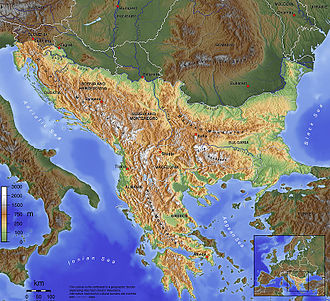
Bosnia and Herzegovina is a country in the western Balkans. It borders Croatia to the north and west, Serbia to the east, and Montenegro to the southeast. The country has a small coastline along the Adriatic Sea near the town of Neum. It is mostly mountainous, with the highest peak being Maglić. The country has many forests and several major rivers, including the Sava, Bosna, and Drina.
The capital and largest city is Sarajevo. Other important cities include Banja Luka, Tuzla, and Mostar.
Main article: Environment of Bosnia and Herzegovina § Biodiversity
Bosnia and Herzegovina has many different types of plants and animals. The country has forests covering much of its land. These forests are mostly found in the central, eastern, and western parts of the country. The southern area has a drier climate and different kinds of land. The forests are mostly owned by the public.
Politics
Main article: Politics of Bosnia and Herzegovina
Government
Main article: Political divisions of Bosnia and Herzegovina
Bosnia and Herzegovina shares power in a special way because of its history. The country has two main parts: the Federation of Bosnia and Herzegovina and Republika Srpska. Each part has its own government, but there is also a central government for the whole country.
Leaders are chosen by the people. There is a President and a Council of Ministers. The President changes every eight months among three people who represent the main groups in the country. The Council of Ministers helps run the government every day.
The country also has a Parliament with two houses that make laws. One house has members chosen by the parliaments of the two main parts, and the other house has members chosen by people voting.
Foreign relations
Main article: Foreign relations of Bosnia and Herzegovina
See also: Accession of Bosnia and Herzegovina to the European Union
Bosnia and Herzegovina wants to join the European Union and has been working on changes to meet the requirements. The country became a candidate to join the EU in December 2022.
The country has good relations with its neighbors, Croatia, Serbia, and Montenegro. Bosnia and Herzegovina is also working towards joining NATO, having received a plan to help it become a full member.
Military
Main article: Armed Forces of Bosnia and Herzegovina
The military of Bosnia and Herzegovina was created in 2005 when the armies of the two main parts of the country joined together. The military includes ground forces and an air force. The ground forces have many soldiers, and the air force has aircraft.
The military has sent small groups to help with peace missions in places like Afghanistan and Iraq. The air force is improving with more money for repairs and better teamwork with the ground forces. The Ministry of Defence is looking to get new aircraft, including helicopters and possibly fighter jets.
Economy
Main article: Economy of Bosnia and Herzegovina
See also: List of companies of Bosnia and Herzegovina
In the past, Bosnia and Herzegovina had a hard time with its money, which took a lot of work to fix. Today, the country is working to build a stronger economy. Long ago, it was known for strong industries, especially in metal, which helped build many important factories.
Farming has always been important, with families growing their own food on private farms.
The war in the 1990s made the economy weaker. Even today, Bosnia faces challenges, but there have been some improvements. The country uses the convertible mark (KM) as its money and is working to create more jobs.
Bosnia and Herzegovina has been making progress and has seen growth in exports, especially in items like car seats, electricity, and furniture. However, there are still issues like high unemployment that need attention.
Tourism
Main article: Tourism in Bosnia and Herzegovina
See also: List of tourist attractions in Sarajevo
Bosnia and Herzegovina has become a popular place for visitors. Many people come to see beautiful places like the Mehmed Paša Sokolović Bridge and Stari Most. The country is also known for its mountains, which are great for skiing and hiking. Rivers like the Vrbas and Tara are famous for activities like whitewater rafting.
In recent years, more tourists have been visiting Bosnia and Herzegovina, enjoying its history, nature, and adventure.
Transport
Main article: Transport in Bosnia and Herzegovina
Sarajevo International Airport is the main airport in Bosnia and Herzegovina, helping people travel in and out of the country easily. The country also has railway services that connect different parts of Bosnia and Herzegovina.
Telecommunications
Main article: Telecommunications in Bosnia and Herzegovina
The communications in Bosnia and Herzegovina now include many ways to connect, like mobile phones and the internet. There are several newspapers and news channels that share information with people across the country. As of 2021, most people in Bosnia and Herzegovina use the internet.
Demographics
Main articles: Demographics of Bosnia and Herzegovina and Bosnians
See also: Demographic history of Bosnia and Herzegovina
Bosnia and Herzegovina's population has changed a lot over time. In 1991, about 4.4 million people lived there. By 2013, the number fell to about 3.5 million. This happened because many people left during difficult times in the 1990s.
The country has three main groups of people: Bosniaks, Serbs, and Croats. These groups are large parts of the population. There are also smaller groups, like Jews and Roma.
People in Bosnia and Herzegovina speak several languages. Bosnian, Serbian, and Croatian are the main languages, and they sound very similar. There are also some minority languages spoken there too.
Bosnia and Herzegovina has many different religions. Most people follow Muslim traditions, but there are also Orthodox Christians, Catholic Christians, and some who do not follow any religion.
Children in Bosnia and Herzegovina go to school for nine years. After that, they can go to secondary schools for four more years. There are many universities and colleges where young people can study different subjects.
The country works hard to make sure everyone has enough food and good health care.
Culture
Main article: Culture of Bosnia and Herzegovina
Bosnia and Herzegovina has many interesting cultural traditions. The country's buildings show influences from different times and styles, creating a special mix.
The media in Bosnia and Herzegovina includes television, magazines, and newspapers. Some are owned by the government, while others are private companies. The Constitution guarantees freedom of speech.
Bosnia and Herzegovina has a rich history of writing. Famous writers include Ivo Andrić, who won a Nobel Prize, and many other poets and authors. The National Theater in Sarajevo opened in 1919.
Art in the country includes old stone monuments and modern paintings. European artists in the early 1900s helped the art scene grow. Today, there are museums and galleries showing both old and new works.
Music is important in Bosnian culture. Traditional songs include ganga and Sevdalinka, and pop and rock music are also popular. Famous musicians come from many backgrounds, and there are many bands and orchestras.
Cinema and theater have a long history in Bosnia and Herzegovina. Sarajevo is known for its film festivals, and many Bosnian filmmakers have won awards around the world.
Bosnian food uses many spices and fresh ingredients. Common dishes include ćevapi, burek, and dolma. The country is also known for its coffee culture, with many coffeehouses in cities like Sarajevo.
Bosnia and Herzegovina has many skilled athletes. The 1984 Winter Olympics were held in Sarajevo. The country has successful teams and people in sports like handball, basketball, football, and chess. Football is very popular, with many players doing well in international competitions.
Images
Related articles



This article is a child-friendly adaptation of the Wikipedia article on Bosnia and Herzegovina, available under CC BY-SA 4.0.
Images from Wikimedia Commons. Tap any image to view credits and license.