
Timeline of geometry
The study of geometry began thousands of years ago. It helps us understand shapes, sizes, and spaces. This timeline shows important moments and ideas in the history of geometry.
Early cultures like the Egyptians and Babylonians used geometry for building and measuring land. Later, mathematicians in ancient Greece, such as Euclid, created rules and proofs that we still use today. Their work helped shape many areas of math and science.
As geometry grew, new types emerged, like non-Euclidean geometry. This explores curved spaces and helps us understand the universe in new ways. Today, geometry is used in designing buildings, creating computer graphics, and studying space travel. Its history shows how human curiosity has built a powerful tool for exploring our world.
Before 1000 BC
Long ago, people started to explore shapes and numbers. Around 2000 BC, special carved balls found in Scotland showed patterns related to perfect shapes.
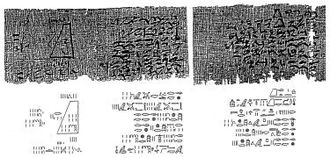
By 1800 BC, important papers like the Moscow Mathematical Papyrus and Plimpton 322 recorded clever ways to measure and understand numbers. Even earlier, around 1650 BC, the Rhind Mathematical Papyrus shared one of the first approximate values for the number π. This showed how ancient people tried to measure circles.
1st millennium BC
The 1st millennium BC was a time of amazing discoveries in geometry. Around 800 BC, Baudhayana wrote the Baudhayana Sulba Sutra, an old book about geometry. It included quadratic equations and could find the square root of 2 very accurately. About 600 BC, other books called Sulba Sutras used Pythagorean triples and made geometrical proofs.
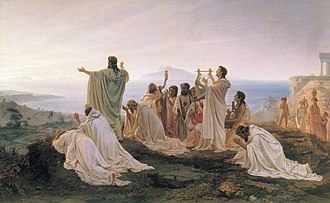
In 530 BC, Pythagoras studied geometry and discovered that the square root of two is an irrational number. Later, around 370 BC, Eudoxus introduced a clever way to find areas called the method of exhaustion. In 300 BC, Euclid wrote his famous book Elements. In it, he studied geometry using axioms, proved there are infinitely many prime numbers, and shared the Euclidean algorithm. Archimedes, around 260 BC, made precise estimates for π and calculated areas of shapes like circles and parabolas. Apollonius of Perga, around 225 BC, wrote about conic sections and named the ellipse, parabola, and hyperbola.
1st millennium
During this time, many important ideas in geometry were developed. Around 340, Pappus of Alexandria shared ideas about shapes like hexagons. By 50, Aryabhata wrote about math functions, introducing sine and cosine.
In the 7th and 8th centuries, mathematicians like Bhaskara I, Virasena, and Shridhara worked on calculating sine values, describing number patterns such as the Fibonacci sequence, and measuring shapes like a frustum and spheres. Around 820, Al-Mahani linked geometry with algebra, and by 975, Al-Batani expanded on math functions, studying tangent.
1000–1500
During this time, many important discoveries in geometry were made. Around the year 1000, the Law of sines was discovered by Muslim mathematicians. Around 1100, Omar Khayyám made advances in solving cubic equations using geometry.
Later, in 1135, Sharafeddin Tusi used algebra to study geometry, which helped start the field of algebraic geometry. By around 1250, Nasir Al-Din Al-Tusi tried to develop a new kind of geometry. In the 15th century, Nilakantha Somayaji from the Kerala school wrote about infinite series and spherical geometry.
17th century
In the 17th century, many new ideas about geometry appeared. An Indian mathematician named Putumana Somayaji wrote a book called "Paddhati" about trigonometry. In 1619, a scientist named Johannes Kepler found two special shapes called the Kepler-Poinsot polyhedra. In 1637, a French thinker named René Descartes wrote a book called La Géométrie. He showed how to use math and equations to describe shapes. This idea is called analytic geometry.
18th century
In the 1700s, many important ideas in geometry were discovered. In 1722, Abraham de Moivre shared a special formula connecting angles and complex numbers, called de Moivre's formula. Giovanni Gerolamo Saccheri wondered what geometry would be like if one of Euclid's basic rules was changed.
Later, in 1796, Carl Friedrich Gauss showed that a shape with 17 sides, called a regular 17-gon, could be drawn perfectly using just a compass and straightedge. Caspar Wessel also explored complex numbers by linking them to directions, and in 1799, Gaspard Monge wrote a book called Géométrie descriptive, starting the field of descriptive geometry.
19th century
In the 1800s, many new ideas changed how we think about shapes and space. In 1806, Louis Poinsot discovered two new shapes called the Kepler-Poinsot polyhedra.
In 1829, Bolyai, Gauss, and Lobachevsky created a new kind of geometry called non-Euclidean geometry. This geometry looks different from the one we usually learn in school.
Other important events include Pierre Wantzel proving in 1837 that some old problems, like doubling the cube or trisecting an angle, cannot be solved with just a compass and straightedge.
In 1854, Bernhard Riemann introduced Riemannian geometry, which helps us understand curved shapes of space. That same year, Arthur Cayley showed how quaternions could describe rotations in four-dimensional space.
August Ferdinand Möbius invented the Möbius strip in 1858, a special surface that has only one side.
Finally, in 1899, David Hilbert made a clear set of rules for geometry in his work Foundations of Geometry.
20th century
The 20th century was a time of exciting discoveries in geometry. In 1901, Élie Cartan developed the exterior derivative, a new way to understand shapes.
In 1912, Luitzen Egbertus Jan Brouwer shared the Brouwer fixed-point theorem, which helps solve problems about where things can end up.
More important ideas came later. In 1916, Einstein's theory of general relativity changed how we think about space.
In 1975, Benoit Mandelbrot introduced fractals, shapes that repeat themselves at different sizes.
By 1998, Thomas Callister Hales proved the Kepler conjecture, solving a long-standing question about how spheres can be packed together.
21st century
In 2003, a mathematician named Grigori Perelman solved a famous problem called the Poincaré conjecture. In 2007, scientists around the world used many computers to discover and map a huge mathematical shape known as E8 (mathematics). These were important steps in learning more about geometry.
Keep exploring




This article is a child-friendly adaptation of the Wikipedia article on Timeline of geometry, available under CC BY-SA 4.0.
Images from Wikimedia Commons. Tap any image to view credits and license.