 Safekipedia
Twelve Olympians
Adapted from Wikipedia · Adventurer experience
In ancient Greek religion and mythology, the twelve Olympians are the most important deities in the Greek pantheon. These twelve powerful gods and goddesses are usually listed as Zeus, Poseidon, Hera, Demeter, Aphrodite, Athena, Artemis, Apollo, Ares, Hephaestus, Hermes, and either Hestia or Dionysus. They earned the name "Olympians" because, according to the stories, they lived on the top of Mount Olympus.
These gods and goddesses played many roles in the lives of ancient Greeks. They were thought to control different parts of the world and human life, like the oceans, war, wisdom, and love. People built temples, held festivals, and offered gifts to honor them, hoping this would bring good luck and favor.
Besides these twelve, the Greeks also had many other groups of twelve gods, each with their own special meanings and stories. The twelve Olympians remain some of the most well-known and loved figures from ancient Greek tales, teaching us about the values and beliefs of that time.
Olympians
The Olympians were important gods in ancient Greek stories. They lived on top of Mount Olympus and were led by Zeus. These gods won their place by fighting older gods called the Titans.
The main Olympians included Zeus, Poseidon, Hera, Demeter, Hestia, and Zeus’s children like Aphrodite, Athena, Artemis, Apollo, Ares, Hephaestus, Hermes, and Dionysus.
There were twelve main Olympians, but other gods also lived on Mount Olympus. For example, Heracles joined them after becoming a god. Some Titan gods like Themis also spent time there. Many other lesser gods and spirits could be found around Olympus too.
Twelve gods
In ancient Greece, many places had groups of twelve gods. The idea of twelve important gods started around the late sixth century BC. In Athens, an altar for these twelve gods was built around 522 BC. This altar became a special place for measuring distances and seeking safety.
Olympia also honored twelve gods. The god Hermes once divided a sacrifice into twelve parts. The hero Heracles was said to have made sacrifices to twelve ruling gods there. Other places like Delos, Chalcedon, Magnesia on the Maeander, and Leontinoi in Sicily also had their own groups of twelve gods. Some of these groups included well-known Olympians, but others had different important figures from Greek myths.
The number of gods was always twelve, but the members of each group could change. Some lists included gods not usually counted among the Olympians, such as the Titan parents Cronus and Rhea, or the river god Alpheus. Even the Roman poet Ennius talked about twelve main gods, including Vesta, who was important in Roman religion.
Main article: Greek
altar of the twelve gods
agora
Athens
archon
Pisistratus
Olympia
Homeric Hymn to Hermes
Alpheus
Heracles
Altis
Herodorus of Heraclea
Delos
Chalcedon
Magnesia on the Maeander
Leontinoi
Sicily
Alpheus
Cronus
Rhea
Graces
Plato
Pluto
Ennius
Roman equivalents
Dii Consentes
Roman religion
Vestals
List
In ancient Greek stories, the twelve Olympians are the main gods and goddesses who live on Mount Olympus. There isn’t just one fixed list of these twelve, but the most common ones include Zeus, Poseidon, Hera, Demeter, Aphrodite, Athena, Artemis, Apollo, Ares, Hephaestus, Hermes, and either Hestia or Dionysus.
| Greek | Roman | Image | Functions and attributes |
|---|---|---|---|
| Zeus | Jupiter | King of the gods and ruler of Mount Olympus; god of the sky, lightning, thunder, law, order and justice. The youngest child of the Titans Cronus and Rhea. Brother and husband of Hera and brother of Poseidon, Hades, Demeter, and Hestia. He had many affairs with goddesses and mortals, such as his sister Demeter and Leto, mortals Leda and Alcmene, and more. His symbols include the thunderbolt, eagle, oak tree, bull, scepter, and scales. | |
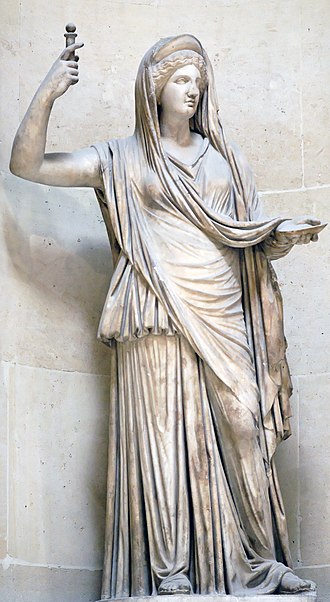
| Hera | Juno | Queen of the gods and the goddess of marriage, women, childbirth and family. The youngest daughter of Cronus and Rhea. Sister and wife of Zeus. Being the goddess of marriage, she frequently tried to get revenge on Zeus' lovers and their children. Her symbols include the peacock, cuckoo, and cow. | |
| Poseidon | Neptune | God of the seas, water, storms, hurricanes, earthquakes and horses. The middle son of Cronus and Rhea. Brother of Zeus and Hades. Married to the Nereid Amphitrite; although, as with many of the male Greek gods, he had many lovers. His symbols include the trident, horse, bull, and dolphin. | |
| Demeter | Ceres | Goddess of the harvest, fertility, agriculture, nature and the seasons. She presided over grains and the fertility of the earth. The middle daughter of Cronus and Rhea. Also the lover of Zeus and Poseidon, and the mother of Persephone, Despoine, Arion. Her symbols include the poppy, wheat, torch, cornucopia, and pig. | |
| Apollo | Apollo | God of Sun, light, prophecy, philosophy, archery, truth, inspiration, poetry, music, arts, manly beauty, medicine, healing, and plague. The son of Zeus and Leto, and the twin brother of Artemis. His symbols include bow and arrow, lyre, raven, swan and wolf. | |
| Artemis | Diana | Goddess of the hunt, the wilderness, virginity, the Moon, archery, childbirth, protection and plague. The daughter of Zeus and Leto, and the twin sister of Apollo. Her symbols include the Moon, horse, deer, hound, she-bear, snake, cypress tree, and bow and arrow. | |
| Ares | Mars | God of war, violence, bloodshed and manly virtues. The son of Zeus and Hera, all the other gods despised him except Aphrodite. His Latin name, Mars, gave us the word "martial". His symbols include the boar, serpent, dog, vulture, spear, and shield. | |
| Athena | Minerva | Goddess of wisdom, handicraft, and warfare. The daughter of Zeus and the Oceanid Metis, she rose from her father's head fully grown and in full battle armor. Her symbols include the owl and the olive tree. | |
| Hephaestus | Vulcan | Master blacksmith and craftsman of the gods; god of the forge, craftsmanship, invention, fire and volcanoes. The son of Hera, either by Zeus or through parthenogenesis. Married to Aphrodite. His Latin name, Vulcan, gave us the word "volcano". His symbols include fire, anvil, axe, donkey, hammer, tongs, and quail. | |
| Aphrodite | Venus | Goddess of love, pleasure, passion, procreation, fertility, beauty and desire. The daughter of Zeus and the Oceanid or Titaness Dione, or perhaps born from the sea foam after Uranus' blood dripped into the sea after being castrated by his youngest son, Cronus, who then threw his father's genitals into the sea. Married to Hephaestus, although she had many adulterous affairs, most notably with Ares. Her name gave us the word "aphrodisiac", while her Latin name, Venus, gave us the word "venereal". Her symbols include the dove, bird, apple, bee, swan, myrtle, and rose. | |
| Hermes | Mercury | Messenger of the gods; god of travel, commerce, communication, borders, eloquence, diplomacy, thieves, and games. He was also the guide of dead souls. The son of Zeus and the nymph Maia. The second-youngest Olympian, just older than Dionysus. His symbols include the caduceus (staff entwined with two snakes), winged sandals and cap, and tortoise (whose shell he used to invent the lyre). | |
| Most lists of the "twelve Olympians" consist of the above eleven plus either Hestia or Dionysus | |||
| Hestia | Vesta | Goddess of the hearth, fire and of the right ordering of domesticity and the family; she was born into the first Olympian generation and was one of the original twelve Olympians. She is the first child of Cronus and Rhea, the elder sister of Hades, Demeter, Poseidon, Hera, and Zeus. Some lists of the Twelve Olympians omit her in favor of Dionysus, but the speculation that she gave her throne to him in order to keep the peace seems to be a modern invention. | |
| Dionysus | Liber | God of wine, the grapevine, fertility, festivity, ecstasy, madness and resurrection. Patron god of the art of theatre. The son of Zeus and the mortal Theban princess Semele, and the youngest Olympian god. Married to the Cretan princess Ariadne. His symbols include the grapevine, ivy, cup, tiger, panther, leopard, dolphin, goat, and pinecone. | |
Genealogy
In ancient Greek stories, the twelve Olympians are the main gods and goddesses. They live on Mount Olympus. The twelve Olympians are Zeus, Poseidon, Hera, Demeter, Aphrodite, Athena, Artemis, Apollo, Ares, Hephaestus, Hermes, and either Hestia or Dionysus. There were also many other groups of twelve gods in Greek belief.
Related articles



This article is a child-friendly adaptation of the Wikipedia article on Twelve Olympians, available under CC BY-SA 4.0.
Images from Wikimedia Commons. Tap any image to view credits and license.