Zeus
Zeus is the most important god in the Greek pantheon. He is a sky and thunder god in ancient Greek religion and mythology. He rules as king of the gods from Mount Olympus. For other uses of the name, see Zeus (disambiguation).
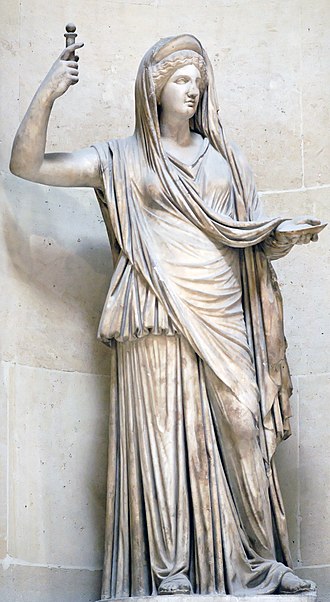
Zeus is the son of Cronus and Rhea. In most stories, he is married to Hera. They are said to be the parents of Ares, Eileithyia, Hebe, and Hephaestus. At the oracle of Dodona, his wife was said to be Dione. The Iliad says that she was the mother of Aphrodite. In the Theogony, Zeus's first wife is Metis, and their child is Athena. Zeus also had many other children, including Apollo, Artemis, Hermes, Persephone, Dionysus, Perseus, Heracles, Helen of Troy, Minos, and the Muses.
Zeus was respected as a sky father and as the chief of the gods, who gave jobs to the others. Even gods who were not his children called him Father, and all the gods stood up when he entered. He was equated with many weather gods from other lands. The writer Pausanias noted that "That Zeus is king in heaven is a saying common to all men." His symbols include the thunderbolt and the eagle.
Zeus's image comes from several places. It draws on his Indo-European inheritance, and his title "cloud-gatherer" also comes from older traditions. Some of his looks, such as the scepter, were borrowed from cultures of the ancient Near East. In ancient Rome, Zeus was identified with the god Jupiter.
Name
The god's name in Greek is Ζεύς (Zeús). The name changes its ending depending on how it is used. For example, it becomes Ζεῦ (Zeû) when calling out to him, Δία (Día) in the accusative case, Διός (Diós) in the genitive case, and Διί (Dií) in the dative case. The writer Diogenes Laërtius said that Pherecydes of Syros spelled the name Ζάς. The oldest known forms come from Mycenaean Greek, which was written in Linear B script as di-we and di-wo. Zeus had many other names, called epithets. Some of these were names of local gods who were later included in the stories about Zeus.
Zeus's name comes from *Dyēus, the name of a very old god of the daytime sky from the Proto-Indo-European people. This god was also called *Dyeus ph2tēr ("Sky Father"). The same god appears in the Rigveda as Vedic Sanskrit Dyaus/Dyaus Pita, and in Latin as Jupiter. These names come from the root *dyeu-, which means "to shine." The Albanian Zoj-z and Messapic Zis are related forms. Zeus is the only god in the Olympic pantheon whose name clearly comes from this old root.
Mythology
In Hesiod's Theogony, Cronus becomes ruler of the universe. He swallows each of his children as they are born, because he has been warned that one of them will overthrow him. His wife, Rhea, saves her youngest child, Zeus, by giving Cronus a stone wrapped in cloth instead. Zeus is raised in secret. The stories do not agree on where he was born. Hesiod says Crete, while other writers name different places. When Zeus is grown, he makes Cronus give up the swallowed children and the stone. He then leads the Olympian gods in a ten-year war against the Titans. He uses Mount Olympus as his home base and wins. Zeus shares the world with his brothers Poseidon and Hades. Zeus gets the sky.
Zeus's rule is challenged by the Giants and by the monster Typhon, but he defeats both. He marries Hera. Many stories tell of Zeus having children with other goddesses and with mortal women, while Hera is often shown as jealous. Zeus also appears in other myths, such as the story of Prometheus and the first woman, Pandora. He is also part of the story of the great flood, which only Deucalion and Pyrrha survived. In Homer's Iliad, about the Trojan War, Zeus has a major role.
Roles and epithets
Main article: Epithets of Zeus
Zeus played a leading role among the Greek Olympian gods. He was the father of many heroes, and he was honored in many of their local cults. Like the gods of nearby lands, he was the god of the sky and thunder. In many ways, he was the best example of Greek religious beliefs and the archetypal Greek god.
People in different places had very different ideas about Zeus. Local versions often had little in common except the name. They had different areas of power and were worshiped in different ways. For example, some local groups saw Zeus as a chthonic earth-god rather than a sky god. Over time, these local gods were slowly joined with the main Greek idea of Zeus, through conquest and religious syncretism. Local versions were given epithets, which are names or titles that show different ideas about the god.
These titles showed different sides of his wide-ranging power:
- Zeus Aegiduchos or Aegiochos: usually seen as Zeus holding the Aegis, a magic shield with the head of Medusa on it. Others connect the name to "goat" and to Zeus's nurse, the divine goat Amalthea.
- Zeus Agoraeus: Zeus as protector of the marketplace (agora) and punisher of dishonest traders.
- Zeus Areius: either "warlike" or "the one who makes amends."
- Zeus Eleutherios: "Zeus the freedom giver," worshiped in Athens.
- Zeus Horkios: Zeus as keeper of oaths. People caught lying had to give a votive statue to Zeus, often at the sanctuary at Olympia.
- Zeus Olympios: Zeus as king of the gods and patron of the Panhellenic Games at Olympia.
- Zeus Panhellenios: "Zeus of All the Greeks," worshiped at Aeacus's temple on Aegina.
- Zeus Xenios, Philoxenon, or Hospites: Zeus as protector of hospitality (xenia) and guests, and as the one who punished wrongs done to strangers.
Cults
Main article: Cult of Zeus
The most important place where all Greeks gathered to honor Zeus was Olympia. There, a festival was held every four years, and it featured the famous Games. Outside of these big gatherings, people honored Zeus in different ways in different places. Still, many Greek temples from Asia Minor to Sicily shared some titles and rituals, such as offering a white animal on a raised altar. On Crete, where Greeks agreed Zeus was born, he was honored as Zeus Velchanos ("boy-Zeus"), often called the Kouros. He was worshipped in caves at Knossos, Ida and Palaikastro.
Zeus was also linked to the wolf-festival of the Lykaia on Mount Lykaion in Arcadia. Many Greek cities also honored a local Zeus connected to the earth, and offerings were made to these gods in pits. Most oracles, places where people sought answers from the gods, were linked to Apollo. A few were dedicated to Zeus. At Dodona in Epirus, people looked for answers from a sacred oak. The oracle of Ammon at the Siwa Oasis in Egypt was also famous, and Zeus Ammon was especially honored at Sparta.
Identifications with other gods
Zeus was matched with the Roman god Jupiter. In a mixing of gods called interpretatio graeca, he was also linked with other gods. These included the Egyptian god Ammon and the Etruscan god Tinia. Together with Dionysus, Zeus became the main Phrygian god Sabazios. In Rome, this mixed god was known as Sabazius, a syncretic god. The Seleucid ruler Antiochus IV Epiphanes set up a statue of Zeus Olympios in the Temple in Jerusalem. Jews who followed Greek ways called it Baal Shamen, which means Lord of Heaven. Zeus is also linked with the Hindu god Indra. Both are kings of the gods, and both use thunder as their weapon.
Zeus was sometimes mixed up with the sun god Helios. Helios was sometimes called Zeus's eye, or was clearly meant that way. Hesiod described Zeus's eye as the sun. This idea may come from older Proto-Indo-European religion, where the sun was sometimes seen as the eye of *Dyḗus Pḥatḗr (see Hvare-khshaeta). Euripides called Zeus "sun-eyed" in his lost play Mysians. In his play Medea, the chorus called Helios "light born from Zeus." Later, the Serapis god, a Greco-Egyptian god seen as a form of Zeus, was shown with the sun's crown and rays. People also gave offerings to "Zeus-Serapis-Helios" across the Mediterranean. The Anastasy papyrus, now kept in the British Museum, also linked Helios with Zeus, Serapis, and Mithras. Inscriptions from Trachonitis show worship of "Zeus the Unconquered Sun." An inscription on the island of Amorgos reads "Zeus the Sun," which suggests sun worship as early as the fifth century BC. The Cretan Zeus Tallaios also had sun elements in his worship, since "Talos" was the local name for Helios.
Later representations
In Neoplatonism, Zeus is taught as the Demiurge or Divine Mind. This idea appears in the writings of Plotinus, especially his book Enneads, and in the Platonic Theology by Proclus. Zeus is also mentioned twice in the Christian New Testament.
The first time is in Acts 14:8–13. People living in Lystra saw the Apostle Paul heal a man who could not walk. They thought Paul and his friend Barnabas were gods. They called Paul Hermes and called Barnabas Zeus, and they even tried to offer them sacrifices. Two ancient inscriptions were found near Lystra in 1909. They show that these two gods were worshipped in that city.
The second mention is in Acts 28:11. A ship carried the prisoner Paul away from the island of Malta. The ship had a figurehead called "Sons of Zeus," which referred to Castor and Pollux.
The book of 2 Maccabees 6:1–2 is part of the Bible but is not in all versions. It tells how King Antiochus IV (Epiphanes) tried to stop Second Temple Judaism during the era. He ordered the Temple in Jerusalem to be treated as unholy and dedicated to Zeus, who was also called Jupiter Olympius.
Genealogy

Quiz time!
4 questions about Zeus
Where does Zeus rule as king of the gods?
Pictures
Keep exploring



This article is a child-friendly adaptation of the Wikipedia article on Zeus, available under CC BY-SA 4.0.
Images from Wikimedia Commons. Tap any image to view credits and license.