 Safekipedia
Visible spectrum
Adapted from Wikipedia · Adventurer experience
The visible spectrum is the band of the electromagnetic spectrum that our human eye can see. This part of the spectrum is made up of what we call visible light. Light is a type of electromagnetic radiation that travels in waves. The length of these waves, called wavelengths, decides the colors we see.
Most people can see light with wavelengths between about 380 to 750 nanometers. This range of light waves matches frequencies between roughly 400–790 terahertz. These limits can change a little depending on the person and conditions.
The visible spectrum does not include every color our eyes can imagine. For example, colors like pink or magenta cannot be found in the spectrum alone because they need a mix of different wavelengths to appear. Colors that come from just one wavelength are called pure colors or spectral colors.
One interesting thing about visible light is that it can travel through Earth’s Earth's atmosphere with little loss. This is called the "optical window" of the atmosphere. Because of this, we see the sky as blue during the day. The air scatters blue light more than red light, making the sky appear blue except near the Sun, where the light looks white.
Spectral colors
Main article: Spectral color
Spectral colors are colors that come from light with just one small range of colors. This light has very narrow bands of wavelengths, which we call monochromatic light. The different color areas you see in pictures are just guesses because the colors blend smoothly into each other without sharp lines.
History
In the 13th century, Roger Bacon thought that rainbows happened because of how light passes through glass or crystal.
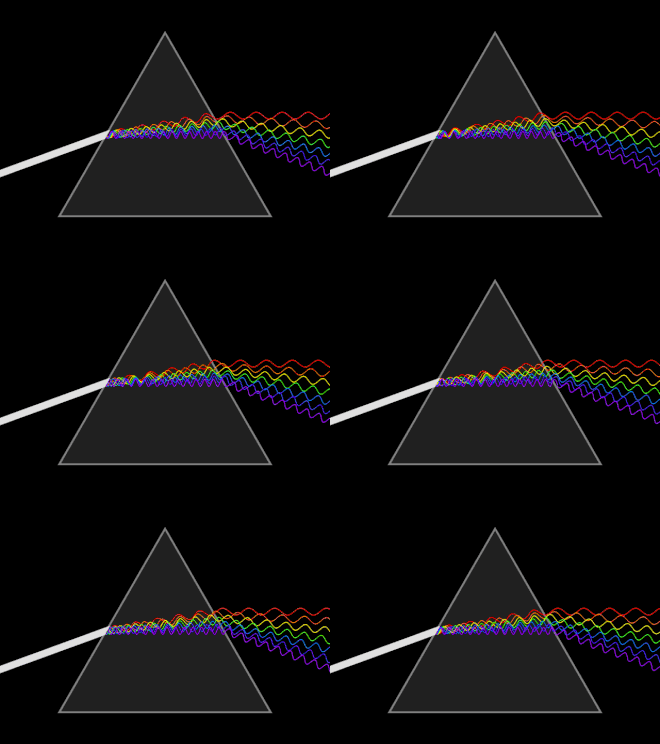
In the 17th century, Isaac Newton found out that prisms could split white light into its colors and then put it back together. He was the first to use the word spectrum in his book Opticks. Newton saw that when sunlight hits a glass prism, it makes a band of colors. He believed that light was made of tiny parts, each with a different color.
Newton first named six colors in the spectrum: red, orange, yellow, green, blue, and violet. Later, he added indigo as the seventh color.
In the 18th century, Johann Wolfgang von Goethe wrote about how we see colors in his book Theory of Colours.
In the early 19th century, scientists discovered light beyond what we can see, like infrared and ultraviolet. Thomas Young was the first to measure the wavelengths of different colors of light. He and Hermann von Helmholtz studied how our eyes see color.
Limits to visible range
See also: Color vision § Physiology of color perception
The visible spectrum is the light our eyes can see. It has all the colors we know, from red to violet. Light that is too bright or far away from these colors usually does not reach our eyes or does not make us see it as a color.
Most animals see light that can move through air easily. This is why the light we see on Earth is the same as the light from the sun. Our eyes have special parts that let light in before it reaches the back of the eye to be seen. This helps us see the colors around us.
In non-humans
See also: Evolution of color vision
The visible spectrum is defined for humans, but many animals see light differently. Animals have special cells called opsins that help them see light. Some animals can see ultraviolet light, which humans cannot see.
Most mammals have fewer types of these cells than humans. But some animals, like birds and fish, have even more. Birds often see ultraviolet light, which helps them see special markings on feathers. Fish can also see ultraviolet light, and some see colors a little different from humans. Some insects, like bees, see ultraviolet light, which helps them find flowers.
Spectroscopy
Main article: Spectroscopy
Spectroscopy is a way to study objects by looking at the colors of light they give off, take in, or bounce back. In astronomy, scientists use this to learn about faraway stars and planets. By watching special lines in the light, they can find out what things are made of. For example, the element helium was first found by looking at the light from the Sun. Scientists also use these lines to see how fast objects are moving toward or away from us.
Images
Related articles




This article is a child-friendly adaptation of the Wikipedia article on Visible spectrum, available under CC BY-SA 4.0.
Images from Wikimedia Commons. Tap any image to view credits and license.