 Safekipedia
Watford
Adapted from Wikipedia · Adventurer experience
Watford is a town and a special area called a non-metropolitan district with borough status in Hertfordshire, England. It is 15 miles northwest of London, next to the River Colne.
At first, Watford was a small market town. Things changed when the Grand Junction Canal was built. This helped create paper mills, print works, and breweries.
Even though many factories closed, Watford’s good location near London and its transport links made it a popular place for companies. One famous spot is Cassiobury Park, a beautiful public park. It was once owned by the Earls of Essex.
Watford grew a lot after the canal was finished in 1798 and the London and Birmingham Railway began in 1837. Important events such as the 2006 World Golf Championship were held at The Grove. Today, Watford is a busy town with many people and activities.
History
Early history
People lived near Watford a long time ago. We know this because we have found a few old things from Celtic and Roman times. But the town did not really start until much later. Watford is where you could cross the River Colne on an old road going from the southeast to the northwest. The town’s High Street follows part of this old road. The land was drier than the marshy edges of the river.
The name Watford might come from old words meaning “full of water” or “hunting” and “ford.” In 1007, Watford was written about in old records, but it was not in a big survey from 1086. In the 1100s, a charter allowed a market to be held, and building of St Mary's Church began. The town’s place helped it grow because of trade along the road and good connections to nearby places.
Industrial Revolution
For many years, Watford was a quiet place with some small trades. The Industrial Revolution brought big changes. The Grand Junction Canal came in 1798, followed by the London and Birmingham Railway in 1837. These helped the town grow. The canal allowed coal to be brought in, and new factories began to appear. Paper mills, breweries, and gas works were built. The town grew, with new streets and many people moving in from London.
20th century
In the early 1900s, Watford kept growing. New neighborhoods were built, but some areas were crowded and not very healthy. After World War I, more homes were built. By the 1920s, printing became a big industry, with many factories in the town. During World War II, these factories made important items for the government.
In the 1950s and 1960s, Watford was home to a famous furniture company. A special chair designed there is still well-known today. An old airplane factory was turned into a film studio, where famous movies were made.
Geography
Watford is in southern Hertfordshire, England. It is next to the River Colne, about 16 miles (26 km) northwest of central London.
Many people live in Watford. In 2021, about 102,246 people lived there. It is close to Greater London. An area called Watford Rural separates Watford from the rest of Greater London. This rural area is part of the Three Rivers District.
Religion
As of the 2021 census, Watford's religious makeup is similar to that of England and Wales, but with more followers of Islam and Hinduism than usual. The Jewish community in Watford grew during the 1900s, with a synagogue built in 1946. It has stayed strong with help from larger Jewish groups nearby, such as in Bushey and Stanmore.
| Area | All people | Christian (%) | Buddhist (%) | Hindu (%) | Jewish (%) | Muslim (%) | Sikh (%) | Other (%) | No religion (%) | Not stated (%) |
|---|---|---|---|---|---|---|---|---|---|---|
| England 2011 | 59.4 | 0.5 | 1.5 | 0.5 | 5.0 | 0.8 | 0.4 | 24.8 | 7.1 | |
| Watford 2011 | 90,300 | 54.1 | 0.7 | 4.8 | 1.1 | 9.9 | 0.6 | 0.5 | 21.4 | 6.7 |
| England 2021 | 56,490,048 | 46.3 | 0.5 | 1.8 | 0.5 | 6.7 | 0.9 | 0.6 | 36.7 | 6.0 |
| Watford 2021 | 102,246 | 44.45 | 1.00 | 8.21 | 0.92 | 12.97 | 0.65 | 0.84 | 24.78 | 6.17 |
Governance
Watford has two levels of local government: the Watford Borough Council and the Hertfordshire County Council.
Watford is special because it is one of only 15 places in England and Wales that has a mayor chosen directly by voters. Dorothy Thornhill was the first person to hold this job, and she was the first woman to be a directly elected mayor in England. The town is divided into 12 areas, called wards. Each ward elects three representatives every four years. Watford also chooses one Member of Parliament to represent the area in the government.
The town has friendly connections, called twinning, with five other towns in different countries.
Economy
Watford is an important town in the northern home counties. It is famous for its shopping and busy High Street, which has many bars, clubs, and restaurants. The main shopping area is the Harlequin Shopping Centre, a large indoor mall with over 140 shops, restaurants, and cafes. It opened in 1992 and is still popular.
The town has offices for several big companies, such as J D Wetherspoon, Camelot Group, Bathstore, and Pepe's Piri Piri. Many international companies also have their UK offices in Watford, including Hilton Worldwide, TotalEnergies, TK Maxx, and Costco.
Parks
Cassiobury Park
Main article: Cassiobury Park
Cassiobury Park is a large green space from an old house called Cassiobury House. The park is 190 acres and has open spaces to explore. It has a children's play area with fun things like a paddling pool, play equipment, and an ice cream van. A canal runs through the park, and people come here for a weekly running event called parkrun.
Cheslyn House and Gardens
Cheslyn House and Gardens has been open to visitors since 1965. The gardens have neat open spaces and natural woodland areas. You can see many interesting plants from all over the world, and there are also new features like a pond and a rock garden.
Woodside Park
Woodside Park has been recognised for being a great green space since 2011. It has large fields for sports and relaxation, with many facilities such as a track, stadium, and community centre. The park is home to a local athletics club and holds big sporting events.
Heritage
Watford has many important buildings. Ninety-two of them are listed nationally. One is St Mary's Church, built in the 12th century. Its inside was changed in 1850 and has special wooden seats. It also has a chapel with fancy stone tombs.
Another important building is the Holy Rood Church, built in 1890. It is known for its beautiful design and colorful windows. There is also the Bushey Arches Viaduct, built in the 1830s, and the Colne Viaduct. Both are important parts of the town's history. Watford has ten areas to protect old buildings, plus one special park and many locally important buildings.
Theatres
Watford Palace Theatre
The Watford Palace Theatre opened in 1908 and is the only theatre in Hertfordshire that makes its own shows. It has fun plays for families, including a special pantomime each year. The theatre has space for 600 people and was updated in 2004. It also has a café, a bar, and sometimes shows movies and special performances of opera and ballet.
Pump House
The Pump House Theatre and Arts Centre is in an old building that used to pump water. It is now a place for local arts groups to meet and perform. The Pump House has a small theatre for 124 people, plus spaces for rehearsing and live music. Many groups use it, including ballet for children, music clubs, and comedy nights. In 2018, it helped start the first Watford Short Film Festival with the local museum.
Watford Colosseum
Watford Colosseum is a big entertainment spot in town. It started in 1938 and was made bigger in 2011 with new spaces to meet and eat. Famous performers like Maria Callas and Luciano Pavarotti have played there. The Colosseum is also where people can watch concerts, films, and even boxing matches. It has hosted many special events for charities and a snooker tournament in February 2020.
Museums
The Museum of Watford has many paintings and sculptures by famous artists like J. M. W. Turner, Sir Joshua Reynolds, William Blake, and Jacob Epstein. It shows items about the Cassiobury Estate, Watford Football Club, and the town's history. You can see old documents, photos, and diaries about the people and places in Watford. The museum used to be in an old brewery but is now closed while it moves to Watford Town Hall. It plans to open again by 2026 or 2027.
The Hertfordshire Fire Museum tells the story of firefighting. It is at Watford Fire Station and has old fire trucks, tools, uniforms, and other memories.
Warner Bros. Studios Leavesden is a big film studio where many famous movies were made. You can visit part of the studio and see costumes and sets from the Harry Potter films at the Warner Bros. Studio Tour London – The Making of Harry Potter. The studio is a little north of the town, about a short bus ride from Watford Junction station.
Transport
Road
Watford is 15 miles north-west of central London. After World War II, new roads were built. Now Watford is close to several motorway junctions on the M1 motorway and the M25 London Orbital Motorway.
Buses
Watford has many bus services. Companies like Arriva Kent Thameside, Arriva Shires & Essex, Carousel, London Sovereign, Mullanys Coaches, Sullivan Buses, Uno and Vale Travel run buses here. Special cards like Oyster Cards work on some routes to London. The Green Line bus route 724 goes from Watford to London Heathrow Airport on weekdays.
Railway
Watford has five railway stations and a London Underground station. Watford Junction is on the West Coast Main Line. Trains go from London Euston to places north. It takes about 16 minutes to get to London Euston. Trains from London Northwestern go to Tring and Milton Keynes. There is also a service to Clapham Junction via Shepherd's Bush. The London Overground and the Abbey Line also stop at Watford.
The Watford tube station is the end of the London Underground’s Metropolitan line. It is near Cassiobury Park.
Direct trains go from Watford Junction to Birmingham International station for Birmingham Airport.
Future plans
Hertfordshire County Council is thinking about creating a new travel system called Hertfordshire Essex Rapid Transit (HERT) that could go from Watford to Harlow. This plan is not certain yet.
Air
Elstree Airfield is 3 miles east of Watford. It is used by private planes and flying clubs.
Waterways
Watford is on the Grand Union Canal. The canal is mostly used for fun now. The River Gade and the River Colne also flow through Watford.
Cycling
Watford is easy to cycle because it is flat. Since 2003, over 9 miles of new bike paths have been made. There are special bike routes on the east and south sides of town and through the town centre. Bike parking spots can be found in the centre and in other parts of the town.
North of Watford expression
There is a phrase, North of Watford, which means places north of Greater London. Sometimes people say North of Watford Junction to mean the same thing, referring to the Watford Junction railway station.
| Pic | Station | Services |
|---|---|---|
 | Watford Junction |  National Rail National Rail |
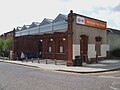 | Watford High Street |  London Overground London Overground |
 | Watford North | National Rail |
 | Garston | National Rail |
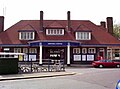 | Watford tube station |  London Underground London Underground |
Education
The history of schools in Watford goes back to 1595, when a teacher named George Redhead taught students. Over time, more schools were built, including a Free School in 1704. Today, Watford has many primary and secondary schools.
Some schools in the area choose students based on their skills, while others welcome everyone. There are also special schools to help students who face challenges. Watford is home to West Herts College, which helps students learn more after they finish school.
Media
Watford is part of the BBC London and ITV London region for television. The signals come from the Crystal Palace TV transmitter and a local transmitter in Hemel Hempstead.
For radio, locals can listen to BBC Three Counties Radio, Heart Hertfordshire, and community stations like Vibe 107.6 and Watford Hospital Radio, known as The Pulse Hospital Radio, which broadcasts to patients at the Watford General Hospital.
The town’s local weekly newspaper is the Watford Observer.
Sport
Watford has a professional football team called Watford F.C.. They play in the EFL Championship during the 2025–2026 season.
The team's famous supporter is the singer Sir Elton John. Watford also has other sports teams, including a non-league football team, an American football team, and a cricket club.
Notable people
Main article: List of people from Watford
Watford has been home to many famous people. Some well-known people grew up here or lived in the town for a time. Their stories show the town's rich cultural background and its part in British history.
Freedom of the Borough
The following people and military units have received the Freedom of the Borough of Watford.
Individuals
- George Villiers, 6th Earl of Clarendon: 28 July 1924.
- Dennis Herbert, 1st Baron Hemingford: 22 March 1943.
- Sir Elton John: 6 October 1977.
- Sir Raphael Tuck: 15 November 1980.
- Graham Taylor: 25 June 2001.
- Luther Blissett: 18 October 2021.
- Norman Tyrwhitt: 23 July 2005.
- Mavis Tyrwhitt: 23 July 2005.
Military Units
- 1st East Anglian Regiment: 1959.
- Royal Anglian Regiment: 1964.
Images
Related articles



This article is a child-friendly adaptation of the Wikipedia article on Watford, available under CC BY-SA 4.0.
Images from Wikimedia Commons. Tap any image to view credits and license.